


Evidence
Sep. 18, 2026
Back-to-school hearsay quiz is back to test your evidence law skills
This second annual back-to-school quiz tests California attorneys' knowledge of hearsay and other evidence rules through 10 practical and playful scenarios.


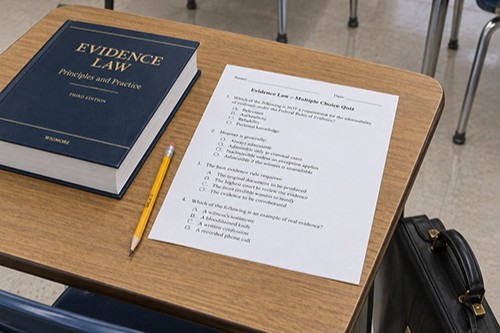
Summer vacation is over (though summer weather is not). The kids are back in school with fresh new sneakers and Trapper Keepers (okay, maybe not the latter). That means it's time for a second annual back-to-school evidence quiz.
The following quiz covers various evidentiary issues (mostly hearsay issues).
Sharpen your #2 pencils, assume relevance and apply California law.
Questions
1. In a prosecution for the murder of Mr. Body, the People want to admit a painting defendant Major Mauve painted one week after the murder depicting himself murdering Mr. Body with a candlestick holder in a billiard room in a creepy mansion, which happens to be how and where Mr. Body was murdered. The defendant objects on hearsay grounds. Ruling?
A. Sustained, hearsay.
B. Overruled, it's a statement against interest.
C. Overruled, it's a party admission.
2. In a slip-and-fall case, the plaintiff seeks to testify to a grocery-store employee's question to him after the plaintiff allegedly slipped on marmalade and fell. The employee's question was "Are you okay?" The defendant grocery store objects. Ruling?
A. Overruled, not hearsay.
B. Overruled, hearsay but a party admission.
C. Sustained, hearsay.
3. In a breach-of-contract case, the defendant, a coffee shop owner, seeks to testify that plaintiff, a coffee supplier, assured him as they were signing the contract that there would be "no problem" if the coffee shop was one or two months late on payments, and that they would be able to work it out. This is in contradiction to the explicit language of the contract. (It is undisputed that the contract is valid.) Defendant admits that she didn't read the contract before signing it.
The plaintiff objects that this is hearsay and barred by the parol evidence rule. Ruling?
A. Hearsay and no exception applies. Sustained.
B. Not hearsay, but barred by the parol evidence rule.
C. Admissible as a statement in negotiations, which is not hearsay.
4. Plaintiff bank has a note from a defendant borrower, inaccurately titled a "Promissory Note," wherein the borrower states that he will be liable for all sums that might be advanced to or credited to his accounts and that he promises to repay all outstanding amounts with interest.
In a breach-of-contract action, the bank seeks to introduce the note. It presents the testimony of its vice president, who states that he found the promissory note in the bank's files, but cannot testify to any record-keeping practices of the bank when the note was drafted. The bank offers no foundation for admission of the note as a party admission or through estoppel. There is no dispute as to the authenticity of the note.
Defendant objects to admission of the note as hearsay. Ruling?
A. Sustained, it's not a proper business record.
B. Overruled, the document is not hearsay.
C. Overruled, the document is a business record.
5. In a robbery trial, a witness testifies that he saw the defendant approach a hotel clerk while the defendant had his hand in his jacket pocket, making it look like he had a gun. The witness testifies that he couldn't hear what the defendant said to the hotel clerk, but that he saw the hotel clerk put his hands up in the air.
The defense objects to the testimony about the clerk putting his hands in the air as hearsay. Ruling?
A. Overruled, the clerk putting his hands in the air is not hearsay; it's just a verbal act.
B. Overruled, physical gestures cannot be statements for the purposes of the rule against hearsay.
C. Sustained, the clerk putting his hands in the air is hearsay and no exception applies.
6. In a criminal prosecution against the Easter Bunny for threats and harassing phone calls, the victim testifies that he received a phone call from the defendant, who made threatening statements. The victim asked the caller: "Who is this?" The caller replied, "It's the Easter Bunny." The victim admits that he had never spoken to the Easter Bunny before.
Defendant Easter Bunny objects to this testimony as hearsay to the extent that it is being offered to prove that he/she made the threats and identified him/herself. The prosecution argues that the testimony is admissible because it's offered against a party declarant. Ruling?
A. Overruled, statement of a party declarant.
B. Overruled. A name is not hearsay.
C. Sustained. Hearsay and no exception applies.
7. At a criminal trial, a key defense witness reveals that she underwent hypnosis for the purpose of helping her recall events that are the subject of her testimony. The prosecution objects and argues that witness's testimony must be excluded. The defense argues that it can make a showing that the testimony is admissible. Ruling?
A. Sustained. Testimony given after hypnosis is inherently unreliable.
B. Overruled. The Court can inquire and conduct a hearing to determine if the testimony should be admitted.
C. Overruled. Whether the witness has previously undergone hypnosis is irrelevant.
8. Plaintiff is walking down the street when he sees a plane skywriting in the sky. The plane leaves behind skywriting in the sky that reads "Baby llamas for sale at Llamaland! $10 per llama!" Plaintiff attempts to buy a baby llama from defendant Llamaland later that day for $10 and Llamaland refuses to sell a baby llama for anything less than $100. Plaintiff sues Llamaland for false advertising.
It is not in dispute that Llamaland hired the skywriter. It is also not in dispute that the skywriting dissipated a few minutes after it was released by the plane. Instead, Llamaland argues that the skywriter simply forgot the final 0 on what was supposed to read $100, not $10.
As the plaintiff begins to testify about the skywriting, the defendant objects to the testimony as hearsay and in violation of the Best Evidence Rule.
A. Overruled, not hearsay and no Best Evidence Rule issue.
B. Sustained. The Best Evidence Rule bars the testimony.
C. Sustained, hearsay without an exception.
9. In a Lemon Law trial, the plaintiff seeks to testify that his luxury car announced to him through its AI automated voice that it was "feeling pretty crappy." Defendant manufacturer objects to this testimony as hearsay. Ruling?
A. Sustained, unless the car testifies.
B. Overruled, it's a party admission and/or a present sense impression.
C. Overruled, not hearsay.
10. Special pals Fumby and Tokey visit a candy shop, where Fumby (according to his memory) buys a box of Super Yum Drops. After eating the candy, Fumby throws away the packaging. Later that day, he becomes very ill and turns orange.
At his civil trial against the candy manufacturer, Yuckums Corp., Fumby testifies that he purchased Super Yum Drops, which were made by Yuckums Corp. and that he knew this from the packaging on the candy. Counsel for Yuckums Corp. objects that the testimony is hearsay. There is no other evidence (circumstantial or otherwise) about what kind of candy Fumby ate, besides his own testimony; Tokey doesn't remember anything about the candy due to his short-term memory loss. Ruling?
A. Overruled. There is no hearsay issue.
B. Overruled. The testimony is hearsay but the writing on the candy packaging was a statement of a party opponent.
C. Sustained. Hearsay.
ANSWERS
1. C. (See Evid. Code §§ 352.2 & 1220; People v. Lawson (2025) 108 Cal.App.5th 990, [finding rap lyrics written after shooting were admissible because they were written shortly after the shooting, contained specific details about the shooting]; but see People v. Venable (2023) 88 Cal.App.5th 445, 458 [finding defendant was unduly prejudiced by admission of rap video where the lyrics had nothing to do with the shooting at issue or suggested that defendant, who appeared in the video, had personal knowledge about the shooting]; cf. Welsch, Judge allows Tupac murder suspect's memoir as evidence at trial, Courthouse News Service (June 30, 2026) available at << https://www.courthousenews.com/judge-allows-tupac-murder-suspects-memoir-as-evidence-at-trial/ >> [discussing a related issue in a Nevada criminal case].)
Here, given that the painting was "created near in time to the charged crime" and appears to "bear a sufficient level of similarity to the charged crime or crimes," it seems as if the evidence would likely come in as an admission against interest, after an Evid. Code § 352 balancing analysis. (Evid. Code § 352.2.) Section 352.2 may also require the court to consider evidence about the nature of the genre at issue, whether introducing a particular type of expression might introduce racial bias, etc. (Id.)
As to option B, simply exercising the right not to testify as a defendant in a criminal trial does not render one "unavailable" as required for admission under Evid. Code § 1230, which governs the declarations-against-interest hearsay exception. (People v. Lightsey (2012) 54 Cal.4th 668, 716 ["It has long been the law that a defendant cannot make himself or herself 'unavailable' for purposes of the statutory hearsay provisions by exercising a privilege not to testify at trial"].)
2. A. Generally, questions are not hearsay as they generally don't contain a truth assertion. (See, e.g., People v. Navarro (2021) 12 Cal.5th 285, 326; see also Chowdhury, How to Do Things with Words, Daily Journal (Oct. 6, 2023) available at <<https://www.dailyjournal.com/articles/375153-how-to-do-things-with-words >>.)
The question "Are you okay?" likely does not qualify as an assertion of any fact for the purposes of Evid. Code § 1200, so options B and C are out.
3. B. Though the assurance is likely not hearsay as a part of contract negotiations (which are generally non-hearsay verbal acts), it is barred by the parol evidence rule. "Although the parol evidence rule results in the exclusion of evidence, it is not a rule of evidence but one of substantive law. ... It is founded on the principle that when the parties put all the terms of their agreement in writing, the writing itself becomes the agreement. The written terms supersede statements made during the negotiations. Extrinsic evidence of the agreement's terms is thus irrelevant and cannot be relied upon. ... [T]he parol evidence rule, unlike the statute of frauds, does not merely serve an evidentiary purpose; it determines the enforceable and incontrovertible terms of an integrated written agreement. ... The purpose of the rule is to ensure that the parties' final understanding, deliberately expressed in writing, is not subject to change." (Riverisland Cold Storage, Inc. v. Fresno-Madera Credit Assn. (2013) 55 Cal.4th 1169, 1174 [cleaned up]; Civil Code § 1625.)
The statement here, without more, is unlikely to justify a promissory fraud exception to the parol evidence rule, especially where the defendant admits to not having read the agreement. (Id. at 1183.)
4. B. (Remington Invs., Inc. v. Hamedani (1997) 55 Cal. App. 4th 1033, 1042 ["The Promissory Note document itself is not a business record as that term is used in the law of hearsay but rather is an operative contractual document admissible merely upon adequate evidence of authenticity. Sufficient evidence of authenticity to support admission of the Promissory Note document could be supplied by numerous means, at least some of which would likely be available even to the FDIC or its assignees."].) Contractual documents are generally not hearsay but verbal acts. (See Chowdhury, How to Do Things with Words, supra; see also People v. Fields (1998) 61 Cal.App.4th 1063, 1068-1069 ["If a fact in controversy is whether certain words were spoken or written and not whether the words were true, evidence that these words were spoken or written is admissible as nonhearsay evidence. Often, such evidence is referred to as 'operative facts.'"] [cleaned up]; Skelly v. Richman (1970) 10 Cal.App.3d 844, 858 ["The oral and written statements of the negotiating parties were verbal acts establishing a legal relationship," not hearsay].)
5. A. (See People v. Myers (2014) 227 Cal. App. 4th 1219, 1227.) In Myers, the court found that the gesture of surrender was the same as saying "I surrender." (Id.) It was a communicative act, and thus an out-of-court statement, but it was a verbal act, not coming in for the truth of the statement, i.e., whether the clerk was in fact surrendering. Simply the verbal act signifying that he was surrendering was sufficient, regardless of the truth of the "statement." (Id.) (See Chowdhury, How to Do Things with Words, supra.)
Option B is out because gestures can indeed constitute hearsay statements. (See, e.g., People v. Jurado (2006) 38 Cal.4th 72, 129 ["a nod of the head in response to a question calling for a yes-or-no answer, or a gesture pointing to a particular person when asked to identify a perpetrator, are examples of assertive conduct"].)
6. C. The statement is being offered for its truth: i.e., that it was the Easter Bunny on the phone making threats. If there was evidence or a stipulation that it was in fact the Easter Bunny, that might allow it in as a statement of a party declarant, but the victim had never spoken to the Easter Bunny before and had no idea who was calling, which would appear to preclude this coming in as a party-opponent admission, if the defendant is disputing it was him/her and there is no proof that it was the Easter Bunny. A name can be hearsay, especially where the testimony about hearing or reading a name is offered to suggest that the statement about the name was in fact true (i.e., that the person using the name was in fact that person). (See Chowdhury, What's in a Name?, Daily Journal (May 27, 2022) available at << https://www.dailyjournal.com/articles/367691-what-s-in-a-name >>; compare People v. Koch (1970) 4 Cal.App.3d 270, 274 [false unemployment compensation forms not hearsay because the prosecution's theory was that the forms were false].)
7. B. (See Evid. Code § 795.) The Court must make several findings before testimony by this witness can be admissible. (Id.) In general, the testimony must be limited to matters the witness "recalled and related prior to the hypnosis"; the "substance of the prehypnotic memory" must have been preserved in writing or otherwise; the hypnosis must have been conducted according to certain procedures and conditions; and "prior to the admission of the testimony, the court must hold a hearing where the proponent of the evidence proves by clear and convincing evidence that the hypnosis did not so affect the witness as to render the witness's prehypnosis recollection unreliable or to substantially impair the ability to cross examine the witness concerning the witness's prehypnosis recollection." (Id.)
8. A. The Best Evidence Rule has been repealed in California. (See Former Evid. Code § 1500.) It has been replaced by the "Secondary evidence rule." (Evid. Code § 1521.) Given that plaintiff "does not have possession or control of a copy of the writing and the original is lost or has been destroyed without fraudulent intent on the part of the [plaintiff]," oral testimony about the writing would appear to be admissible. (Evid. Code § 1523.)
Section 1521 would not appear to bar the testimony: Llamaland does not dispute that the skywriting said $10; it simply argues that the skywriter made a mistake, and it should have said $100. (See § 1521(a)(1).) The admission of plaintiff's testimony, which appears to be reliable, would not appear to be unfair. (See § 1521(a)(2).)
The skywriting is an offer, which is not hearsay, but a verbal act (i.e., there is no truth assertion in the statement). (See Chowdhury, How to Do Things with Words, supra.)
9. C. The rule against hearsay applies only to human declarants (for now). "The Evidence Code does not contemplate that a machine can make a statement." (People v. Hawkins (2002) 98 Cal.App.4th 1428, 1449 [citing Evid. Code § 1200].) Option B presents an interesting suggestion that this could be a party admission, but the car is not a party, and it would likely be a stretch to attribute the car's statement to the manufacturer.
10. C. (See DiCola v. White Bros. Performance Prods., Inc. (2008) 158 Cal. App. 4th 666, 681 ["The package labeling reading 'Burly Brands' as well as the instruction sheet in this case constitute hearsay because they are extrajudicial assertions offered to prove the truth of the matter asserted, namely, that the box contained a 'Burly Brands' model 12-1200X product."].) DiCola suggests that the testimony couldn't come in under § 1220 as an admission of a party, especially since the only evidence on this point is plaintiff's testimony.
However, note the ruling in Hart v. Keenan Properties, Inc. (2020) 9 Cal.5th 442, 449-450, where the California Supreme Court deemed similar testimony about a company's logo non-hearsay where there was other circumstantial evidence linking the company to the case. (See Chowdhury, What's in a Name?, supra [discussing the Hart case and its apparent departure from standard application of the Rule Against Hearsay].)
How did you do? If you bombed, it may be time to hit the books, or at least one book (the California Evidence Code).
Finally, please note that this quiz was drafted and written by me, and not AI. Any mistakes are my own. Complaints and quibbles can be directed to me in care of the Daily Journal.
Submit your own column for publication to Diana Bosetti
For reprint rights or to order a copy of your photo:
Email
Jeremy_Ellis@dailyjournal.com
for prices.
Direct dial: 213-229-5424
Send a letter to the editor:
Email: letters@dailyjournal.com