


Technology
Aug. 6, 2026
Can AI reduce the work it creates?
Purpose-built AI tools that catch curable defects before filing and flag issues during court review--from pleadings and default judgments to class and PAGA settlements--could be developed to help alleviate the added caseload pressure AI itself is expected to create.



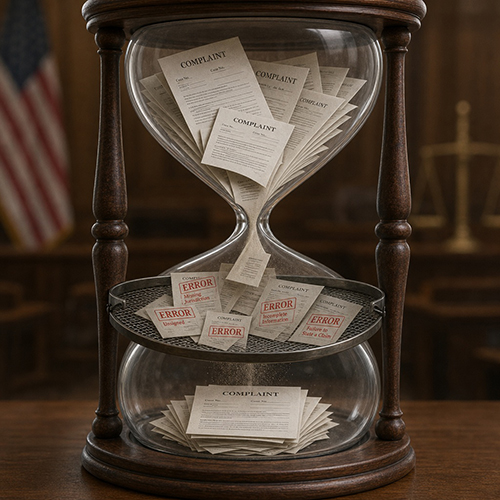
Last week, I discussed the additional strains on already heavy caseloads in the California state courts likely to occur as AI changes the economics of litigation. (Karin Schwartz, "Beyond chatbots: Is there a role for adjudicative AI," Daily Journal (July 28, 2026).) As AI makes legal work faster and less expensive to produce, courts may see more filings, more motions and more sophisticated submissions from litigants who previously lacked the resources to produce them. Courts already struggling with overwhelming caseloads could find themselves asked to absorb still more.
If AI is going to contribute to the workload problem, it seems fair to ask whether it can also be made part of the solution.
There are areas of civil litigation where courts repeatedly spend scarce resources dealing with problems that are predictable, preventable and, frequently, mundane. Lawyers file pleadings with curable defects. Default judgment packages arrive incomplete or legally deficient. Judges and research attorneys work through lengthy submissions looking for information that could have been organized and checked before the motion ever reached chambers.
None of this is the glamorous part of judging. Much of it is necessary. Some of it protects important rights. But does all of it have to be done this way?
Development and implementation of specialty AI legal tools could (1) help litigants avoid defects that lead to motion practice, and therefore function as an upstream reduction on court workloads; and (2) help courts in reviewing and identifying defects in certain types of repeat motions and applications, thus functioning as a downstream reduction of avoidable court work, and thereby freeing up court resources for more (potentially discretion-heavy) tasks. This article, therefore, offers some observations regarding the potential positive impacts on court workloads if specialty AI legal tools are developed and used on both sides of the courthouse door.
Turning first to the litigant side. Consider the pleadings: some demurrers and motions to dismiss present genuine legal disputes. Those motions are not going away, nor should they. But others address deficiencies that could have been identified before the complaint was filed: a missing element, insufficient factual allegations, an inconsistency between the facts alleged and the relief requested.
Existing legal AI can already assist with this work. As a test, I recently gave one widely available legal AI product a set of hypothetical facts and asked it to prepare a complaint. It identified potential causes of action, told me what additional facts were needed, and produced an impressively good pleading.
But the more interesting possibility is not simply AI that can draft. Imagine a tool specifically designed to test a proposed complaint for pleading sufficiency before filing. Its job would not be to produce more litigation. Its job would be to identify curable defects before those defects generate motion practice.
That could save litigants money. It could also save courts considerable time.
Defaults may be an even better example. Any judge who regularly reviews requests for default judgment knows how frequently they present problems. California's requirements are technical, and errors can have consequences far out of proportion to the apparent mistake.
A plaintiff seeking damages for personal injury or wrongful death, for example, generally must serve a statement of damages before default may be entered. (Code Civ. Proc., § 425.11, subd. (c).) Punitive damages have their own notice requirements. (Id., § 425.115, subd. (f).) And a judgment following default generally cannot exceed the relief of which the defendant received adequate notice--a potential pitfall, e.g., where a complaint demands damages "according to proof" rather than specifying a particular number. (Id., § 580, subd. (a); see id., § 585; Becker v. S.P.V. Construction Co. (1980) 27 Cal.3d 489, 494.)
Sometimes a problem can be fixed relatively easily. Sometimes it cannot. A defect discovered at the default judgment stage may require unwinding the default. Depending on the problem, counsel may need to amend the complaint, serve it again and start over.
Meanwhile, the court has reviewed the package once. It may review it again. And perhaps again.
The plaintiff waits. The court spends time repeatedly reviewing the same case.
This is where I become interested in specialty AI legal tools--not because AI is inherently better at the work, but because the work has characteristics that may make AI useful.
Much of default review is structured. Is the required document present? Was it served? When? Does the amount requested correspond to the amount for which adequate notice was provided? Is the evidentiary support there? Are interest and fees properly supported? Is there something unusual that requires closer review?
Why should the judge be the first person to discover a readily detectable defect? A lawyer-facing default tool could review the package before filing, identify missing documents or inconsistencies and flag issues that need to be addressed. It might eventually populate the mandatory forms as well.
Opportunity exists on the court side as well.
A court-specific tool could perform a first-pass review of a default package, ideally retrieving the necessary filings directly from the court's case-management system (via an API). It could generate a report identifying the requirements it found satisfied, the defects it identified and the issues requiring judicial attention, with links to the underlying record so its work could be checked.
That last part matters. The point is not to replace one opaque process with another. A court should be able to see what the system reviewed, what rule it applied and why it flagged--or failed to flag--an issue.
The use of AI for default review is more than theoretical. Stanford researchers, working with Los Angeles Superior Court judges and research attorneys, recently developed an AI "Default Assistant" that checks a debt-collection default package against the governing statutory requirements and grounds each recommendation in citations to the filings. In a controlled study, reviewers using the tool were roughly 6% more accurate and about 26% faster than those working unaided. (Theodora Worledge et al., "AI Assistance for Human Review of Default Judgments," (arXiv working paper No. 2607.01256, June 4, 2026).)
Class and PAGA settlement review presents a different version of the same problem.
These motions can be lengthy, but portions of the review are highly structured. Courts repeatedly examine settlement allocations, attorney fees and costs, enhancement payments, releases, notice provisions, PAGA allocations and other recurring issues. Court approval is required to settle a class action (Cal. Rules of Court, rule 3.769) or a PAGA claim (Lab. Code, § 2699, subd. (s)(2)), and several courts publish detailed checklists to guide that review, directing counsel to organize their submissions accordingly. (See, e.g., L.A. Super. Ct., Preliminary Approval of Class Action Settlement (checklist); Sacramento Super. Ct., Checklist for Approval of Class Action and/or PAGA Settlements.)
A specialty tool could extract that information, organize it, perform calculations, compare submissions against established requirements and identify matters warranting closer attention.
Again, the point would not be for AI to decide whether the settlement should be approved. It would be for AI to surface issues, in a predictable and consistent manner, that merit judicial review and that might otherwise be overlooked.
If technology can reduce the time spent finding numbers, comparing documents and determining whether required information has been provided, the result need not be less judicial review. It could permit more meaningful judicial review of the issues that actually require judgment.
None of this means that AI review is automatically trustworthy. A poorly designed AI implementation could repetitively overlook important issues. A model can misunderstand a document. A system trained around existing practices can reproduce existing mistakes. And standardization has a downside: a mistake embedded in a court-wide tool can be repeated far more consistently than a mistake made by a single judge.
Those concerns argue for careful design, testing, transparency and human review. They do not, in my view, argue for leaving every judge to invent an individual AI workflow.
There is a fairness and consistency problem here that poorly deployed AI tools could exacerbate, but that properly designed and deployed tools might ameliorate. Judges have widely varying experience, not just with reviewing defaults, but with working with AI. Some are already developing sophisticated workflows using general-purpose legal tools; others are not. If AI-assisted review proves useful, the quality of that assistance should not depend on a particular judge's skill at prompting a chatbot.
Purpose-built court tools could provide a common baseline: the same requirements checked, the same categories of information reviewed, the same kinds of potential problems surfaced. The tool could standardize the review process without standardizing the ultimate judgment.
That distinction matters.
The discussion about AI and courts has understandably focused on what AI might do to the judicial system: more litigation, more filings, new forms of error and increasingly difficult questions about what work can responsibly be delegated to machines.
Those problems are real.
But there is another side to the equation. We can also ask where our existing system generates unnecessary work, where predictable errors create avoidable motion practice and delay, and where repetitive review consumes time that judges could spend on questions that actually require judging.
AI may well increase the amount of litigation coming through the courthouse door.
If it does, we should be equally interested in whether thoughtful, narrowly designed uses of the same technology can reduce the unnecessary work waiting on the other side.
Author's Note: In the interest of transparency, I used legal AI tools during the research and development of this article. I independently reviewed the authorities. I accept full responsibility for every statement and conclusion expressed here.
Submit your own column for publication to Diana Bosetti
For reprint rights or to order a copy of your photo:
Email
Jeremy_Ellis@dailyjournal.com
for prices.
Direct dial: 213-229-5424
Send a letter to the editor:
Email: letters@dailyjournal.com