


Constitutional Law
Jun. 30, 2026
250 years later, the Constitution still knows how to facilitate change
See more on 250 years later, the Constitution still knows how to facilitate changeAlthough formal constitutional amendments are rare, many of the most important practical changes in our system of governance have come through legislation, state reforms, and institutional evolution that our Constitution enables, rather than textual revision.



Vikram David Amar
Vikram David Amar is the Daniel J. Dykstra endowed chair and distinguished professor of law at UC Davis School of Law and former dean and Iwan Foundation professor of law at the University of Illinois Urbana-Champaign College of Law.
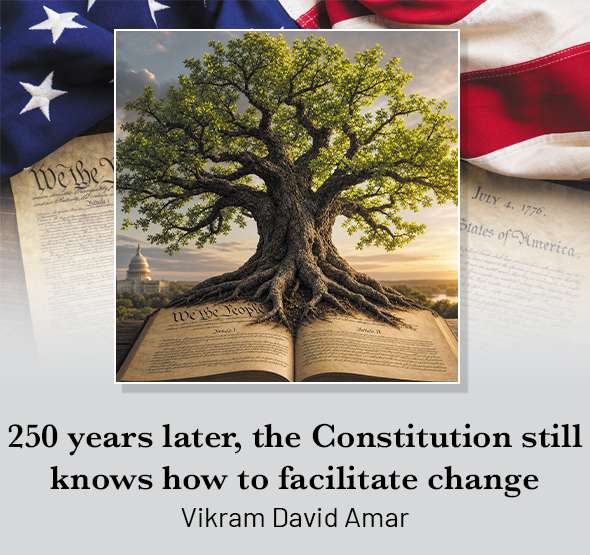
As the nation celebrates its 250th birthday, it is, to borrow a phrase Abraham Lincoln made famous, "altogether fitting and proper" that we reflect on both the strengths of and residual imperfections in the Declaration of Independence and the U.S. Constitution.
These two founding documents are, of course, separate and distinct (with the latter not coming until a decade after 1776), but there are important theoretical and legal linkages between the two. One important through-line is the overridingly important assertion in the Declaration that--because kings have no place in the New World inasmuch as sovereignty resides in the people themselves--citizens have a fundamental entitlement to "alter and abolish" outdated or malfunctioning forms of government. That entitlement gives rise to the Constitution's Article V--the section that explicitly lays out at least one set of legitimate processes for adopting "amendments" to the Constitution, processes that have led to 27 textual revisions that we currently consider part of our Constitution.
As a whole, these amendments have substantially moved the country toward, as the Constitution's Preamble puts it, "a more perfect Union." The vast majority of the amendments adopted after the founding era have focused on democratizing elections for federal officials. Some illustrations: the 15th, 19th, 24th and 26th Amendments expand the franchise by prohibiting voting discrimination on the basis of race, sex, class and age, respectively; the 17th Amendment relocates election of U.S. Senators from elected state legislatures (which historically have been plagued by a variety of unsavory gerrymanders) to the people themselves; and the 22nd Amendment addresses not who can vote but who can be elected, making someone who has already been twice chosen President ineligible for further election to the presidency or vice presidency.
Despite progress that has been achieved in this realm via amendment, many modern observers are disappointed that the amendment gauntlet has been successfully navigated so infrequently. And there is some basis for that disappointment; in reality, the Constitution's amendment machinery has worked smoothly far fewer than 27 times to reform the Constitution, because 11 amendments (the first 10 and the 27th) were part of a single package (the so-called Bill of Rights) that was considered part of the original deal by which the Constitution itself was ratified in 1789, three amendments (the 13th, 14th and 15th) were enacted under unusual circumstances and through unusual processes in the wake of a Civil War, and two amendments (the 18th and 21st, dealing with prohibition) more or less cancel each other out. Outside of these 16 amendments, there have been fewer than a dozen textual constitutional changes effected through an orderly and regularized Article V process. And given the supermajority requirements in Article V, both in Congress (where all amendments to date have originated) and in the states (three-quarters of which must, under Article V, ratify amendments before the changes become effective), the prospect for any more successful amendment attempts in today's hyper-striven environment seem close to zero. This is dispiriting to many contemporary Americans, who are deeply jaded and believe that the country's democratic processes no longer vindicate the interests and desires of the American mainstream, but instead cater to ideological extremes and ultra-wealthy individuals and institutions.
I would be lying if I said I didn't have any concerns about the present and future of American constitutional democracy. But in my (hopeful) essay today, I want to remind readers that amending the Constitution is not the only way to bring about salutary and enduring change to our governmental systems. Let me offer a few examples.
Start with the corrosive, national problem of partisan gerrymandering, which has become worse as big data and AI make it easier for politicians who draw legislative district lines to predict the behavior of voting groups and individuals. But states are free to regulate and remove (as many states have chosen to do) partisanship from district drawing, either by creating independent non-partisan districting commissions or by lodging in state constitutions prohibitions on zealous partisan considerations. These two techniques have been upheld by the U.S. Supreme Court, both for state and congressional districting. And if we are (rightly) concerned (as the last year has borne out) that some states will not want to "unilaterally disarm" when it comes to congressional districting, we should remember that under Article I, Section 4 of the Constitution, Congress could at any time solve the problem by mandating the use of independent commissions, or by requiring that states use party-proportional representation devices to elect members to the House of Representatives. Such an action by Congress would almost certainly require getting rid of the filibuster, but the filibuster is in no sense constitutionally required and may be on its way out anyway.
When we move from how House members are elected to how the President is selected, we see even more clearly that reforms needn't take the form of constitutional amendment. Under Article II, each state can pick its electors to the electoral college any way it chooses, and so even after the Supreme Court ruling in Trump v. Anderson that Section 3 of the Fourteenth Amendment didn't authorize Colorado to exclude Donald Trump from competing for Colorado's electors, any state could simply decide and proclaim that--as a matter of state-law choice that Article II protects rather than under the Fourteenth Amendment--no slate of electors may be appointed to represent the state if the slate is pledged to support as President anyone who has engaged in what the state considers to be rebellion.
And other changes to presidential-selection processes can also be made at the state level to redress what some might consider glitches in our current system. Take the 2000 presidential election. Put to one side Bush v. Gore and valid criticisms of that ruling; if Florida had adopted (as it undeniably could have) ranked-choice voting, then most votes for Ralph Nader there would have flowed to Al Gore, and the candidate who garnered the most votes nationwide (Gore) would have won the state and the White House. Of course, more ambitious reforms of presidential selection, such as the National Popular Vote (NPV) Interstate Compact (an idea as to which AI considers me and my brother Akhil to be "intellectual Godfathers"), has been slowly adding signatory states. I have come to believe that before this idea should be implemented there needs to be much more logistical attention paid to how a truly national tally can be discerned free of corruption and technical glitches. But NPV stands as a good example of fundamental, but non-constitutional, reforms that are within the realm of the possible.
Turning from Congress and the presidency to the Supreme Court, we again see that important, beneficial reforms needn't always involve constitutional amendments. The idea of a single 18-year term for each Supreme Court Justice, after which the Justice would continue to serve as a life-tenured federal judge but be assigned to a federal court other than the Supreme Court, is one that may well be feasible through congressional statute. Such a reform (which would properly be put into effect only prospectively over time as Court vacancies occur) could, if structured sensibly, provide each President with much more equal, and much more predictable, opportunity to appoint Justices, and could also reduce partisan considerations that currently dictate when individual Justices choose to retire.
And there are other non-constitutional reforms that are ripe for consideration at our 250th birthday, including changes to how primary elections are held, how campaign contributions and expenditures are disclosed, how gifts to Justices should be regulated, etc. My point here is simply that while the Constitution remains imperfect, its basic framework still enables us to deal with 21st-century problems if we take the time to learn more history and civics and engage each other in polite, if sometimes freighted, discourse.
Vikram David Amar is the Daniel J. Dykstra endowed chair and distinguished professor of law at UC Davis School of Law and former dean and Iwan Foundation professor of law at the University of Illinois Urbana-Champaign College of Law.
For reprint rights or to order a copy of your photo:
Email
Jeremy_Ellis@dailyjournal.com
for prices.
Direct dial: 213-229-5424
Send a letter to the editor:
Email: letters@dailyjournal.com