


Constitutional Law
Jun. 30, 2026
Equality at 250: A crisis of empathy in the Constitution's promise
See more on Equality at 250: A crisis of empathy in the Constitution's promise


Karis Stephen
Associate
Allred, Maroko & Goldberg
6300 Wilshire Blvd., Suite 1500
Los Angeles , CA 90014-8
Cell: (562) 519-0976
Email: kstephen@amglaw.com
I was given a tall order in setting out to write this essay. I was to opine about the United States Constitution and its relation to the doctrine of equality, which I will explore later in this essay. But I would be remiss in my duty as a member of multiple underrepresented identities to address a threshold question, prior to dissecting the nation's relationship to equality.
First, I must make it personal. For me, I was raised to understand that the country is unequal. I was raised to expect to be treated differently. I was raised knowing that it was dangerous for me to go certain places or do certain things on account of the color of my skin and my womanhood. For other people, particularly those who are members of majority groups, this preparation was unnecessary. And so, in opening this essay, I set forth a pertinent observation: I believe that this country and its peoples are in the midst of a crisis of empathy.
Throughout this essay, I've made the intentional choice to use collectivist language, such as the global "we." This decision of diction, however, is in direct contradiction to our highly individualistic perceptions of society and its constructs. It is my belief that the inequality discussed herein is a parasitic byproduct of the dangerous trend of hyper-individualism as well as a paucity empathy. The fabricated divisions of people, contrived classifications of communities and superficial separations amongst us are fatal to our advancement as a people. And they are catastrophic for equality.
Equality is universally enshrined in our collective, capacious understandings of personhood. In multiple versions of the English dictionary, equality is consistently defined as the very state of being equal. Equality is understood as a quality that the individual inherently possesses, widely interpreted as a thing that simply accompanies the very state of being. Humans, though varied, are supposed to be equal--a closely held belief that has circulated our shared consciousness for centuries, despite the much darker human urge to make it not so.
We see equality conceptualized as a quality of the human condition in our ancient texts. In the biblical context, according to the book of Genesis, all people are created in God's image. Logically then, it follows that all people hold that intangible quality of equality. The Declaration of Independence, the nation's foundational document, tracks this moral judgment when it famously proclaims that "all men are created equal." Although equality is largely heralded as fundamental to our humanness, inequality also persists because of our humanness.
The birth of the Civil War Amendments, absorbed by the Constitution of the United States between 1865 and 1870 after the Civil War, was an attempt to preserve our understandings of equality as a human characteristic. Equality as legally applied to individual persons was secured during the Reconstruction era, crystallized in the 14th Amendment's Equal Protection Clause in 1868. The civil rights that arose from the Equal Protection Clause endeavored to protect formerly enslaved African Americans from attacks on their equality. In this way, with the abolition of slavery came the condemnation of denying "any person within its jurisdiction the equal protection of the laws."
It is clear then that this union of equality and liberty is sacred under the law. Despite the major advancement in racial equity brought on by the Reconstruction Amendments, the enforcement mechanisms of equal protection were lacking.
In the late 19th century to the early 20th century, segregation was customary and discrimination was still the marker of the zeitgeist. It was not until the Civil Rights Era that equality was enforced in earnest. The Civil Rights Act of 1964 made major strides in equality doctrine as it codified anti-discrimination law in the arenas of employment and public places, where discrimination was generally accepted as routine practice. Also, the Voting Rights Act of 1965 emerged during this era and banned racial discrimination in voting.
The pursuit of equality continued into the 20th century for other minority groups including women, individuals with disabilities, members of the LGBTQ+ community and many other oppressed groups of people. The turn of the century marked landmark wins for the canon of equality, such as the legalization of same-sex marriage, Title IX and the Americans with Disabilities Act of 1990. The United States penned legislation with real teeth that were rooted in the philosophy of egalitarianism. Yet, at present, inequalities run rampant and civil liberties are constantly at risk. Even though we are created equally, we are not treated equally.
In spite of the fact that lawmakers have been working on our legal concepts of equality for 250 years, our legal doctrine is far from perfect. We fail to have equal access. Systems conspire to keep minority populations small. Prejudices abound. Laws fail to apply across demographics with a steady hand. We live in a world that, at its core, is unequal. It is something of an egregious blunder that we must still push for equality, as commonplace and widely accepted of a theory as it is. It is the words of Maya Angelou that ring emblematic of our times, "The truth is, no one of us can be free until everybody is free." There is no such thing as equality if we are not all equal.
While we enjoy reiterating the phrase that pairs well with the creed of equal protection--"no one is above the law"--we also are inundated with daily proof that these are empty words. The current administration has illuminated the sinister truth that with enough money, power and influence, some people are, in fact, above the law. Some people are indeed padded from the blows of the law, our primary tool for building a more equitable world. It is a gross deviation from our understanding of equality.
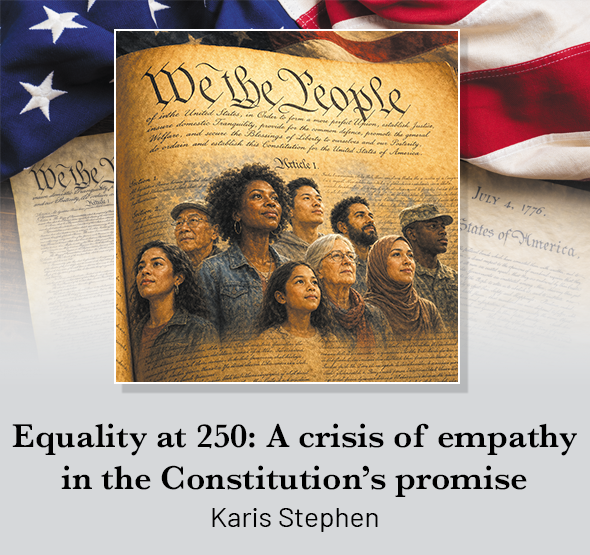
Even still, in the 250 years since the signing of the Declaration of Independence, the principles of equality and liberty are hard-fought. Unfortunately, it is we, the people, who must continually prove our worthiness for what should already be afforded to us. It is we, the people, who must orchestrate social movements to make our humanity heard. It is we, the people, who must take up the fight for equality - after all, our humanity is at stake.
Karis Stephen is an associate at Allred, Maroko & Goldberg.
For reprint rights or to order a copy of your photo:
Email
Jeremy_Ellis@dailyjournal.com
for prices.
Direct dial: 213-229-5424
Send a letter to the editor:
Email: letters@dailyjournal.com