


Constitutional Law
Jun. 30, 2026
Declaration of Independence: No mere relic
See more on Declaration of Independence: No mere relic


William Slomanson
Distinguished Professor Emeritus
Thomas Jefferson School of Law
Email: bills@tjsl.edu
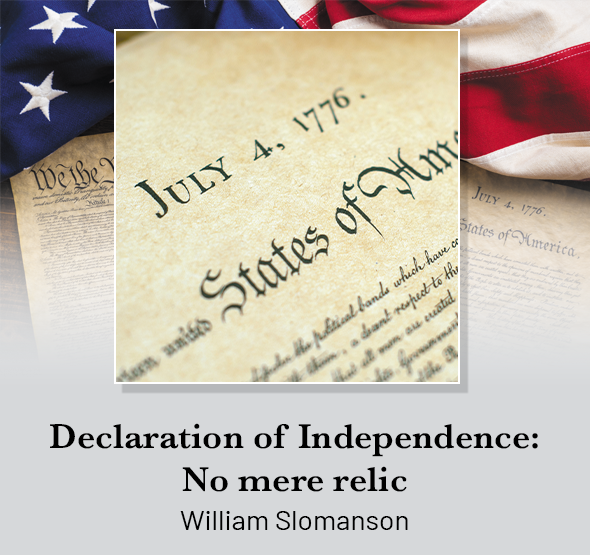
The Declaration of Independence launched America's 1776 entry into the global political dialogue. It ushered in a new form of government, distinct in many ways from the then-reigning European model. We have often benefitted from its enduring impact, but without a spirited recognition of its role in our interconnected national fabric.
Unlike the Constitution, the Declaration does not constitute a legally binding document. But it continues to function as a recurring source of philosophy, moral authority and civic identity. Its core themes are consent of the governed, and their right to alter or abolish an unjust government.
Courts have never characterized the Declaration of Independence as enforceable law. But its principles often guide constitutional interpretation. Judges and scholars have cited it to illuminate the meaning of liberty, equality and due process. Supreme Court opinions have essentially characterized it as a buttress supporting the moral edifice of our constitutional structure. As recently stated by Justice Brett Kavanaugh: "The pre-ratification history of America's many objections to ... the system of oppressive British rule over the Colonies--identified most prominently in the Declaration of Independence--can likewise inform interpretation of some of the crucial provisions of the original Constitution and Bill of Rights." U.S. v. Rahimi, 602 U.S. 680, 719 (2024) (Kavanaugh, J., concurring). The Declaration thus functions as a compass--pointing courts toward the values the Constitution was designed to protect.
Over time, various presidents, Martin Luther King Jr., and countless authors have invoked the Declaration to remind America to live up to its founding promises. Abraham Lincoln's 1863 Gettysburg Address began with the most iconic utterance of the Civil War: "Four score and seven years ago our fathers brought forth on this continent, a new nation, conceived in Liberty, and dedicated to the proposition that all men are created equal." He thus acknowledged the Declaration of Independence as animating the unique political experiment he hoped to preserve.
Doctor King's 1963 I Have a Dream speech proclaimed that "we have come to our nation's Capital to cash a check. When the architects of our republic wrote the ... Constitution and Declaration of Independence, they were signing a promissory note to which every American was to fall heir. This note was a promise that all men ... would be guaranteed the unalienable rights of life, liberty and the pursuit of happiness." One might quip that the terms life and liberty made it into the Constitution. Happiness did not. For that, one must rely on a spouse or boss.
President Ronald Reagan occasionally quoted the Declaration of Independence. As he proclaimed in a 1981 speech: "Let the Fourth of July always be a reminder that here in this land, for the first time, it was decided that man is born with certain God-given rights; that government is only a convenience created and managed by the people, with no powers of its own except those voluntarily granted to it by the people. We sometimes forget that great truth, and we never should." His essential message was that no king should ever reign over our democracy.
A Supreme Court Justice has just co-authored a book that coincides with the 250th celebration of our nation's birth. Neil Gorsuch and Janie Nitze, Heros Of 1776: The Story of the Declaration of Independence (HarperCollins, 2026). In a promotional interview, Neil Gorsuch proclaimed that "[t]he Declaration of Independence had three great ideas in it. That all of us are equal, that each of us has inalienable rights given to us by God, not government; and that we have the right to rule ourselves."
Contemporary readers should thus embrace the Declaration as something more than a mere relic of a bygone era. Numerous passages trigger thoughtful reflection. For example: "The history of the present [k]ing [George III] ... is a history of ... the establishment of an absolute Tyranny over these States. ... He has ... exposed to all the dangers of invasion from without, and convulsions within. ... He has combined with others ... [f]or imposing [t]axes on us without our Consent. ... He has excited domestic insurrections among us...."
When we celebrate July 4th, we should thus focus on Ben Franklin's response about the kind of government the Constitution's Founding Fathers had just created: "[a] republic, if we can keep it."
William Slomanson is Club Historian, Point Loma Rotary Club of San Diego; a distinguished professor emeritus at Thomas Jefferson School of Law and an author of multiple books on civil procedure and international law. Slomanson delivered a speech about the Declaration of Independence to the Point Loma Rotary Club on June 26. He can be reached at bills@tjsl.edu.