


Judges and Judiciary,
Constitutional Law
Jun. 30, 2026
The founders didn't foresee the erosion of judicial independence
See more on The founders didn't foresee the erosion of judicial independence


Joseph W. Cotchett Jr.
Founding Partner
Cotchett, Pitre & McCarthy LLP
840 Malcolm Rd #200
Burlingame , CA 94010
Phone: (650) 697-6000
Fax: (650) 697-0577
Email: jcotchett@cpmlegal.com
UC Hastings COL; San Francisco CA
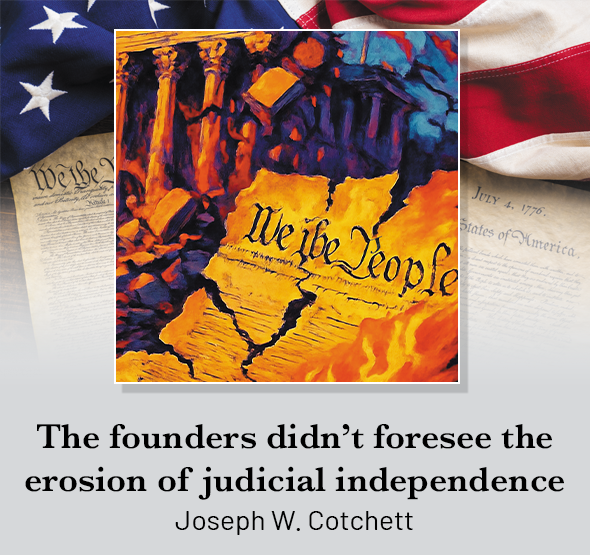
The Third Branch of our government--the judiciary--was placed in Article III of the Constitution roughly 250 years ago to serve as a guardian against tyranny, insulated from electoral winds and bound by precedent rather than popular sentiment. Two hundred and fifty years later, our courts are under severe attack at every level, caught in escalating political pressure driven largely by the Trump administration's efforts to expand executive power. At stake is whether the rule of law can survive.
A Supreme Court reshaped
Three Trump appointments have formed a 6-3 supermajority that has functioned, with occasional exceptions, as an engine of executive expansion. In the first year of Trump's present term, the Court overwhelmingly ruled in the administration's favor--as many as 20 out of 25 "shadow docket" decisions (rushed rulings issued without full briefing or written explanation) favored the administration, an unprecedented figure in such a condensed period.
At the same time, Trump has been openly critical of the Court itself. When it ruled against his tariffs, he reportedly called Justices Gorsuch and Barrett--both his appointees--"an embarrassment to their families" and, along with Chief Justice Roberts, "fools and lap dogs for the RINOs and the radical-left Democrats." He has also called for the impeachment of judges who blocked his executive orders, including Washington, D.C., U.S. District Judge James Boasberg, who halted deportations of Venezuelan nationals. Trump posted on Truth Social: "This judge, like many of the Crooked Judges I am forced to appear before, should be IMPEACHED!!!"
When the Supreme Court routinely vacates lower court injunctions within days of their issuance, it sends a damaging message to every court below it--and emboldens the executive branch to push further. Combined with the administration's pursuit of disciplinary charges against judges, litigation against every individual judge in the District of Maryland, and defiance of court orders, these actions have eroded public confidence and fueled a serious increase in threats--including death threats--against judges and court staff.
Back in 2016, the Republican Senate refused to approve OBAMA's Supreme Court nominee Merrick Garland and then later rushed through the confirmation of Amy Barrett, just 10 days before the general election in 2020. As a result, in 2023, several Senators and House members, led by Ed Markey of Massachusetts, introduced legislation to expand the Court from 9 to 13 members. The bill never secured passage of the Senate Judiciary Committee.
Judges push back
Judges across the ideological spectrum have spoken out. Reagan appointee U.S. District Judge William G. Young of Massachusetts criticized the administration's approach to free speech, warning that the president's "palpable misunderstanding that the government cannot seek retribution for speech he disdains poses a great threat to Americans' freedom of speech." Obama appointee U.S. District Judge Indira Talwani, also of Massachusetts, blocked the administration from canceling the Biden-era CHNV parole program. Bush appointee U.S. Court of Appeals Judge Jeffrey Sutton of the Sixth Circuit warned that weakening impeachment standards is "not just a problem for judges--that's a problem for all three branches of government." And Trump appointee U.S. District Judge Thomas Cullen of Virginia, dismissing the administration's lawsuit against the entire Maryland federal bench, called it "both unprecedented and unfortunate."
One of the clearest examples of the Third Branch holding the line came in late May 2026, when U.S. District Judge Christopher "Casey" Cooper ruled that adding Trump's name to the Kennedy Center violated federal law. He ordered the name removed from the façade within two weeks and blocked a planned two-year closure. Trump's response--posting that "Judge Cooper should be ashamed of himself!" before pivoting to disown the center as a "failing institution"--was a rare retreat, and a moment where the separation of powers visibly worked.
Retired judges respond
Within the past month, 35 former federal judges filed a motion to intervene and reopen a case filed against the IRS by the Trump administration to assist Trump and his allies. The lawsuit would shield he and his family from federal tax liabilities and fraud investigations and set up a $1.776 billion fund to pay MAGA loyalists who were incarcerated or charged in the Jan. 6, 2021, attack on the Capitol. It was quickly signed by the acting attorney general and the administration. One of the judges on the motion, former District Court Judge Nancy Gertner of Massachusetts, appointed by President Clinton, said "what happened in this case was, essentially, Trump was suing himself. There was no question that Trump was on both sides of the 'v.'" District Judge Kathleen Williams from Florida appointed by President Obama reopened the "settlement" and ordered the president to answer the motion by the retired judges to reopen the case.
Similarly, in May, more than one 100 former judges urged the federal appeals court in Boston to address what they described as a pattern of misconduct by immigration officials, including transferring detainees to distant jurisdictions while legal challenges were underway to impede judicial review. The judges also argued that these actions reflected a growing disregard by ICE for the authority of the courts.
In March, more than 173 judges filed a brief before the U.S. Supreme Court requesting that its emergency orders not be treated as binding on lower courts unless those orders set forth reasons for the High Court's decision. These judges criticized what they described as an "extraordinary assault" on the Third Branch, citing accusations by the attorney general of "unprecedented judicial activism" by "activist judges," as well as comments made by Trump regarding Judge Boasberg in March 2025. They further cited statements by the Department of Homeland Security referring to "out of control judges ... race-baiting to distract from the facts."
Prominent former Judge Michael Luttig, appointed by President George H.W. Bush, signed all three of these briefs, joining an effort by current and former judges to oppose conduct they viewed as undermining the integrity of the federal judiciary. Historically, filings of this nature by former judges have been rare, and there is ongoing debate as to whether former judges should enter such disputes. However, the sheer number of former judges who have spoken out underscores just how serious the actions of the Trump Administration and its allies are viewed by members of the judiciary.
The future of our courts
Courts have no independent enforcement power. They govern only through the shared belief that their decisions carry authority under the Constitution. When the executive defies court orders, uses circuit appointments as policy tools, and subjects judges to retaliatory litigation and death threats, that shared belief begins to erode.
The 2026 Senate elections will shape the judiciary's future--including the prospect of replacing Justices Thomas (78) and Alito (76) with younger, ideologically aligned justices to influence constitutional law for generations. Whether the institution can absorb the current assault before that shared conviction breaks may be the defining constitutional question of our time.
Joseph W. Cotchett is in the California and American Trial Lawyers Hall of Fame. He is the founding partner of Cotchett, Pitre & McCarthy and is a fellow of the American College of Trial Lawyers, International Academy, International Society of Barristers and a Diplomate in the American Board of Trial Advocates. He received a Bachelor of Science in engineering from Cal Poly Tech and his law degree from the University of California College of Law, San Francisco. He served in the Army as an officer and was awarded the distinguished Legion of Merit for his service. He is an author of several books on law and ethics and lectures at law schools around the country.