


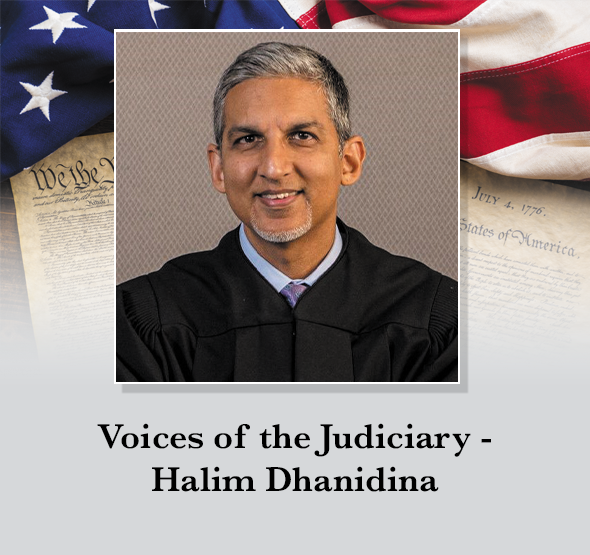
Retired associate justice, 2nd District Court of Appeal
If you could have argued any case in U.S. history, which one and why?
If I had the chance to argue a case from our past, I would choose Korematsu v. United States. I would have found it personally satisfying, if not cathartic, to articulate the abundant reasons why the mass incarceration of a minority group based on race cannot be justified by a so-called "strategic imperative" determined by the president. The specious arguments adopted by the Supreme Court in that case erroneously created an exception to the principle of Equal Protection that weakened our Constitution while broadcasting the Court's lack of confidence in democracy at the precise time our nation purported to be fighting for it in all corners of the globe. It is particularly ironic that Korematsu would not be repudiated by the Court for another 74 years in yet another case legitimizing the president's authority to maliciously discriminate against a discreet and insular minority group in Trump v. Hawaii.
How would you define the judiciary's legacy over the past two and a half centuries?
The judiciary has a decidedly mixed legacy over the past 250 years. As society has struggled with evolving notions of fairness and individual rights, those struggles have found their way into the courts. For every decision offering protection to previously subjugated groups, there are others that reinforce the dominance of the most powerful in society in every aspect of life. One can't help but see the law not as a consistently benevolent force but as a vehicle through which power is exercised and legitimized. In that sense, the judiciary has often represented the arbiters of this power rather than enforcers of ethical or moral ideals. Just as fire can be used to warm your home, cook your food and light the darkness, so can it be used to bring great devastation depending on who wields it. The law has been no different, bringing outcomes only as good as our judiciary.