


Constitutional Law
Jun. 30, 2026
The jury: A history of change and progress
See more on The jury: A history of change and progress



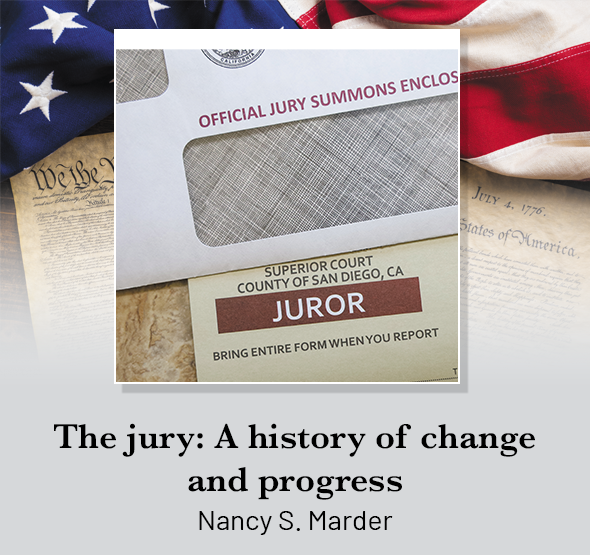
The right to a jury trial was included in the U.S. Constitution and the Bill of Rights. The Sixth Amendment to the U.S. Constitution provides for "an impartial jury" in criminal trials, and the U.S. Supreme Court explained in Thiel v. Southern Pacific Co. (1946) that the same right applies to civil jury trials. Although the jury was important to the Founders of our nation because it gave ordinary citizens the power to decide cases and was a bulwark against government overreach, the jury has changed along with our nation. Today's jury faces new challenges. Citizens need to understand the importance of serving on a jury, to resist sharing their experience on social media while they serve, and to recognize that juries need to be diverse so that jurors have an array of perspectives to consider and so the larger community will accept the verdict even if they disagree with it.
Making juries more diverse
Initially, only white men with property could serve as jurors. Black men began to serve during Reconstruction (1863-1877) in some states in the South and North. However, Black men lost their place on juries in the South in the 1890s. They were kept from being seated on juries through violence, as well as other practices, such as color-coding by race the names placed in the jury wheel from which jurors were selected. Lawyers also used their peremptory challenges, for which no reason had to be given, to remove Black prospective jurors from the jury.
Women's experience in serving as jurors tracked Black men's experience in some ways. Women were not permitted to serve until later than Black men, but like Black men, they lost the right to serve and did not regain it for many years. Women in at least two Western territories were permitted to vote and to serve as jurors (in Wyoming Territory in 1869 and in Washington Territory in 1884). However, women in the state of Wyoming lost their right to serve in 1872 or later (the precise year is disputed), and women in the state of Washington lost their right to serve in 1887. In 1898, Utah became the first state to permit women to serve as jurors.
Even the 19th Amendment to the U.S. Constitution (1920), which gave women the right to vote, did not necessarily give them the right to serve on a jury in state court; each state decided its own practice. In addition, women could only serve on a jury in federal court if the state in which they lived permitted women to serve in that state's courts. In fact, women did not obtain the right to serve in federal court without relying on state court practice until the Civil Rights Act of 1957. Even though most states had given women the right to serve on juries by 1961, some states required women to register if they wanted to serve. "Affirmative registration" was finally declared unconstitutional by the U.S. Supreme Court in Taylor v. Louisiana in 1975.
Reexamining peremptory challenges
Lawyers also used their peremptory challenges to remove Black men from the jury, just as they later used them to remove women. In 1986, the U.S. Supreme Court finally held in Batson v. Kentucky that race-based peremptory challenges were unconstitutional and created a three-part test that was supposed to help trial judges determine if a peremptory challenge was based on race. Although Justice Thurgood Marshall joined the majority's opinion in Batson, he wrote a concurrence in which he explained that discriminatory peremptory challenges would not stop until peremptory challenges were eliminated. In 1994, in J.E.B. v. Alabama ex rel. T.B., the Court extended the logic of Batson to gender-based peremptory challenges.
Although Batson and the cases that followed were a step in the right direction, it was difficult for a party to show that a lawyer had exercised a peremptory challenge based on purposeful discrimination. As a result, Batson was easy to evade. Trial judges did not press lawyers on their reasons and lawyers developed reasons that did not mention race (or, later, ethnicity or gender). Today, particularly in death penalty cases, prosecutors continue to exercise peremptory challenges against Black men and women. In death penalty cases, where a criminal defendant's life is at stake, juries need to be diverse so that jurors have a range of perspectives to consider during deliberations.
Although the U.S. Supreme Court has not revisited the Batson test, states have begun to reexamine Batson. Washington, through a judicial rule change, has instructed trial judges to view a questioned peremptory challenge from the perspective of "an objective observer" who is familiar with the role that systemic discrimination has played in the judicial system. California, through a statute, has followed Washington's approach and protects even more marginalized groups than Washington. Arizona has taken a different approach and has eliminated peremptory challenges. These states provide blueprints for other states.
New challenges for jurors
Jurors face new challenges with new developments in American society. Some citizens do not respond to their jury summons because they do not think it is important or they see it as an interruption in their daily lives. In an age of social media, some jurors are tempted to do research or to share their views about the jury trial online despite the judge's instructions that they must rely only on the evidence presented in the courtroom. Meanwhile, the number of jury trials in federal and state courts continues to decline. High-profile jury trials attract public attention, but they pose their own challenges, such as exposing prospective jurors to pretrial publicity.
One reassuring finding in polls is that most jurors leave their jury service feeling positive about the experience. They might not have wanted to serve initially but the jury process transformed them and prepared them for deliberation. Several studies have shown that those who serve on a jury are more likely to participate in other civic duties afterward, such as voting. Alexis de Tocqueville, a French writer who travelled to the United States in the 1830s to study American institutions, described the jury as "a free school" that helped citizens to develop skills essential to self-governance in a democracy. His observations about juries, described in Democracy in America (1835), still resonate today.
Nancy S. Marder is a professor of law, director of the Justice John Paul Stevens Jury Center and co-director of the Institute for Law and the Humanities at Chicago-Kent College of Law.