


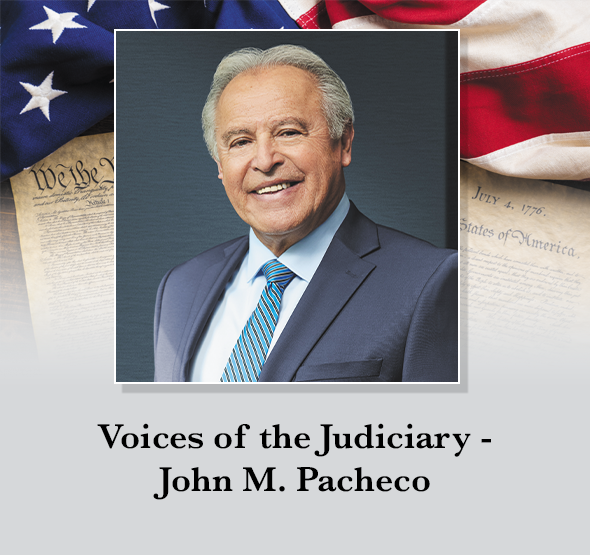
Retired judge, San Bernardino County Superior Court
Which moments in American legal history do you view as most consequential in shaping the modern judiciary?
Marbury v. Madison (1803) was monumental in its impact, holding that the Supreme Court has the power to strike down laws that violate the Constitution. This established the principle of judicial review and transformed the judiciary from the weakest branch of government into a co-equal branch capable of checking both Congress and the president.
Sadly, the current administration has profoundly reshaped the modern judiciary. It has made our judiciary more political, it has continuously refused to accept the doctrine of stare decisis, and it has deliberately degraded the rule of law. Judicial independence and impartiality are under attack as never before.
Under its "my way or the highway" mentality, this administration seems to have purposefully stacked the courts with jurists who adhere to the same political philosophy as its own. It appears to have intentionally blurred the lines between the three separate but equal branches of government, seeking to establish a monarchical form of government.
Legal professionals should be actively questioning this shift. All of us should be forcefully advocating for a strong and independent judicial branch.
If you could offer one piece of guidance to future jurists marking the nation's 300th anniversary, what would it be?
As we mark the nation's 250th anniversary, my singular guidance to legal practitioners is to focus your jurisprudence on humanity; don't simply rely on the cold, hard text when representing clients, making decisions and pursuing justice.
Fifty years from now, the legal landscape will be unrecognizable. We will likely adjudicate disputes involving artificial intelligence and technology in ways that the Founders could never have imagined. Our world will be driven by hyper-advanced algorithms, and we will be tempted to treat the law as a calculation--a simple problem.
But we must not allow human intellect to be put by the wayside. There must still be humanity in our rulings, to provide not just static answers but an enduring framework for human dignity, fairness and self-governance. The tools available to us will be advanced and intelligent, but our fundamental charge must remain unchanged.
Use your immense power to ensure that as "technology accelerates, the law continues to shield the vulnerable, check the powerful, and preserve the human element of justice."