


Intellectual Property,
Constitutional Law
Jun. 30, 2026
America's original patent system in the AI age
See more on America's original patent system in the AI age



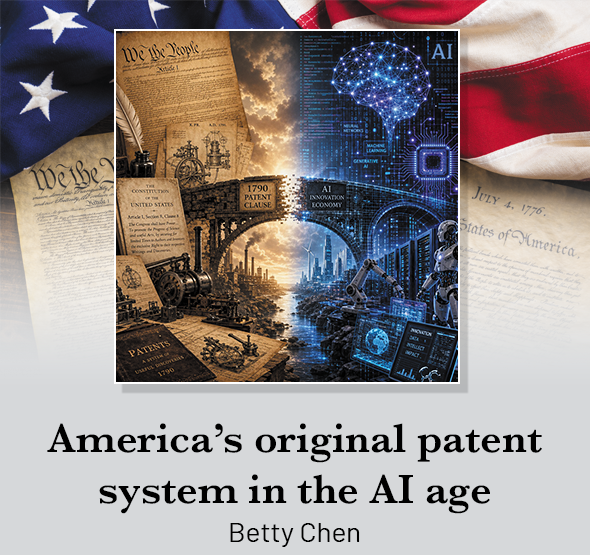
When the Framers enumerated the powers of a new federal government, they said surprisingly little about private property.
The original Constitution addressed territory and property belonging to the United States, but it did not create a general federal code for the land, commodities and physical wealth that dominated the economy at the time. Instead, in Article I, Section 8, it made one notably forward-looking grant, and it was for Intellectual Property: Congress shall "promote the Progress of Science and useful Arts" by securing, "for limited Times," to authors and inventors "the exclusive Right to their respective Writings and Discoveries." It is the only place in the original Constitution where the word "Right" appears.
Thus, one of the few proprietary interests the Framers expressly named in the founding charter was not land or gold, but the work of the human mind, long before intangible assets became central to American enterprises. Just as important, the Framers did not identify intellectual property as an unlimited right. They gave Congress tools to advance a public end. The exclusive right is the means; progress is the goal. It was constitutional economic engineering: a time-limited bargain designed to encourage invention, disclosure and eventual public access.
Today, that bargain underwrites a large part of the American economy. Software, pharmaceuticals, entertainment, semiconductors and AI all depend on protected ideas, technical know-how and creative works. The intangible now drives an extraordinary share of economic value. But the question the Framers framed in a single sentence--how to reward invention without locking up progress itself--has become extraordinarily hard to administer.
The first major patent-law question AI posed was who counts as an inventor. Under current law, that answer is clear. In Thaler v. Vidal, the Federal Circuit held that the Patent Act requires an inventor to be a natural person. The Supreme Court declined review. The Patent Office has since reaffirmed the same rule: AI systems may be tools used by human inventors, but they cannot themselves be named as inventors.
The harder question is not who invents, but what AI-related inventions may be patentable. Section 101 of the Patent Act identifies broad categories of patentable subject matter: processes, machines, manufactures and compositions of matter. But the Supreme Court has long recognized judicial exceptions for abstract ideas, laws of nature and natural phenomena. Courts therefore ask whether a claim is directed to an ineligible concept and, if so, whether the claim adds enough to transform that concept into a patent-eligible application.
That test is meant to preserve the bargain. A patent should protect a concrete technological contribution, not a desired result stated at a high level. For example, one cannot patent an economic concept merely by saying "do it on a computer." Nor should one be able to patent "use AI to optimize this process" without disclosing a technical advance in how the AI works, how data is processed or how a machine or system is improved. Patent law should require more than an aspiration. It should require an invention.
For more than a decade, that line has been difficult to draw. Software patents have been especially vulnerable to Section 101 challenges. Practitioners, district courts and Federal Circuit panels have wrestled with Section 101, often and in varying ways. But the Supreme Court last weighed in on Section 101 in Alice Corp. Pty. Ltd. v. CLS Bank Int'l back in 2014, long before generative AI became prevalent.
Now, AI has sharpened the problem. On one view, it makes abstraction worse. A claim that simply applies generic machine-learning techniques to a new data environment looks very much like the old problem in a new costume. The mere presence of generic servers, GPUs or data centers should not rescue an abstract claim. But AI also cuts the other way. The most valuable AI technologies may involve specialized chips, new architectures or other technical systems that solve concrete technological problems. The challenge is to distinguish claims that slap on AI as a label from claims that disclose a real technological advance.
This column takes no position on whether any particular AI patent should issue. Reasonable practitioners will line up on both sides. But the system needs firmer guidance, and it needs it soon. AI patenting has been expanding for years, and generative AI has raised the stakes. Litigation will follow. If the last decade of Section 101 disputes were costly, the next decade could be worse: more filings, larger investments at risk and more uncertainty around a technology central to the economy.
There is also a competitiveness dimension the Framers would have understood. They created a national patent system because state-by-state protection could not serve a national market. Today the market is global. The United States has made AI leadership a national objective, and a clear, predictable patent system is part of the foundation on which that leadership depends.
So, what should the next era look like? The Supreme Court would ideally take an appropriate Section 101 case, perhaps one with an AI dimension, so that lower courts, inventors, and practitioners have a crisp understanding as to where abstraction ends and patentable invention begins.
The Framers bet that limited protection for invention and authorship would build a stronger country. As the nation marks 250 years since its founding, the task is to keep faith with the bargain: reward real invention, preserve the public domain and give the inventors of the AI age the clarity they need to build what comes next.
Betty Chen is a partner at Desmarais LLP in San Francisco, where she advises technology and artificial-intelligence companies on intellectual property litigation matters.