


U.S. Supreme Court,
Constitutional Law
Jun. 30, 2026
From obscurity to omnipotence, the evolution of the Supreme Court's long rise to power
See more on From obscurity to omnipotence, the evolution of the Supreme Court's long rise to power


John S. Caragozian
Email: caragozian@gmail.com
John is a Los Angeles-based lawyer and sits on the Board of the California Supreme Court Historical Society. He welcomes ideas for future monthly columns on California's legal history at caragozian@gmail.com.
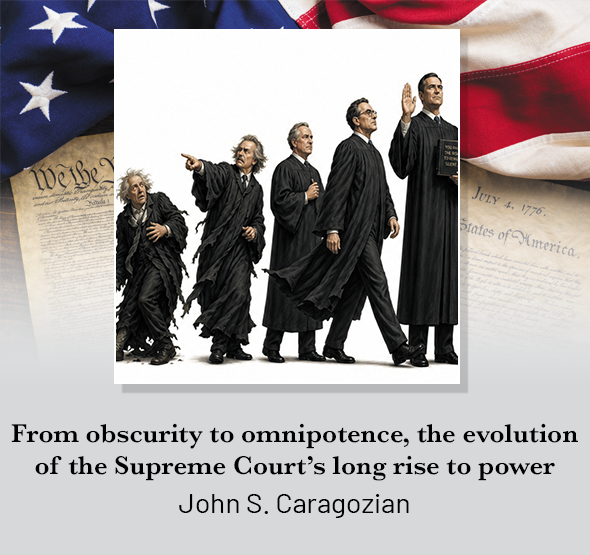
Today, the U.S. Supreme Court is the world's most powerful court. From democracy basics (such as citizenship, ballot access and redistricting) to cultural issues (such as abortion, gun control and LGBTQ rights), from civil rights (such as affirmative action) to civil liberties (such as deploying federal troops in cities), the nine unelected Supreme Court justices who deliberate in secret often have the last word.
How did this power arise?
The 1787 Constitution's framers recognized that dividing sovereignty between federal and state governments would be initially unresolved. Adding to this uncertainty, the Constitution's "Judicial Power" is the shortest and least defined of the three branches of government: Article III's nine sentences provide for "one supreme Court"--with appellate jurisdiction "arising under this Constitution, [and] the Laws of the United States ..."--plus "inferior Courts as the Congress may ... establish."
The first U.S. Congress, with a majority of federalists (who favored a strong national government), began to flesh out Article III's spare language. The Judiciary Act of 1789 provided for the Supreme Court to hear appeals from federal and state courts' interpretations of federal law. The latter was opposed by anti-federalists, who favored each state having final authority to interpret federal law.
In these early years, the Supreme Court was hardly a co-equal branch. Simply, it lacked esteem. When New York City was the nation's first capital, the Court shared state government space and later, in Washington, D.C., met in various rooms of the new Capitol. Moreover, the chief justice repeatedly had to beg for nominees to the Court. See, e.g., Kermit Hall (ed.), "The Oxford Guide to the Supreme Court" (2d ed. 2005), at 434.
Still, the Supreme Court began to create its role with steps that, at the time, were not self-evident. The early Court, mostly comprised of federalist justices, implicitly assumed authority to invalidate (a) congressional statutes that violate the Constitution and (b) state laws that conflict with federal authority. E.g., Hayburn's Case, 2 Dall. (2 U.S.) 409 (1792); Ware v. Hylton, 3 Dall. (3 U.S.) 199 (1796).
In the seminal 1803 case Marbury v. Madison, 1 Cranch (5 U.S.) 137, the Court, under federalist Chief Justice John Marshall, cemented itself as the final constitutional interpreter, holding that the "Essence of judicial duty" is to obey the Constitution, and, accordingly, laws "repugnant" to the Constitution--as decided by the Court--are void, with the Court's decisions binding on the government's other branches. French visitor Alexis de Tocqueville reported in 1835, "Americans have therefore entrusted an immense political power to their courts." Alexis de Tocqueville, "Democracy in America" (Harvey Mansfield and Debra Winthrop, trans. 2000), at 96.
Prudently, the Court refrained from exercising such power (nowadays "judicial review") for decades. However, in 1857, when the slavery debate consumed America, a divided Supreme Court decided the infamous Dred Scott case. It invalidated the Missouri Compromise--1820 legislation that had barred slavery in most Louisiana Purchase territories--as exceeding Congress's constitutional authority. The Court further ruled that African Americans, whether enslaved or free, were not "citizens of the United States" and lacked "rights and privileges" under the Constitution. Scott v. Sandford, 19 How. (60 U.S.) 393 (1857).
The Civil War, with an estimated 200,000 battlefield deaths, effectively overruled Dred Scott. The postwar 13th, 14th and 15th Amendments were ratified to outlaw slavery and to guarantee civil and voting rights to formerly enslaved African Americans.
Unfortunately, the Court eviscerated these amendments, thus contributing to Reconstruction's overall failure. For example, the Court struck down the Civil Rights Act of 1875 that had barred racial discrimination in public accommodations and transportation, holding that Congress lacked authority under the 14th Amendment to outlaw private discrimination. Civil Rights Cases, 109 U.S. 3 (1883). More fundamentally, the Court approved states' "separate but equal" laws to mandate segregation of African Americans and other persons of color in schools, marriage, transportation, housing, hospitals, parks, cemeteries and other aspects of everyday life, all notwithstanding the 14th Amendment's "equal protection" guarantee. E.g., Plessy v. Ferguson, 163 U.S. 537 (1896).
Ironically, as the Court narrowed equal protection, the Court expanded "due process" under the same 14th Amendment, repeatedly using due process to strike down states' worker protection legislation and other business regulation. The Court's philosophy was that "liberty of contract" was protected by due process, and, accordingly, many laws regulating child labor, work hours, minimum wages and the like unconstitutionally interfered with such liberty. E.g., Lochner v. New York, 198 U.S. 45 (1905). Under this philosophy--"substantive due process"--the Court anointed itself as arbiter of economic regulation.
Even during the Great Depression, the Court struck down several of President Franklin Roosevelt's New Deal programs on a variety of theories. E.g., Schechter Poultry Corp. v. U.S., 295 U.S. 495 (1935).
Given the New Deal's popularity, as evidenced by Roosevelt's 1936 landslide re-election, Roosevelt proposed reducing Supreme Court interference via the 1937 Judiciary Reorganization Bill. It would have allowed Roosevelt to add up to six new justices (who, presumably, would uphold New Deal legislation). This bill, popularly termed the Court-packing plan, ignited a backlash: even Roosevelt's political allies criticized the bill as threatening judicial independence. While Congress never enacted the bill, the Court promptly stopped using substantive due process and other theories to invalidate economic legislation. More broadly, the Court began deferring more to federal and state elected officials regarding regulation. See West Coast Hotel Co. v. Parrish, 300 U.S. 379 (1937). See also Kermit Hall, supra, at 233-34, 454.
As the Supreme Court retreated from invalidating popular economic regulation, it also had to address the opposite situation--protecting unpopular causes--and thus waded into civil liberties. During World War I, the federal government prosecuted socialists for distributing antiwar leaflets to military personnel; the Court rejected a First Amendment freedom of speech defense, because the leaflets were a "clear and present danger" of military obstruction. Schenck v. U.S., 249 U.S. 47 (1919).
Did the developing civil liberties jurisprudence give the Court authority over state laws? The Court had long held Bill of Rights protections applicable only to the federal government, not to states. In Gitlow v. New York, 268 U.S. 652 (1925), however, the Court began to give itself authority over states by "incorporation" of the First Amendment into the 14th Amendment's due process clause. Since then, the Court has incorporated almost all the Bill of Rights into the 14th Amendment, thereby allowing the Court to invalidate state laws violating the Bill of Rights.
During World War II, the Supreme Court deferred to the military in Bill of Rights cases, even to the extent of approving blatant racial discrimination. The Court approved a curfew for Japanese Americans and then exclusion of Japanese Americans from the west coast, all solely based on Japanese ancestry and without trial. Hirabayashi v. U.S., 320 U.S. 81 (1943); Korematsu v. U.S., 323 U.S. 214 (1944).
After the war, though, the civil rights tide began to turn. The Court re-examined separate but equal and--under Chief Justice Earl Warren--unanimously rejected it in public education (and, later, in other areas). Brown v. Board of Education, 347 U.S. 483 (1954). While Brown and its progeny met with massive resistance in the south, and implementation took decades, the Court deserves credit for helping to dismantle America's apartheid.
In the 1960s, the Warren Court expanded judicial power by revolutionizing criminal procedure. As examples, the Fourth Amendment requires states to exclude illegally seized evidence (Mapp v. Ohio, 367 U.S. 643 (1961), the Fifth Amendment requires police to inform arrestees of the right to remain silent (Miranda v. Arizona, 384 U.S. 436 (1966)), and the Sixth Amendment requires states to provide counsel for indigent defendants (Gideon v. Wainwright, 372 U.S. 335 (1963)). These decisions were controversial but now have become largely accepted.
During the same era, the Court further expanded its role by deciding that 14th Amendment equal protection requires legislative districts to have equal populations. E.g., Baker v. Carr, 369 U.S. 186 (1962). Accordingly, district maps--congressional, state, and local--across the nation had to be redrawn, often in favor of growing urban areas. See, e.g., Kermit Hall, supra, at 67-68 (Per chief justice Warren, Baker was his Court's "most vital decision.").
Yet more expansion occurred when the Court read "privacy" into due process. Privacy violations, in turn, led the Court to invalidate states' restrictions ranging from birth control to consensual sex. Griswold v. Connecticut, 381 U.S. 479 (1965); Lawrence v. Texas, 539 U.S. 558 (2003).
As noted at the top, the Supreme Court influences much of today's politics. This influence is due to the federal government's overall growth and to the Court's accretion of authority. Whether such influence continues will depend on citizens and elected officials respecting the rule of law and the Court earning such respect with independent and principled decisions.
John S. Caragozian is a retired lawyer and on the Board of the California Supreme Court Historical Society. He thanks Emeritus Professor Nat Stern for his substantial contributions to this column.