


Law Practice,
Constitutional Law
Jun. 30, 2026
What John Adams carried
See more on What John Adams carried


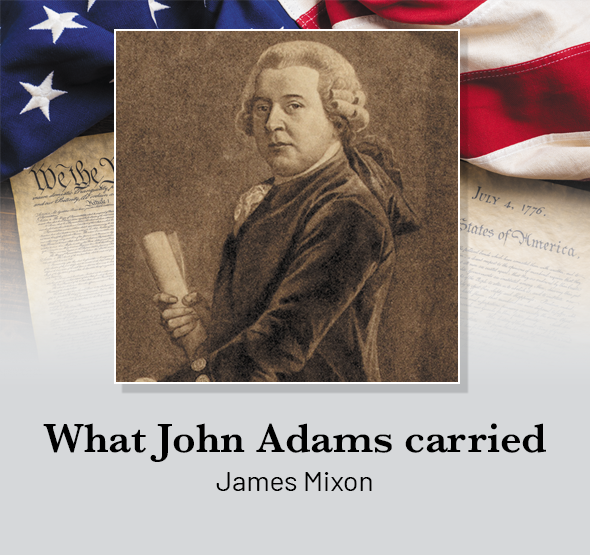
On a night in late November 1770, John Adams sat at a desk in Boston with Beccaria open before him. He had been preparing for weeks. He had worked through Foster on the law of self-defense and Hawkins on the criminal law. He had taken notes in a slim manuscript, which included his Notes of Authorities. The pages survive. The Massachusetts Historical Society holds them in three sets, alongside his minutes of Crown witnesses and his outline of the defense to come.
In a few days, he would stand for two consecutive days before 12 jurors in the Boston Massacre trial. The town wanted the soldiers hanged; he had taken the case anyway. He would argue that the soldiers on King Street had a right of self-defense; that two outsiders had provoked the violence; and that even where the killings could not be justified, the proper charge was manslaughter. The argument would be transcribed in shorthand by John Hodgson and printed as a pamphlet. The line everyone remembers, "facts are stubborn things," was already a proverb when Adams reached for it. He had drafted his use of it, polished it, and committed the passage to memory before he ever opened his mouth in court.
Six years before independence, Adams was practicing law on a premise the new republic would inherit: that the lawyer who stood up to argue had first done the reading.
This is what we are looking at when we look at a Founding-era lawyer preparing a case: one man, a small library, a notebook and many nights.
There were no associates. There was no document review. There was no precedent database, no machine that had read the books for him.
Two hundred fifty-six years after that desk in Boston, another lawyer prepares another brief. He also has no associates, no document review department, no precedent database in any sense Adams would have understood the term. He obtained his Notes of Authorities not from Rutter Group or Witkin but from an AI model. For each authority he intends to cite, he has asked it to summarize the holding. He has read the summaries. He has shaped his argument around what they told him. The cases themselves he has not opened. He skims the draft. He makes light edits. He files.
Would Adams recognize this lawyer? From a distance, the scenes look identical. The 1770 figure and the 2026 figure both appear to be doing the same thing: lawyering alone.
Adams had read the authorities. He held the doctrine in his head. The brief, when it came, was material he had absorbed across months of nights, surfacing under pressure. The cognitive labor was inside him.
The 2026 brief is the inverse. The machine has read the authorities. The lawyer has not. The brief is not the surfacing of anything from inside the lawyer; it is the importation of something from outside, the citation of cases he did not summarize, the deployment of doctrine he could not reconstruct on a whiteboard. The output is fluent. The interior is empty.
Adams without his books would have been helpless; with them, he became what the books made possible, a man who knew. The 2026 lawyer without his AI model is helpless; with it, he becomes something the model has made possible, a person who appears to know.
In Noland v. Land of the Free, the Second District held last year that no court filing should contain citations, whether generated by AI or any other source, that the responsible attorney has not personally read and verified. The 9th Circuit endorsed that rule this month in Lnu v. Blanche, suspending two attorneys for six months after they filed briefs containing cases that do not exist.
Adams would recognize this. Barnardiston's Reports were said to include invented cases. Lord Mansfield, chief justice through Adams's career, forbade counsel to cite them. The bar gossiped that pranksters scribbled the invented cases into his notebook while he slept. Whether that was true or only true-to-reputation, the response was the same. Before that court, the fabricated authority could not be cited. Noland and Lnu are the modern articulation of an older rule.
But Noland and Lnu address the visible failures: cases that do not exist, citations that do not support the claim. The harder problem is the brief that does not fall apart. The brief whose citations check out, whose doctrine is correctly summarized, and whose author has read none of it. The signature is regular, the work product is acceptable, and somewhere behind it a lawyer has stopped doing the one thing the practice of law was historically organized around: knowing what is in the document he put his name to.
Adams would not call this the practice of law. For 250 years, the legal profession has weathered transformations: the printing press, the typewriter, online research, e-discovery. It has changed how lawyers stored and retrieved knowledge (few miss filing cabinets). But none changed whether lawyers had to have knowledge. A lawyer in 1985 who had not read the cases in his Westlaw printout would be lost. The retrieval system did not double as a reasoning system. Now it does.
Adams would recognize the desk, the laptop standing in for his small shelf, the absence of associates, the single mind producing a single document. But when he walked closer and questioned the lawyer about the brief, within a minute he would understand. A thing he had taken for granted, that the lawyer at the desk had read what was being argued, had become optional.
He would have a word for it. The 18th century called such a man a pretender, and the word was not gentle. Adams used it pejoratively across his diaries. It carried a resonance the modern ear has lost: it was also the term for the Stuart claimants to the British throne. One word, two usurpations: the man who claims a throne he has no right to, and the man who claims a competence he has not earned. Either the man at the desk had done the work the office required, or he had not. The bar card, the signature block, the appearance of competence answered nothing.
The practical question for the practitioner is not whether to use the tools. The tools are not the problem. Adams would have used Westlaw if he could have, and an AI model if he could have. The question is whether the human at the desk is still doing Adams's work, or has quietly stopped doing it.
Cases move. The judge asks the question that is not in the brief. The lawyer who has read only summaries has nothing of his own to draw from.
There is a test. Close the laptop. Cover the brief. Ask yourself, in your own words, why your client should win. If you can answer with the cases, the rule, the analogy, the counterargument, you have done Adams's work in some recognizable form. If you cannot, you have produced a document that looks like a brief. But is it the practice of law?
The 250th anniversary of the country is a useful moment to run that test on yourself. Not because the Founders' way was sacred, but because their practice rested on an assumption we have never retired: that the person who signs the document is the person who knows what it says. That was true in 1770. It is true now. And it is the one thing the machine cannot supply on the lawyer's behalf, however clean the work it hands him.
Adams carried his preparation into the courtroom inside his head. What do you carry?
James Mixon is managing attorney for central staff at the California Court of Appeal, Second Appellate District. The views expressed are his own and do not represent the position of the California Courts.
For reprint rights or to order a copy of your photo:
Email
Jeremy_Ellis@dailyjournal.com
for prices.
Direct dial: 213-229-5424
Send a letter to the editor:
Email: letters@dailyjournal.com