

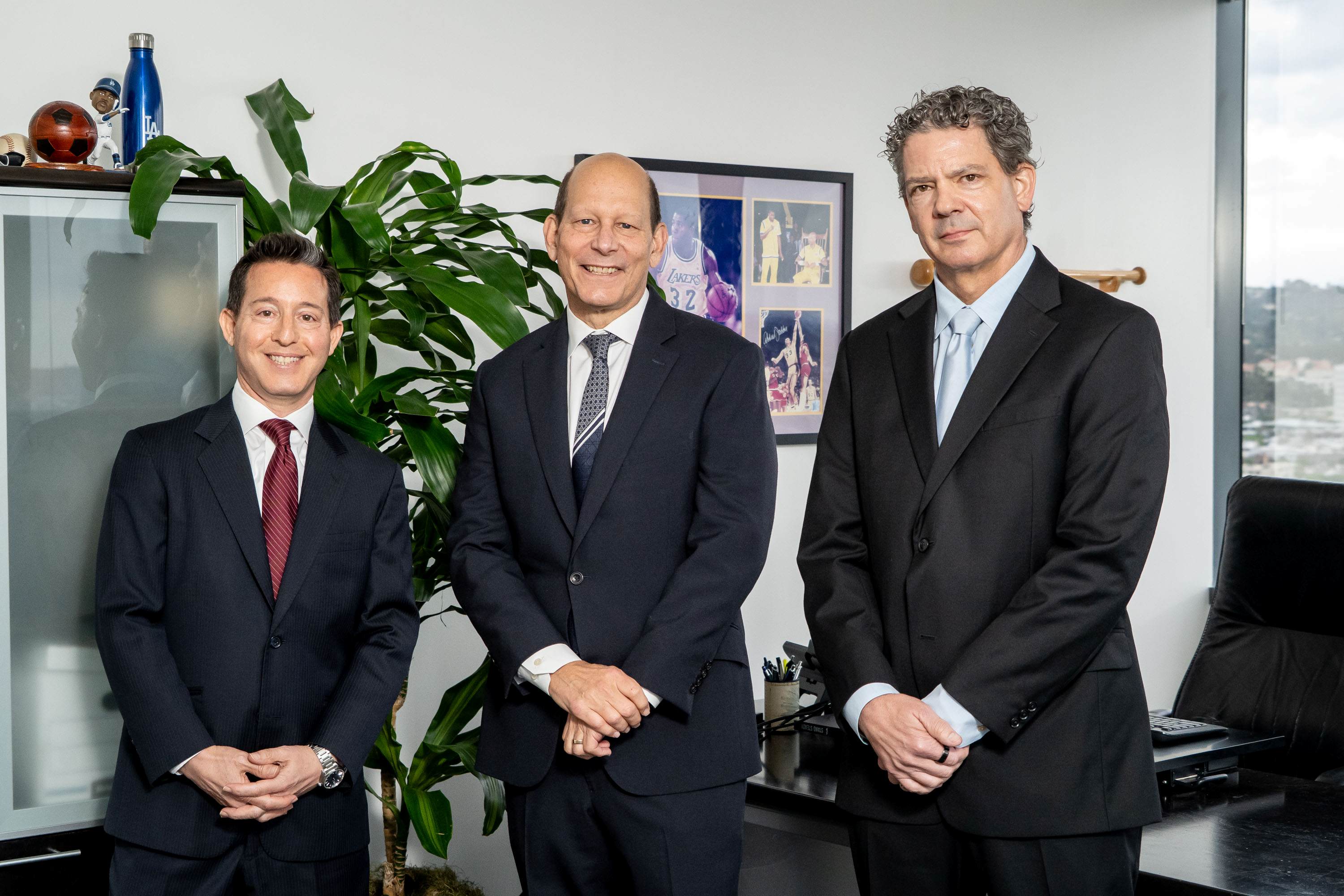
At Armbruster Goldsmith & Delvac LLP, there is no receptionist, no reception desk and not a single paralegal.
The six-attorney Los Angeles land use boutique recently cut its office space in half. Its lawyers generally work without legal secretaries, and clients rarely visit the office. Three experienced land use planners handle much of the work that larger firms might assign to junior attorneys.
It is an unusually spare operation for a firm whose lawyers have helped secure approvals for some of Southern California's most recognizable developments, including L.A. Live, the Lucas Museum of Narrative Arts, the Getty Villa, Dodger Stadium renovations and major projects at Los Angeles International Airport.
But managing partner Dale Goldsmith says that is precisely the point.
"Lean and mean was our byword," Goldsmith said. "Lean and mean works particularly well when the economy is not as robust as it can be."
That philosophy has helped the firm weather economic downturns without the significant disruptions Goldsmith said some competitors experienced. It has also positioned the boutique to navigate California's increasingly complicated development laws, even as legislators attempt to streamline the approval process.
"The Legislature keeps altering CEQA," said partner Damon Mamalakis, referring to the California Environmental Quality Act. "It's a lawyer employment act, because you're always going to need us because the Legislature keeps making it more complicated."
For Mamalakis, who handles the firm's litigation practice, that constant evolution is part of the attraction.
"It doesn't get easier, quite honestly," he said. "But that's also why I enjoy it. It doesn't get rote."
A different kind of law firm
Goldsmith began practicing law in 1985, when land use was emerging as a distinct legal specialty.
Working alongside former Los Angeles City Attorney Burt Pines at Alschuler Grossman & Pines, he helped develop a practice that occupied the space between traditional real estate law and political lobbying. As development regulations grew more complicated, developers increasingly needed lawyers who understood not only environmental law but also planning commissions, municipal governments and the political process.
Goldsmith moved to Greenberg Glusker in 1999 but eventually grew dissatisfied with the economics of a large law firm. Land use, he concluded, was poorly suited to the traditional model of assigning multiple associates to matters and generating revenue through leverage.
"There's a lot of specialty knowledge and relationships, and I can't just grab five associates out of the lunchroom and get them to do what we need to do," he said.
In 2004, he met for breakfast with fellow land use attorney Mark Armbruster, with whom he had worked on several projects. They decided to establish their own firm, beginning with two partners, an associate, and a planner. Their approach emphasized senior-level attention, specialized expertise and hourly rates substantially below those charged by large firms.
Goldsmith said his own rate is comparable to what some competing firms charge for a senior associate or junior partner.
The model attracted developers, whose projects frequently require years of legal work before producing any revenue. As the practice expanded, the founders recruited lawyers from major firms, including William Delvac, David Goldberg and Mamalakis, all formerly of Latham & Watkins LLP.
Goldberg joined in 2011 after more than a decade at Latham, where he had become a partner. He said the economics of land use increasingly favored specialized boutiques over firms whose billing structures were shaped by corporate transactions and securities litigation.
"The land use practice is often expertise-based, and partners are more involved in the work," Goldberg said. "The leverage is a little bit lower, and that lends itself more to a boutique practice."
Mamalakis followed in January 2013, becoming the firm's principal litigator. Beyond legal expertise, he said, the partners placed considerable importance on personal compatibility and a shared approach to practicing law.
Big projects, small teams
Despite its size, Armbruster Goldsmith & Delvac has assembled a portfolio that would be substantial for a much larger real estate practice.
Goldsmith has helped clients obtain governmental approvals for more than 50 million square feet of residential, commercial, industrial and institutional development throughout California. His projects include USC's 5 million-square-foot University Park Campus master plan, Apple's office campus in Culver City and Los Angeles, and the Los Angeles Lakers' headquarters and training facility in El Segundo.
Goldberg has concentrated much of his practice on the California Coastal Act, representing clients before the California Coastal Commission on projects including the Getty Villa expansion, the Carlsbad desalination facility and work involving Pacific Gas & Electric Co.'s Diablo Canyon nuclear power plant.
Mamalakis brings litigation experience to the practice, defending development approvals and handling disputes involving CEQA, environmental regulations and government decision-making. His work has included projects involving Costco, the Academy Museum of Motion Pictures and major energy infrastructure.
The partners say their complementary specialties allow them to collaborate when necessary without routinely staffing matters with large teams.
"If you hire me, you hire me," Mamalakis said. "I don't have to feed two or three other people."
The firm's three planners are particularly important to that model. They assist with entitlement applications, analyze development possibilities and navigate local planning departments. Their experience includes prior work inside government agencies, giving them practical knowledge of how projects move through the approval process.
Mamalakis said the planners provide expertise that clients might otherwise have to obtain from attorneys charging substantially higher rates.
The firm has also dispensed with paralegals. Its litigation work generally involves administrative writ proceedings, which rely on an existing record rather than extensive discovery. Electronic filing has further reduced the need for administrative support. An office manager and part-time assistant handle much of the remaining work.
Artificial intelligence is becoming another tool for maintaining efficiency. Goldberg uses AI to identify potentially relevant statutes, regulations and decisions, which he then independently verifies. Mamalakis said the technology can accelerate document analysis and preliminary land use due diligence.
The firm has also experimented with AI tools to analyze general plans and identify applicable legal authorities. But the partners say technology cannot replace the judgment, relationships and understanding of local government that remain central to their practice.
A moving legal target
The firm's lean structure has not insulated its clients from the difficulties of developing property in California.
Goldsmith said lengthy environmental reviews, municipal bureaucracy and increasingly expensive construction have made some projects extraordinarily difficult to complete. He has worked on environmental impact reports that took five or six years to prepare.
For one research project at USC's Health Sciences Campus, Goldsmith recalled, the development team had to appear for seven planning commission hearings. Only two proceeded because the commission repeatedly lost its quorum, adding several months to the approval process.
The Legislature's efforts to accelerate housing construction have changed that landscape, particularly with the enactment of AB 130 in 2025. The legislation established a CEQA exemption for qualifying urban infill housing projects, potentially eliminating years of environmental review.
"If you're an AB 130 project, it's just basically a checklist," Goldsmith said. "It could be reviewed in a couple of weeks rather than several months."
But the exemptions come with conditions, including prevailing-wage requirements for certain taller projects. Those labor costs can be difficult for developers to absorb amid high interest rates, expensive land and rising construction costs.
Goldsmith said some projects remain financially impractical even when environmental review can be substantially shortened. The challenge is finding the fastest legally defensible approval process while anticipating potential litigation.
"Every time you go into a process, at least I look at it thinking, how could we minimize the risk of a CEQA lawsuit?" he said.
For Goldberg, the changes have created a complicated balance between accelerating housing construction and preserving public participation. Housing legislation has converted some previously discretionary approvals into ministerial decisions, eliminating hearings and certain avenues for appeal.
The tension is particularly pronounced along California's coastline, where Coastal Act protections for biological resources, scenic views and public access limit the reach of housing streamlining laws. Sea-level rise has added another layer of complexity as regulators scrutinize projects based on projected future conditions.
Goldberg said he expects coastal development to remain a particularly demanding area of land use practice.
Passing the mantle
After 22 years, Armbruster Goldsmith & Delvac is approaching a leadership transition, although its founders are in no hurry to leave.
Goldsmith, 66, said he has no intention of retiring in the near future, or even the distant future. Still, he sees Goldberg and Mamalakis as the firm's next generation of leaders.
"I'd like to pass the mantle on to David and Damon," he said, envisioning a gradual transition that would bring additional younger attorneys into the practice.
Both lawyers favor modest growth, including expanding the client base and recruiting younger attorneys, but neither wants to transform the boutique into a midsize firm or abandon its business model.
Mamalakis said the partners regularly receive inquiries about potential mergers or acquisitions. They have little interest.
"We like our group," he said. "We're profitable for the partners. We are cost-effective for our clients. We all enjoy what we're doing."