

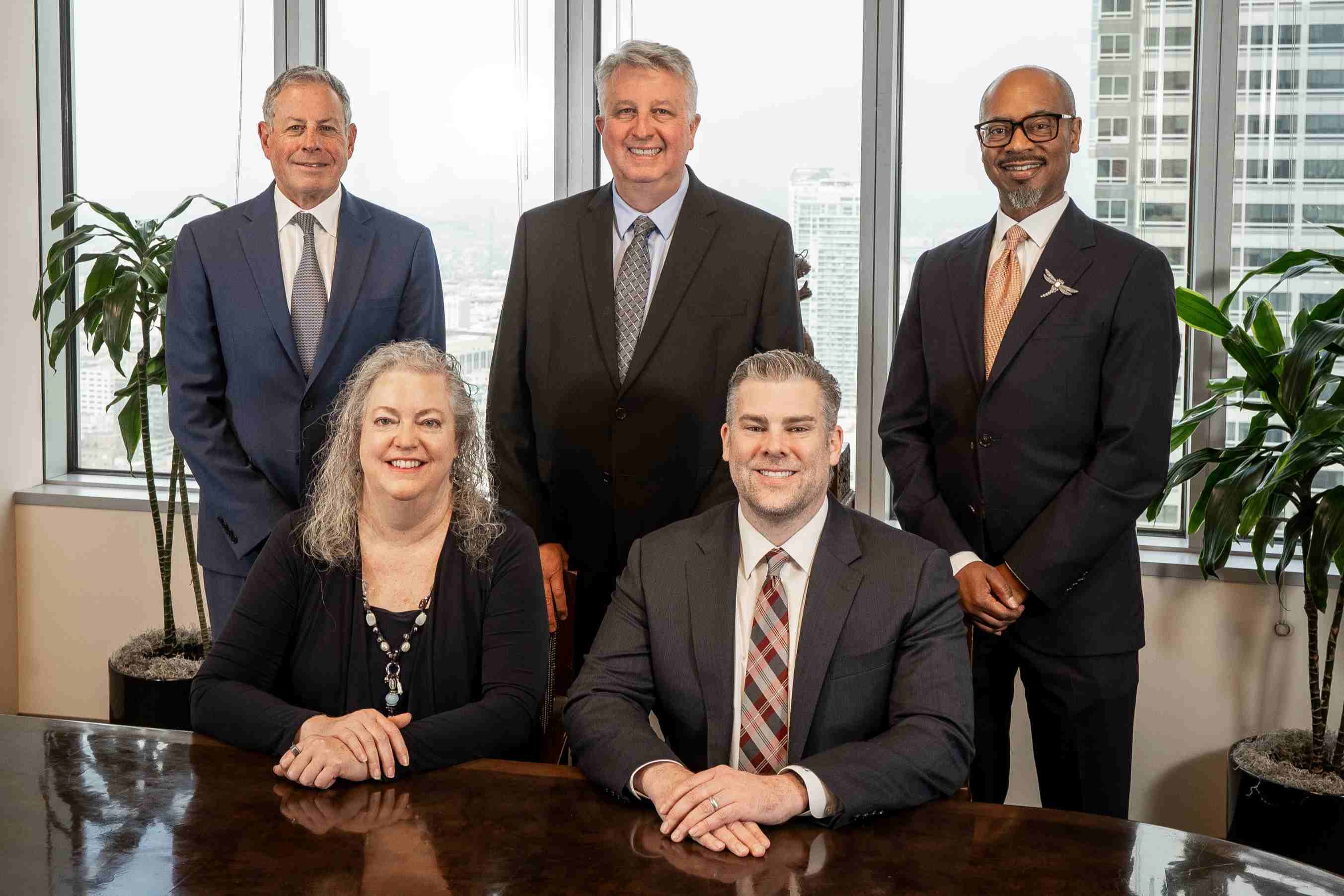
When Sacks, Glazier, Franklin, Lodise, McMurtrey & Scheerer LLP launched 25 years ago, trusts and estates litigation was still emerging as a distinct legal specialty.
Probate work had long been associated primarily with estate planning and administration. But the lawyers who founded the Los Angeles boutique saw the field changing -- driven by increasingly complex wealth transfers, aging populations, evolving family structures and growing disputes over fiduciary duties, inheritance rights and elder abuse.
What followed was the emergence of a firm that became deeply involved in shaping California trusts and estates law.
"We're always trying to figure out what's happening in the law and how we can help shape it in ways that move it forward," founding partner Terrence "Terry" Franklin said during a recent interview marking the firm's anniversary.
That influence has come through multiple channels: landmark appellate litigation, statewide bar leadership, judicial education, legislative involvement, and national policy work through organizations such as the American College of Trust and Estate Counsel, known as ACTEC.
The firm traces its roots to the early 1990s, when Franklin and partner Meg Lodise separately left large-firm practice to join legendary probate litigator Bruce Ross, and Robert Sacks who went on to co-found the first iteration of the firm, Sacks, Glazier, Franklin & Lodise, LLP.
At the time, trusts and estates was beginning to develop into a more specialized litigation discipline rather than an extension of transactional estate planning.
"Bruce was one of those people who was helping to bring together people who do trust and estate work but are really litigators to try to create this new trust and estate litigation practice area," Franklin recalled.
Lodise said the appeal was the chance to build a smaller, highly specialized practice centered on sophisticated litigation rather than large-firm bureaucracy.
"You're going to go out with a startup firm, you might as well go with the guy who wrote the book," Lodise said of Ross, who edited a leading probate practice guide.
By 2001, Franklin, Lodise, Kenneth Glazier, and Robert Sacks launched their own firm.
Their timing proved prescient.
Over the next two decades, trust and estate litigation expanded dramatically as California experienced enormous intergenerational wealth transfers, increasingly complicated family relationships and rising elder abuse litigation.
"Between nontraditional relationships, high levels of wealth, and a large retiree population, the Southland is never without a high-profile family feud," Franklin said.
The firm became involved in several cases that helped define California probate and fiduciary law.
Among the most significant was Moeller v. Superior Court, a landmark California Supreme Court decision involving attorney-client privilege and successor trustees. Franklin served as counsel in the case, which established what became known as the fiduciary exception to attorney-client privilege in certain trust disputes and held that predecessor trustees generally cannot withhold trust administration communications from successor trustees. Moeller v. Superior Court (1997) 16 Cal. 4th 1124.
The ruling remains foundational in California trust litigation.
More recently, Lodise secured a published appellate victory in Estate of O'Connor, a decision clarifying when testamentary language sufficiently exercises a power of appointment under California probate law. Estate of O'Connor, 26 Cal. App. 5th 871 (2018).
Lodise said the case remained personally memorable because of the client relationship that developed through years of litigation and appeal. "I still get flowers every year on the anniversary from my clients thanking me for getting the ruling that we did on that," she said.
The firm has also handled some of the state's largest modern trust disputes, including the successful defense in 2025 of a $3 billion challenge to the Barron Hilton Trust and the Conrad N. Hilton Foundation. The litigation, brought by four children of hotel magnate William Barron Hilton after his 2019 death, alleged that he improperly influenced his wife Marilyn Hilton's estate planning decades earlier. Sacks Glazier secured dismissals and appellate victories in multiple related actions before prevailing in summary judgment weeks before trial in the final case.
But the firm's influence has extended far beyond courtroom victories.
Lodise is president of ACTEC, one of the nation's most influential trusts and estates organizations. Through ACTEC, she has worked on technical comment projects involving U.S. Department of Treasury regulations and participated in amicus curiae efforts before the U.S. Supreme Court.
The organization has also become increasingly involved in efforts to preserve trusts and estates education in law schools and on the new "NextGen" bar exam -- an effort they lost, at least for the moment.
"There's just a huge amount of wealth being transferred," Lodise said. "Not having that taught in law schools on a regular basis is a huge detriment to the public, we think."
Both Lodise and managing partner Matthew McMurtrey have chaired the California Lawyers Association's Trusts and Estates Executive Committee, known as TEXCOM, which helps shape statewide probate legislation and policy discussions.
Franklin chairs USC Gould School of Law's annual Trust and Estate Conference, one of Southern California's leading probate CLE programs, while partner John Scheerer has a leadership role in the American Bar Association's Real Property, Trust and Estate Law Section.
The firm has also become involved in broader access-to-justice efforts tied to estate law.
Franklin has worked on initiatives involving heirs' property disputes -- situations in which property informally passes across generations without probate or title transfers, often creating fractured ownership interests that disproportionately affect African American and Native American families.
Through ACTEC and collaborations with Bet Tzedek Legal Services, Franklin said the firm has also supported efforts to expand estate planning services to underserved communities.
"We see it go wrong," Franklin said of inadequate estate planning. "And then we think, 'How can we make sure more people are getting the right kind of service and getting it done right?'"
The firm's reputation has also attracted clients from well beyond California. Kevin Reed, general counsel at the University of Oregon, turned to Franklin when the university became involved in several California estate disputes as a beneficiary. Reed said the matters required a careful balance between protecting the university's interests and controlling litigation costs when the value of potential recoveries remained uncertain.
"Terry proved not just very skilled in the area, but able to protect our interests in a very effective and efficient way," Reed said. "I never had to turn to my clients and say that I spent more money than I was able to obtain for them."
Reed also credited Franklin with staffing matters efficiently by pairing younger attorneys with experienced supervision. "Terry does a really good job of putting really smart younger attorneys and associates on matters, but stepping in as needed," Reed said.
The firm's reach has also extended to national charitable organizations involved in California probate disputes. Guy Swanson, chief operating officer of Unity World Headquarters in Kansas City, said his organization has relied on Lodise for more than a decade in a series of contested estate matters involving charitable gifts.
Swanson said he was first referred to Lodise through ACTEC and has since worked with her through trials, mediations and complex estate litigation. "Meg knows estate law forwards and backwards," he said. "She's really smart, and she's calm, and doesn't get all wound up."
Technology is now creating another wave of legal uncertainty the firm expects will reshape the field.
The rise of electronic wills, digitally signed estate documents, AI-assisted communications and text-message testamentary disputes is already forcing probate courts to confront questions traditional statutes never anticipated.
"What kinds of things that have writing upon them can actually be treated as a will has been one of those growing technology issues," Franklin said.
The lawyers say the next generation of probate disputes may focus as much on digital intent and electronically stored communications as traditional will contests.
Despite those changes, the firm has intentionally resisted dramatic growth. The boutique has remained relatively small -- roughly 10 lawyers for much of its history -- while focusing on high-end litigation and active mentorship of younger attorneys.
"We want to be the firm in Los Angeles when people think from across the country, 'Hey, I need a trust and estate litigator. Who should I go to?'" Franklin said.