


Environmental & Energy
Nov. 9, 2026
Leaving the shallows: Diving deeper than fish v. farms
California's water conflicts are not new, nor are they simply a matter of "fish v. farms." The real issue is whether all branches of government honor the state's supreme water law.



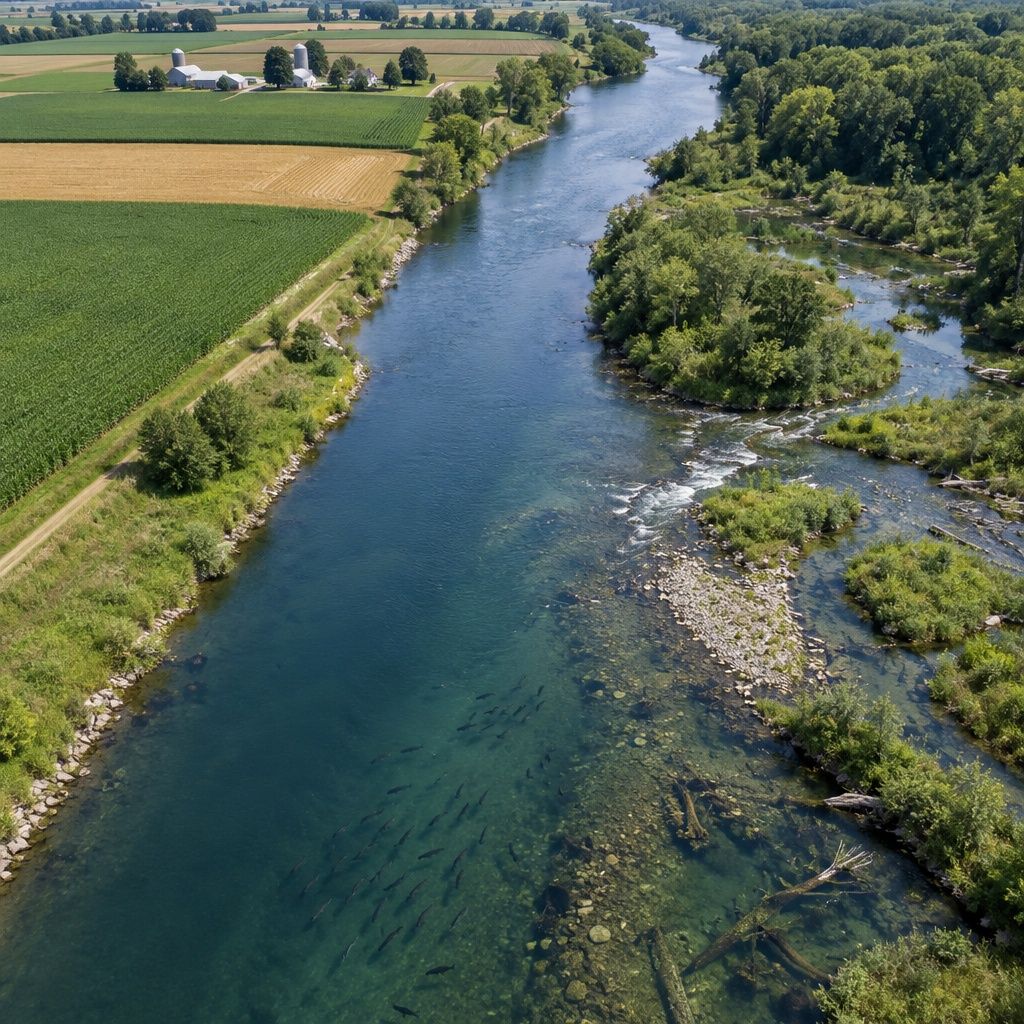
California is again at a crossroads in its water law and policy. The competing interests are not new. For decades, two sides have clashed over the allocation of water. On one side are those relentlessly pressing to steer streamflows and reservoir supplies from people and farms to fisheries and their ecosystems. On the other are those who supply water to those same people and farms and ardently oppose the singular focus on commandeering their water as "flow" for fisheries without addressing other causes of decline. This conflict breeds perpetual uncertainty that disrupts the planning required to support the houses we need, the food we eat and the environment we seek to protect.
It is not new that one side prioritizes adaptive management and flexibility while the other requires certainty. However, it is not now, nor has it ever been, an either-or situation. While such characterizations as "fish v. farms" drive clicks, they fail to describe the real issue: the long-acknowledged and exacting standards of the supreme water law of the land, and whether it applies to the judicial, administrative and legislative branches of government.
It is not surprising that within five years of statehood, in Irwin v. Phillips, the California Supreme Court easily sorted out that the state's water law must take notice of the condition of the territory that is subject to its rules. The "conditions" of California are diverse. There are large streams meandering through vast watersheds, mountains, prairies, coastal plains, and high and low deserts with ephemeral streams. There are also a world-class economy, farms to feed a nation and 40 million people.
Despite early doctrinal conflicts, California found its way. Splitting a baby was never a prescription for survival. Instead, we learned that a single legal framework was necessary for all physical, social and economic conditions and circumstances. This law must be sufficiently certain to enable wise, consistent and predictable decision-making and spur investment. The law also must be sufficiently flexible and adaptive to adjust to facts and circumstances.
In 1928, these considerations came together in the voter-led constitutional amendment, Article X, section 2. The enactment was as profound in its respect for property rights in water as it was in commanding that beneficial use must be pursued "to the fullest extent of which they are capable" under reasonable means. Waste and unreasonable use were prohibited. No use or right is exempt.
Five years later, in Gin Chow v. the City of Santa Barbara, the Supreme Court declared the amendment to be "the supreme law of the state, which the courts are bound to enforce, and made effectual in all cases and as to all rights not protected by other constitutional guaranties." The evaluation of beneficial purpose and what constitutes an unreasonable use was expressly, and without equivocation, held to be a judicial question dependent upon the facts and circumstances of each case. For over 98 years, this standard has been faithfully applied by the courts and withstood the test of time in vastly different circumstances all while honoring the rule of law and priorities among competing water right holders.
The list of beneficial uses has expanded gradually to the point that very little beyond drowning gophers has failed to meet the standard. But naming and even emphasizing beneficial use per se by the Legislature has had no influence on judicial allocation decisions.
Much more meaningful are the common-law property rights and public trust protections that lead to prima facie priorities, which must be put to the test of reasonable use under the facts and circumstances of each case. The standard is adaptive to hydrologic conditions and grows more exacting for consumptive users with the passage of time. Non-flow habitat improvements may improve temperature and habitat availability, reduce predation and lower mortality. We must continue to not only prefer but also insist that water be used efficiently and reused. In so doing, we can accommodate as many beneficial uses as possible.
One can see forthcoming applications of the constitutional amendment in addressing the labyrinth of the Northern California water system, the intricate relationship of streams, dams, conveyance systems and current efforts to regulate property rights through quasi-legislative action in the governor's newly approved Water Quality Control Plan for the Bay-Delta. Another recent suit pits the California Water Impact Network (CWIN) against the Department of Water Resources and alleges that the department's operations fail to comport with Article X, section 2, and cause harm to fisheries.
The public interest demands that all branches of government embrace evolutionary opportunities and demand greater efficiency as an inherent requirement of our property rights and in satisfying the needs for all beneficial uses. And where improvements to methods of use are identified, they can be required, even when beyond any individual's means, by embracing the "beneficiary pays" and "physical solution" approaches to finance such upgrades. It is noteworthy that this principle was successfully applied through agreement to achieve the conservation of 300,000 acre-feet within the Imperial Irrigation District 24 years ago.
Yes, the California Constitution may place burdens on the courts, a feature Gin Chow concluded they were uniquely qualified to undertake. Some cases may be complex and lengthy, yet befit the subject matter: dividing the state's most precious resource among deserving interests. Nothing about the profound consequences of these decisions lends itself to resolution by blunt instrument, convenience and expediency. Our experience has taught us that there are no shortcuts.
Submit your own column for publication to Diana Bosetti
For reprint rights or to order a copy of your photo:
Email
Jeremy_Ellis@dailyjournal.com
for prices.
Direct dial: 213-229-5424
Send a letter to the editor:
Email: letters@dailyjournal.com