


Alternative Dispute Resolution
Oct. 30, 2026
Must corporations be represented by counsel in California arbitrations?
Arbitration rules may allow parties to choose their representatives, but applicable law can limit that choice. For California attorney-arbitrators, permitting nonlawyer representation also raises questions about professional responsibility.



Jim Burgess
Jim Burgess is an arbitrator on the American Arbitration Association's Healthcare, Commercial and Consumer Panels.
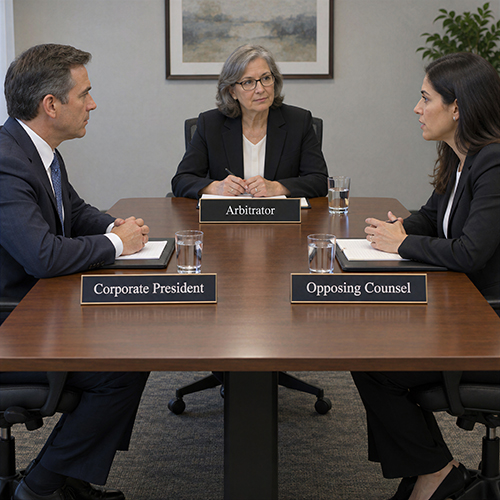
A corporation appears at an arbitration hearing through its president, who is not a lawyer. The president explains that the company cannot afford an attorney and that arbitration is supposed to be less expensive than litigation. The arbitration agreement incorporates rules allowing parties to appear without counsel.
Can the arbitrator permit a nonlawyer to represent the corporation? And, if the arbitrator is a California attorney, does permitting that representation risk violating the Rules of Professional Conduct?
The answers may not be as straightforward as some arbitrators and parties assume.
The American Arbitration Association's Commercial and Consumer Arbitration Rules permit parties to participate without representation or through a representative of their choosing, unless that choice is prohibited by applicable law. Some parties interpret these rules as permitting a corporation to appear through a corporate officer who is not an attorney. But the qualification concerning applicable law is important.
Can a corporation represent itself in arbitration?
California law has long prohibited corporations from representing themselves in courts of record through nonlawyer officers or employees. In Merco Construction Engineers, Inc. v. Municipal Court (1978) 21 Cal.3d 724, 730, the California Supreme Court explained that the Legislature cannot authorize a person who is not licensed to practice law to appear in a court of record on behalf of another person, including a corporation.
Similarly, in CLD Construction, Inc. v. City of San Ramon (2004) 120 Cal.App.4th 1141, 1145, the Court held that a corporation cannot represent itself in propria persona before courts of record or appear through a corporate officer, director or employee who is not an attorney.
Both decisions involved court proceedings. Do those prohibitions apply to private arbitration?
In Birbrower, Montalbano, Condon & Frank v. Superior Court (1998) 17 Cal.4th 119, the California Supreme Court considered whether out-of-state attorneys could perform legal services in connection with a California arbitration without being admitted to practice law in California.
The court relied on Business and Professions Code section 6125, which provided that "no person shall practice law in California unless the person is an active member of the State Bar." The law firm argued that the Supreme Court should recognize an exception for legal services incidental to private arbitration.
The Supreme Court rejected that argument:
"We decline Birbrower's invitation to craft an arbitration exception to section 6125's prohibition of the unlicensed practice of law in this state. Any exception for arbitration is best left to the Legislature." (Id. at pp. 133-134.)
The court also recognized that the Legislature had expressly permitted representation by nonlawyers in certain international commercial arbitrations. It observed that the Legislature had not enacted a similar general exception for private arbitration proceedings.
Following Birbrower, the Legislature amended Code of Civil Procedure section 1282.4 to permit out-of-state attorneys to represent parties in California arbitrations, subject to specified requirements.
Importantly, section 1282.4, subdivision (j)(3), preserved whatever rights parties possessed before Birbrower to select nonlawyer representatives in nonjudicial arbitration. But preserving existing rights does not establish that such rights existed, much less create a new right for a corporation to be represented by a nonlawyer in an ordinary commercial arbitration.
Although Birbrower did not directly decide whether a corporation must be represented by counsel in every domestic arbitration, its rejection of a general arbitration exception to the unauthorized practice of law strongly supports that conclusion.
Indeed, if California law restricts the ability of attorneys licensed in other states to represent parties in California arbitrations, it is difficult to see why corporate officers who are not licensed to practice law anywhere should have greater freedom to do so.
A recent appellate decision addresses the issue
In Home Designers & Contractors, Inc. v. Buono (Jan. 13, 2025, B327493) [nonpub. opn.], the Second District Court of Appeal considered a challenge to an arbitration award where the arbitrator had required a corporation to be represented by counsel rather than its nonlawyer corporate officer.
The corporation argued that the arbitrator exceeded his powers by refusing to allow its officer to represent it. The Court of Appeal rejected that argument.
After discussing Merco, CLD Construction and Birbrower, the court observed:
"Although an arbitral forum is not a 'court of record,' no statute or explicit public policy authorizes corporations to appear in arbitral fora without a licensed attorney."
The court further concluded that California's longstanding prohibition against nonlawyer corporate representation supported the arbitrator's decision to require counsel.
The Home Designers opinion is unpublished, so it is not precedential authority under California Rules of Court, rule 8.1115(a). Its holding was also limited. The court decided only that the arbitrator did not exceed his powers by requiring counsel. It did not hold that every arbitrator violates the law by allowing a corporation to appear through a nonlawyer.
Nevertheless, the decision is instructive. The appellate court found no statutory or public policy permitting a corporation to appear in arbitration through a nonlawyer. A future court or the State Bar likely will find that parties cannot effectively contract around the requirement that a corporation be represented by a lawyer by opting for arbitration.
What does this mean for California attorneys serving as arbitrators?
This issue implicates the duties of California attorneys acting as arbitrators under the Rules of Professional Conduct.
Rule 5.5(a)(2) provides that a California lawyer shall not "knowingly assist a person in the unauthorized practice of law in that jurisdiction."
Rule 2.4 expressly recognizes the role of lawyers serving as third-party neutrals, and California's Ethics Standards for Neutral Arbitrators impose additional obligations.
Standard 13(a) requires an arbitrator to conduct proceedings fairly, promptly and diligently, and in accordance with applicable law governing arbitration proceedings.
A California attorney-arbitrator who knows that a corporation is appearing through a nonlawyer officer faces potential professional responsibility risks if it turns out that the nonlawyer's conduct constitutes the unauthorized practice of law. If the arbitrator knowingly permits that representation to continue, the arbitrator risks a finding that doing so assists in the unauthorized practice of law in violation of Rule 5.5.
The fact that the issue has not been resolved definitively is little comfort for the first arbitrator to face a disciplinary proceeding.
The problem is particularly acute when the arbitrator is aware of the prohibition against nonlawyer corporate representation in court proceedings, the Supreme Court's reasoning in Birbrower, and the appellate court's analysis in Home Designers.
The arbitrator may believe that allowing the corporate officer to proceed promotes efficiency or reduces costs. But arbitration's procedural flexibility does not authorize conduct that would otherwise constitute the unauthorized practice of law.
If permitting the representation constitutes knowing assistance in the unauthorized practice of law, the arbitrator may face professional responsibility consequences independent of whether the resulting award is enforceable.
Why take the risk?
What should arbitrators do?
The better practice is to address corporate representation at the outset of the arbitration, preferably during the first preliminary scheduling conference.
California attorney-arbitrators should determine whether a corporation is represented by appropriately authorized counsel or whether a recognized statutory exception exists.
If the corporation proposes to appear through an out-of-state attorney, the arbitrator should confirm compliance with Code of Civil Procedure section 1282.4 and the applicable Out-of-State Attorney Arbitration Counsel requirements.
If the corporation proposes to appear through a nonlawyer officer or employee, and no recognized exception applies, the arbitrator should require the corporation to retain counsel.
That does not mean that the corporation should automatically be excluded from the proceedings or subjected to an adverse award. A reasonable continuance to obtain counsel likely would be appropriate and perhaps even mandatory.
Of course, an arbitrator need not tolerate repeated delays or deliberate noncompliance. But the objective should be to ensure lawful representation while preserving fairness and efficiency.
The better course
California appellate courts have not definitively resolved whether corporations must be represented by licensed counsel in every domestic arbitration. Nevertheless, the existing authorities strongly support requiring counsel in ordinary commercial arbitrations.
Requiring counsel may increase arbitration costs, particularly for small businesses. But reducing costs does not justify disregarding applicable law. Indeed, proper representation may ultimately promote both efficiency and fairness.
Until the law is clarified, California attorney-arbitrators should require corporations to appear through appropriately authorized counsel, absent a recognized exception. The risk of disciplinary action may be low, but it is not negligible.
And it is entirely avoidable.
Submit your own column for publication to Diana Bosetti
For reprint rights or to order a copy of your photo:
Email
Jeremy_Ellis@dailyjournal.com
for prices.
Direct dial: 213-229-5424
Send a letter to the editor:
Email: letters@dailyjournal.com