


Oct. 14, 2026
Casting a wide net: Litigation generalization in an age of specialization
See more on Casting a wide net: Litigation generalization in an age of specializationA broad and diverse litigation practice sharpens legal judgment, strengthens courtroom advocacy and prepares trial lawyers to meet clients' most complex, high-stakes challenges.



Stephen G. Larson
Partner
Larson LLP
Phone: (213) 436-4864
Email: slarson@larsonllp.com
USC Law School; Los Angeles CA
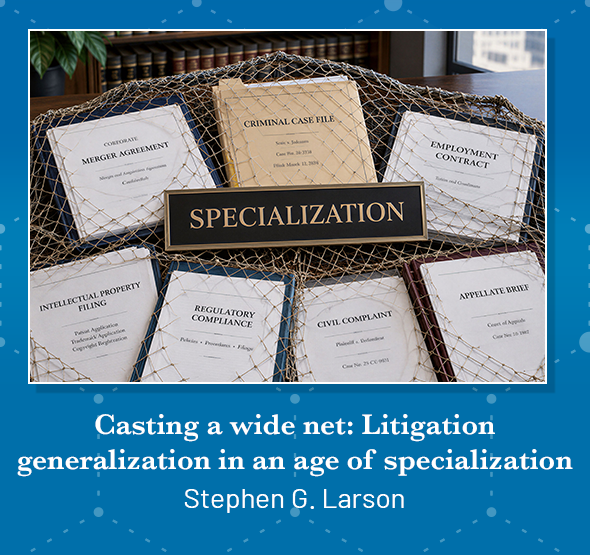
Ten years ago, we founded a litigation firm on the theory that clients benefit most when lawyers share a deep commitment to courtroom advocacy and possess a breadth of courtroom experience. There is an important role for lawyers who specialize and develop significant expertise--we regularly work with specialists whose knowledge is essential to particular matters--but there is also a need for trial lawyers and appellate advocates who have developed their legal judgment through an expansive legal background and a wide variety of adversarial experiences.
This philosophy supports a generalist approach to litigation, emphasizing diverse backgrounds, extensive hands-on courtroom experience and the rhetorical and analytical skills required to effectively present a client's case in court.
This approach to team building has been shaped by my own career. Early on, I served for nearly a decade as an assistant U.S. attorney in Los Angeles working in the Organized Crime Section, then called the Organized Crime Strike Force. Rather unusual within the Justice Department at the time, the Strike Force, instead of focusing on a particular crime or group of crimes, addressed various criminal enterprises (La Cosa Nostra, Chinese triads, Russian organized crime, etc.) engaged in a wide range of offenses: tax evasion, murder, money laundering, extortion, insurance fraud, illegal gambling, and public corruption--a list as long as the number of RICO predicates.
That early experience handling diverse matters was not unlike the even broader range of cases I adjudicated during my decade on the federal bench, where the docket included civil and criminal cases, matters raising federal or constitutional questions, diversity cases based on state law, and petitions and appeals. Together, those 20 years of government service in the Central District's federal courthouses shaped my understanding of what makes a good trial lawyer, an effective law firm, and an enjoyable law practice. A common thread is diversity of experience.
Surmounting challenges and addressing priorities across a broad array of clients, industries, and forums can help attorneys understand what matters most to the clients for whom they advocate and the courts and decision-makers before whom they appear. In many ways, attorneys with diverse experience can better anticipate what comes next and better ensure successfully achieving each client's ultimate objectives.
Beyond that, having a broad and varied practice can make for a more interesting and fulfilling litigation practice. Each engagement can bring a new mountain to summit rather than the same peaks and the same views. Every matter presents an opportunity to deepen knowledge and broaden perspective. Each time lawyers apply their experience to something new, it sharpens their judgment and strengthens their effectiveness.
Increasingly, clients in true existential or bet-the-company disputes want to know that their attorneys have the experience and aptitude necessary to go to trial. They want lawyers who are prepared to address not just some of their legal challenges, but all of them. In support of that effort, a firm culture that emphasizes courtroom experience and trial skills can be invaluable.
Building that culture must be intentional. Mentorship, collaboration and learning by doing are critical. Lawyers cannot develop all the skills required of a trial advocate from behind a video screen, which makes frequent, direct interaction between early-career attorneys and experienced lawyers important. Younger attorneys also need opportunities to assume meaningful responsibility early in their careers and to contribute their perspectives to case strategy.
A culture that values those contributions can help attorneys develop broad experience and strong courtroom skills while giving them the capacity to handle complex matters holistically. Often, clients are not just facing a civil claim, a criminal charge or a complicated regulatory issue--they may be facing all three at once, sometimes in multiple forums. Attorneys with diverse experience and a readiness to advocate in different venues can help address those challenges with an eye toward the bigger picture.
A decade of experience has reinforced my belief that comprehensive experience, a passion for the courtroom, and meaningful mentorship are important ingredients in developing effective trial lawyers. Building that kind of practice requires giving attorneys opportunities to confront unfamiliar issues, learn from experienced colleagues and take meaningful responsibility for their work.
The goal should be to create an environment where talented attorneys can develop into capable trial lawyers and where clients can find steady counsel when the stakes are highest. For litigation boutiques, maintaining that focus as they grow may be just as important as growth itself.
Stephen G. Larson is a partner at Larson LLP.
For reprint rights or to order a copy of your photo:
Email
Jeremy_Ellis@dailyjournal.com
for prices.
Direct dial: 213-229-5424
Send a letter to the editor:
Email: letters@dailyjournal.com