


Oct. 13, 2026
Martinez's eviction ruling reaches high court ahead of retention vote
Presiding Justice Gonzalo C. Martinez, Jr., whose L.A. eviction ruling is before the California Supreme Court, has written opinions on government authority, consumer fees and environmental review as he faces voters Nov. 3.


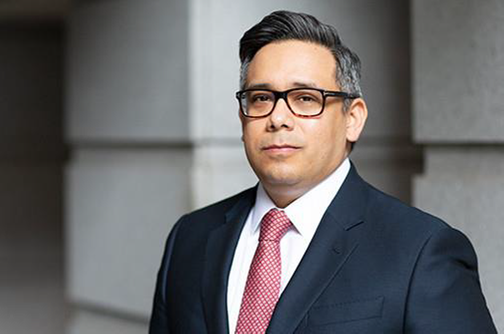
Los Angeles can bar landlords from evicting tenants who owe less than a month's rent, Presiding Justice Gonzalo C. Martinez, Jr.,of the 2nd District Court of Appeal ruled, rejecting apartment owners' argument that state law forbids it. The California Supreme Court is now reviewing that decision as Martinez seeks voters' approval of a full 12-year term.
Writing for Division 7 in Apartment Assn. of Los Angeles County, Inc. v. City of Los Angeles (2026), Martinez held that the state Unlawful Detainer Act does not preempt the city's Eviction Threshold Ordinance. The Supreme Court granted review Aug. 27 to decide whether state law preempts such a local limit on evictions for unpaid rent.
Martinez joined the appellate court in 2023 and became the division's presiding justice in 2024. Before that, he spent four years helping choose the state's judges as Gov. Gavin Newsom's deputy judicial appointments secretary.
The landlords argued the ordinance was a disguised extension of the three-day notice required before suing for unpaid rent. Relying on Birkenfeld v. City of Berkeley (1976), Martinez distinguished between procedural barriers to court and local restrictions on the grounds for eviction. While the ordinance may delay property owners getting nonpaying tenants out, it "does not extend the statutory timeline or add steps before filing, he wrote; it establishes when a cause of action exists."
The association warned that the same reasoning could allow Los Angeles to bar nonpayment evictions altogether. That question "is not before us," Martinez wrote.
Martinez's other opinions also examine what the law requires of government agencies, employers and businesses -- and whether they have done enough to meet it.
An environmental challenge to a 19,000-home Antelope Valley development turned on what Los Angeles County claimed about greenhouse gas emissions. In Center for Biological Diversity v. County of Los Angeles (2025), Martinez upheld an order setting aside approval of Tejon Ranch Co.'s Centennial project, rejecting the environmental impact report's reliance on the state cap-and-trade program to offset about 96% of the project's emissions. He also found its one-paragraph treatment of off-site wildfire risk inadequate.
A labor dispute turned instead on what the union had given up -- or had not. Martinez found that Los Angeles County must bargain over its decision to outsource security work at the Kenneth Hahn Hall of Administration, ruling that contract language covering "any reorganization" too vague to waive the union's statutory bargaining rights. Los Angeles County Professional Peace Officers Assn. v. County of Los Angeles (2026).
He likewise looked beyond disclosure itself in a class action over "energy" and "environmental" fees of about $30 each per concrete delivery. Although the charges were disclosed, "a reasonable consumer would likely be surprised to learn" they were pure profit, as alleged, Martinez wrote in reviving the suit. Sepanossian v. National Ready Mix Concrete Co. (2023).
After Harvard Law School, Martinez practiced at several firms before becoming a partner and certified appellate specialist at Squire Patton Boggs, where he worked on Plata v. Brown, the long-running litigation over prison mental healthcare.
As a deputy state solicitor general, he represented California before the state and U.S. supreme courts. He later promoted a judicial mentorship program in Newsom's appointments office aimed at broadening the judicial applicant pool.
Martinez has served as a lawyer representative to the 9th U.S. Circuit Judicial Council and was elected to the American Law Institute in 2025.
He clerked for U.S. District Judges Maxine M. Chesney in San Francisco and Anthony W. Ishii in Fresno, an experience that exposed him to "two vastly different parts of California," he told the Daily Journal in 2022.
"I learned how hard judges work to get it right."
Laurinda Keys
laurinda_keys@dailyjournal.com
For reprint rights or to order a copy of your photo:
Email
Jeremy_Ellis@dailyjournal.com
for prices.
Direct dial: 213-229-5424
Send a letter to the editor:
Email: letters@dailyjournal.com