


Ethics/Professional Responsibility
Oct. 13, 2026
Persuasion techniques: AI shortcuts put conscientious lawyering to the test
Preventing AI-generated citation errors requires more than checking sources--it demands conscientious legal practice grounded in attention to detail, integrity, commitment, consistency and credibility.


Christopher Frost
Trial Litigator, Law Professor, and the Founding and Name Partner
FROST LLP
Email: chris@frostllp.com
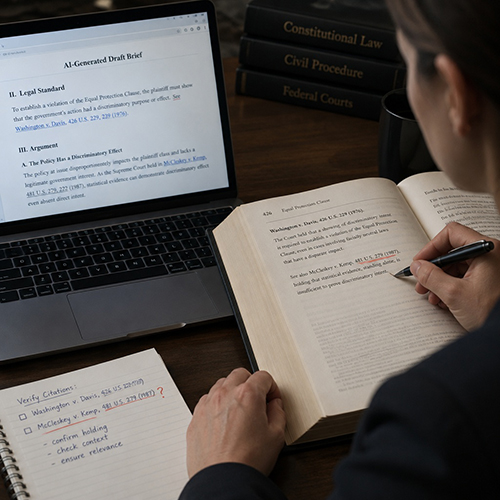
With all the recent headlines about AI-hallucinated citations in legal briefing, and the increasing punishments for such misuse, it is remarkable that the practice continues. We've heard a variety of explanations: "AI is not ready for prime time." "I was in a hurry." "I assumed a colleague checked the citations." This could be a starting point for a larger conversation about the race to benefit from AI's efficiencies and how best to safeguard against the risks. But the larger conversation I'd like to have is one about conscientious practice.
"Conscientiousness" is credibly defined as "the quality of desiring to do one's work well and thoroughly." (Yes, I, too, obtained that definition through AI, but I am quite sure it is accurate.) It is often characterized by:
Attention to detail. A conscientious practice requires attention to the most intricate of details. Often a case will rise and fall on a single theory, factual dispute, or even document or argument. Understanding the intricacies of each case is important to make the best and most well-founded arguments on behalf of a client. And as simple as this principle may seem, it is often the hardest to put into practice. It requires a meticulous focus that can be lost when we rely on others or simply overwhelm ourselves with so many "files" that we lose the time to develop a deeper understanding of each file.
Integrity. Integrity requires, among other things, respect for the rule of law and the magnitude of each representation you undertake. We operate in the confines of: (i) upholding the rule of law or (ii) advocating good faith arguments for extension or change of the rule of law. In a society where many seek to undermine the rule of law, we are sworn to be its torchbearers. We operate in a system that only stands so long as people uphold and support it.
Commitment. In a legal setting, commitment requires, among other things, striving to perform at the highest level for the sake of the client. No matter how many files we may have on our literal and proverbial desks, conscientiousness requires understanding that, to each client, their legal situation is our most important one. Each file deserves that level of attention. It is also important to remember that the commitment is not just to the "file" itself, but to the client. Clients know when they are merely a means to an invoice. Focus on the overall business or situational needs of a client, and develop an understanding of how their particular legal situation can be resolved within that global world view rather than simply focusing on how to "win" a singular dispute. "Winning the battle, but losing the war," is trite and overused, but still saliently true.
Consistency: It has often been said (and attributed to many) that it takes 20 years to develop a reputation, and five minutes to ruin it. This is true of both personal and professional settings. And as unfair as the concept may seem, the most elegant solution is to practice with consistency. Respond to every client; practice as if each file is your only one; show the same integrity and commitment in every matter you handle.
Credibility: Practicing conscientiously requires understanding that every argument we advance, along with the details and manner of our practice, reflects upon us as individuals and entities. For as many lawyers are licensed to practice law in California, we still swim in a relatively small pond. We often see the same judges, opposing counsel, and even parties. Short interactions can result in long consequences.
This is where we come back to the AI hallucinations example. What so many people miss is the "macro" in this "micro" conversation. By focusing on the excuses, we lose sight of the larger picture: that the hallucinations would never have occurred had we taken the time to research the actual case law itself and to delve into the deeper analysis of the salient legal issues. The "macro" point of a legal citation is not to find "a case" that stands for a particular sound bite, but to develop a deeper understanding of the rule of law in the particular context of a specific dispute. By simply citing to an AI-generated case, we are abdicating our greater responsibility to holistically understanding legal arguments and authorities for the sake of a quick turn of a brief.
The hallucination citation issue is not the end-goal of this article. The more salient point to understand is the importance of taking pride in one's work, for all the reasons discussed above. AI is here to stay, but it is a tool for improving efficiency, not a replacement for sound judgment, discretion and commitment to a client and the rule of law.
Submit your own column for publication to Diana Bosetti
For reprint rights or to order a copy of your photo:
Email
Jeremy_Ellis@dailyjournal.com
for prices.
Direct dial: 213-229-5424
Send a letter to the editor:
Email: letters@dailyjournal.com