


Ethics/Professional Responsibility
Oct. 6, 2026
California keeps AI in the passenger seat
Practicing law requires intelligent use of artificial assistance. SB 574, now the law, provides guidelines and guardrails.


Wendy L. Patrick
Wendy is a California lawyer, past chair and advisor of the California State Bar Ethics Committee (Committee on Professional Responsibility and Conduct), and past chair of the San Diego County Bar Association Legal Ethics Committee. Any opinions expressed here are her own, and do not reflect that of her employer. This article does not constitute legal advice.
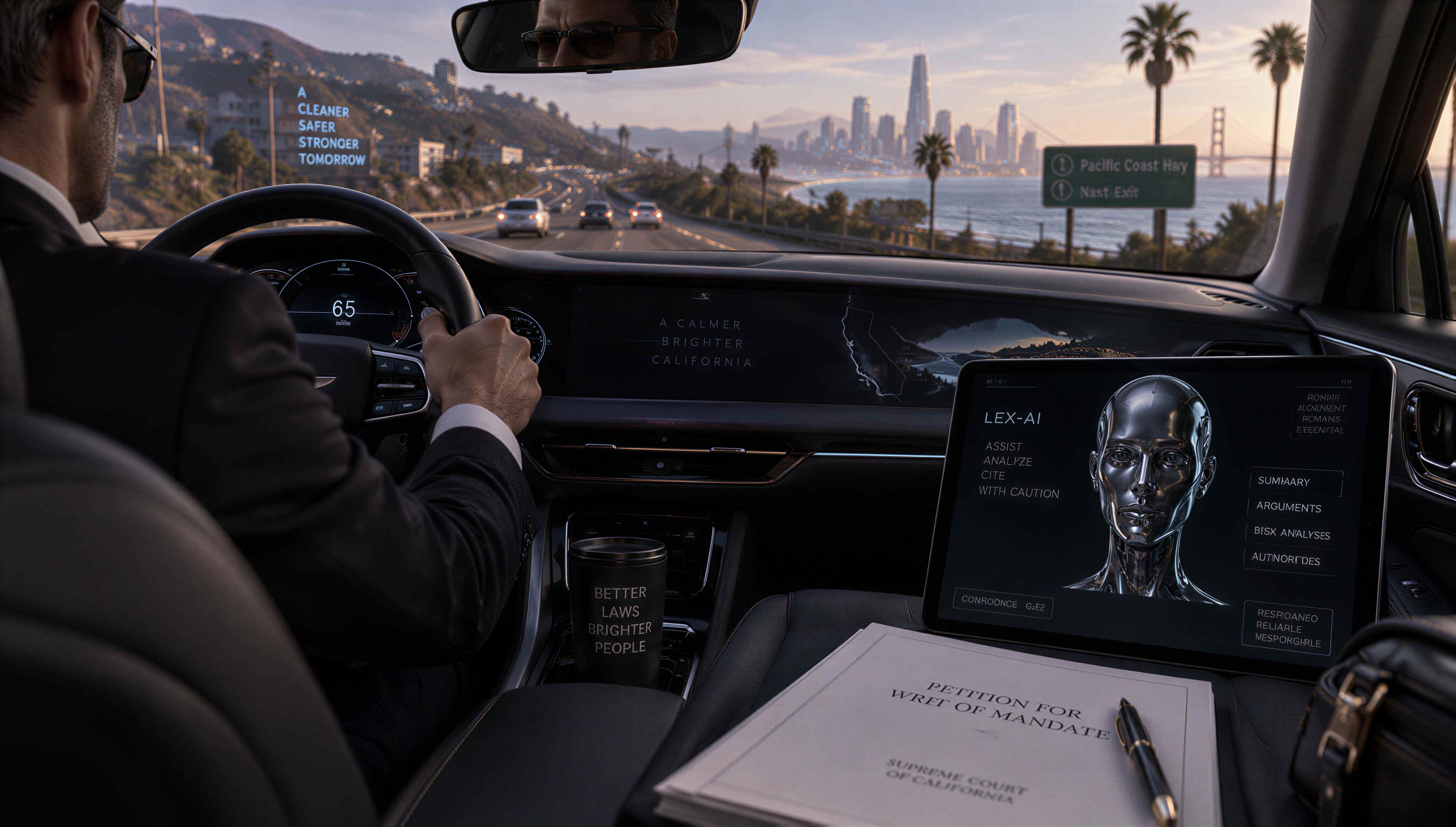
California has officially racked up another first-of-its-kind law, this one governing the way lawyers do business and showcase their work. On Sept. 30, 2026, Gov. Gavin Newsom signed SB 574 into law, first-in-the-nation legislation that regulates the use of generative artificial intelligence in legal work. Expanding on state court rules, it prohibits lawyers from delegating the practice of law to AI, restricts the sharing of confidential information with AI and imposes new disclosure requirements. Having spent the last few years reading about false case law citations, awkward in-court admissions and sometimes hefty sanctions, many lawyers welcome these new California legal requirements. The new law may also serve as a model for the rest of the nation.
Formal codification of AI rules and regulations seeks to ensure that lawyers, arbitrators, mediators and judges remain able to use AI in their work without running afoul of applicable ethical rules. Considering that many high-profile court sanctions have stemmed not only from AI use but also from attorneys' failure to check citations or read hallucinated cases--and their subsequent attempts to defend those failures--SB 574's language provides a welcome, consistent standard upon which to ground future motions and legal research.
The trend toward transparency
One of the primary measures addressed in the new law is attorney transparency. SB 574 requires lawyers to verify all citations before filing documents in court, including citations generated by AI tools, and requires at least one attorney to sign every paper filed in court in the attorney's individual name when representing a client. This requirement emphasizes the push for accountability when integrating AI tools into the practice of law, including when drafting briefs and other legal documents requiring specialized research.
SB 574 also covers work done by arbitrators under the California Arbitration Act, which provides a statutory framework for contractual arbitration in California. Specifically, it prohibits an arbitrator from delegating "any part of their decision-making process" to any type of generative artificial intelligence tool and prohibits an arbitrator from relying on AI-generated information outside the record without first making appropriate disclosures to the parties.
Regarding judges, SB 574 requires the Judicial Council to reconsider existing standards of judicial administration to incorporate any changes that may be necessary in light of the ongoing development of generative artificial intelligence.
New code sections govern some of the specifics.
SB 574 sections create safeguards
SB 574 adds several important sections to California law to help lawyers, judges, arbitrators and mediators (covered in Section 2 which amends Section 6173 of the Business and Professions Code) know exactly how they must handle their use of generative AI.
Section 1 adds Section 6068.1 to the Business and Professions Code. This section codifies requirements that attorneys do not delegate the practice of law to generative artificial intelligence (section (a)(2)), refrain from sharing personally identifiable, confidential or other nonpublic information with AI (section (a)(3)(A)) and verify the accuracy of generative artificial intelligence results. Beyond verifying accuracy, section (a)(3)(B) requires lawyers to correct any results that turn out to have been "hallucinated," and section (a)(3)(C) requires lawyers to disclose to the court that they have used generative artificial intelligence in creating documents.
Business and Professions Code Section 6068.1(b)(1) defines generative artificial intelligence as AI that can generate "derived synthetic content", including images, video, text and audio, that "emulates the structure and characteristics of the system's training data."
Section 3 of the law amends Section 128.7 of the Code of Civil Procedure, including, among other provisions, a requirement that petitions, pleadings, written notices of motions and similar papers filed on behalf of a client be signed by at least one attorney of record in the attorney's individual name.
Section 128.7(b)(2) requires that a paper filed in court not include unverified citations, including any citation "provided by generative artificial intelligence". The term is defined in paragraph (b)(2)(B) in the same manner as in Business and Professions Code Section 6068.1(b)(1).
Section 4 adds Section 180 to the Code of Civil Procedure to require the Judicial Council to publicly revisit and revise, as necessary, Standard 10.80 of the California Standards of Judicial Administration to incorporate any changes deemed necessary to address the evolution and use of generative artificial intelligence.
Section 5 adds Section 1282.1 to the Code of Civil Procedure. Section (b)(1) provides that an arbitrator may not delegate any part of the arbitrator's independent decision-making to generative artificial intelligence. Paragraph (b)(2) prohibits an arbitrator from relying on AI-generated information outside the record without making appropriate disclosures to the parties in advance and allowing the parties to comment on its use.
The future of AI in the law
SB 574 is a formalized recitation of the trajectory already in place in the legal profession through requirements imposed by courts and the California State Bar, seeking to provide guidance on the front end before allegations of misconduct arise. As lawyers and courts navigate this brave new frontier together, transparency will likely remain a priority because, when it comes to the use of new technology, it is always better to disclose and discuss. As AI continues to evolve in both its capabilities and speed, ethical AI rules will no doubt continue to keep pace.
Submit your own column for publication to Diana Bosetti
For reprint rights or to order a copy of your photo:
Email
Jeremy_Ellis@dailyjournal.com
for prices.
Direct dial: 213-229-5424
Send a letter to the editor:
Email: letters@dailyjournal.com