


Judges and Judiciary
Aug. 28, 2026
Keep humans on the bench
As courts experiment with AI-generated rulings, the push for efficiency is raising concerns about judicial independence, transparency and the role of human judgment.



John J. Kralik
Judge (ret.)
University of Michigan Law School, 1979
John J. Kralik has been a judge of the Los Angeles County Superior Court for sixteen years. He is the author of "A Simple Act of Gratitude," a memoir, and "Three Bodies by the River," a novel. For further information, see www.johnjkralik.com.
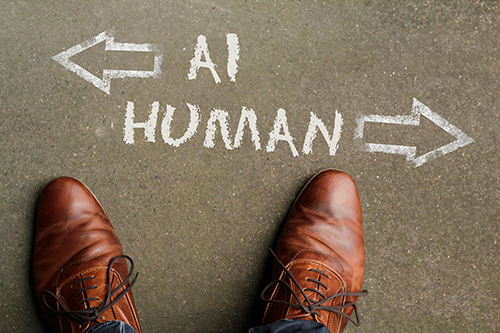
The March 18, 2026, headline in the Los Angeles Times jolted me out of the quiet ease of retirement. I was debating whether I really wanted to learn pickleball when I read that an "AI Pilot Program" was being used to "Help Judges Craft Rulings." I had thought we had more time before computers replaced judges and law clerks, but apparently that moment has arrived.
According to the Times, some judges have been using an artificial intelligence supported program called "Learned Hand," in apparent homage to the esteemed justice who bore that name, to craft tentative rulings. According to the Learned Hand website, judges upload case documents, and the program "maps" issues, "structures" arguments and "surfaces" disputed facts. It can handle motions for summary judgment, motions in limine and post-conviction relief. It then produces what the company now carefully calls a "first draft" of a tentative ruling or order. And don't worry, it's "built for impartiality."
Court officials have emphasized that judges are required to review and edit the drafts. The presiding judge has assured everyone that Learned Hand "will not replace, or in any way compromise, the sanctity, independence, and impartiality of judicial decision making."
Others are not so sure. District Attorney Nathan Hochman expressed concern that reviewing computer-generated tentative rulings could "predispose" a judge to the result. An anonymous judge similarly worried that an AI-generated ruling could become a psychological anchor that a judge would then have to overcome.
I worry, too, that judges felt they needed anonymity to say so. Judges, so long as they do it with proper decorum, can speak out on matters concerning the law, the legal system and the administration of justice. If judges cannot defend the importance of their humanity in factual determination, legal analysis and decision making, then who will?
That Times headline has continued to nag at my conscience. Each day's news reinforces the notion that we have reached a critical crossroads where AI can do many jobs humans once did. Neither earning a degree nor working in a profession for a lifetime will protect you from being replaced by a computer program. Executives, pastors and doctors are cloning themselves in the name of efficiency. As Kurt Vonnegut predicted in his 1952 novel, Player Piano, judges and lawyers turn out to be easier for computers to replace than barbers and plumbers.
It is no longer a question of whether computers can do our jobs, in some cases better than we can. We must now address the extent to which we will allow them to do so.
Someone needs to speak up. Mark Zuckerberg recently wrote that AI will soon give the public "superintelligent lawyers." How long will the public tolerate human judges if superintelligent ones are available?
Someone needs to say how important it is that human beings hear the evidence, read the law, analyze how it applies to the facts and make their own independent decisions. Since I can no longer be reassigned to a court far from home, I have no excuse for not rising to the defense of the idea that human judges have a constitutional duty to do the job of judging.
Even if people prefer the "superintelligent" judges that AI is developing, the law requires that humans do the job, at least for now. Under the California Constitution, Art. VI, § 15, judges are persons and must be members of the bar or former judges. Whether they do it in open court or in chambers, judges "hear" and have a "duty" to decide cases. Cal. Civ. Proc. Code §§ 166, 170. Thus, for now, the law provides the answer. Judging is a job limited to humans.
A human judge has weaknesses that a computer program does not. In real life, we get tired and impatient. We get old. We have predilections based on experience that some view as "bias" or "prejudice." We make mistakes, even stupid mistakes that AI might not make. We believe some people we should not believe and doubt some people we should believe.
But because we sit out in the open, we must personally defend our opinions and analysis. Our fallibility is on full display. We can be corrected by the Courts of Appeal and brought up on charges before the Commission on Judicial Performance.
Human judges also have strengths that will never be totally duplicated by a machine because many of our human qualities are rooted in our human weaknesses. We can be moved to tears or laughter. We can be humbled by our shortcomings. We can show mercy. We have mentors, friends and families who can keep us from veering down the wrong path. When the law does not seem to provide the right answer from the cases cited, we can search more deeply for an answer that is more just. We have values shaped by a lifetime of experience. Most of us hold ourselves to account under a set of advanced ideals. Some of us even believe in an all-knowing and all-powerful God who will judge us by an even higher standard than the Courts of Appeal, the supervising judge or the Commission on Judicial Performance.
Apparently one objective of Learned Hand is to achieve uniformity in judicial decision making. As its CEO stated in the Daily Journal, "The hope is that you should get the same justice in Richmond, Virginia as you do in Richmond, California."
In my aging opinion, lack of independent thinking is a more critical problem than lack of conformity.
Moreover, the development of the law requires innovative thinking that often cannot be found in existing statutes or case law. The historical Learned Hand, for example, was distinguished by more than his eyebrows. He could be innovative and creatively thoughtful. In United States v. Carroll Towing Co., 159 F.2d 169 (2d Cir. 1947), he used an algebraic formula to resolve the extent of a barge owner's duty to keep a responsible crewman on board. Maybe there will be an AI agent that can be that innovative someday, probably someday soon, but what will be its political and ideological motivations?
Trial judges regularly confront situations for which there is no clearly established ruling. Do we really want all of them to view those situations the same way? Each trial judge may view a new situation differently, and that diversity of perspectives contributes to making the eventual holding of the common law a more informed resolution of those viewpoints.
And what if the program misreads a case? Treatises, appellate opinions and party-drafted briefs often overstate holdings or rely on dicta. Different readers can come away from the same opinion with different views of what is holding and what is dicta. It seems dangerous to delegate that reading to an AI program with its own, presumably consistent, interpretation.
What if it is flat-out wrong? Do we want a programming error to permeate an entire trial court?
The claim that AI can be "built for impartiality" also seems naïve to me. Who is the judge of the AI's "impartiality"? The programmers? And who are they? Are they really impartial, or are they themselves biased? Learned Hand reportedly uses a combination of language models from Anthropic, OpenAI and Google. How would impartiality even be measured? At least a human judge can be criticized and held to account for being partial, but how does a litigant find the programmers?
Learned Hand's CEO analogizes the product to a law clerk, describing it as a digital law clerk for judges who cannot afford a real one. But a law clerk -- in Los Angeles we call them research attorneys when they are members of the bar -- is, thankfully, still a human being.
A research attorney works under the direct supervision of a judge, who can train that attorney to implement the judge's approach. The research attorney can be ignored or reassigned when the work is unsatisfactory. I have had research attorneys whose work I discarded on the theory that I didn't need a third bad brief to help me with the other two. Others earned my trust. My last research attorney developed her approach based on her knowledge of my viewpoints. She operated as an extension of my unique approach, not that of every other judge.
The concerns about Learned Hand are being met with the claim that the system is only being tested. But that raises another question: Why are the courts paying $300,000, not to mention providing access to court files and support personnel, to a private company to refine and test a product designed to do the work of judicial decision-making?
There is plenty of private capital being devoted to AI without help from taxpayers. If this is product testing, Learned Hand should be paying the court for its assistance, not the other way around.
The ultimate selling point is that the crushing workload of the courts makes products like Learned Hand necessary. But those who have made the policy choices contributing to that workload have a responsibility to provide courts with the resources necessary to handle it. That responsibility is not discharged by helping develop a computer program to mimic judicial decision making.
The solution is to hire and support enough human judges to decide the cases our policies have encouraged. It is not an exaggeration to say that at least 100 additional judges and justices are now necessary.
There are also a few policy decisions we can make right now. ADR Services Inc., with which I am affiliated, has recognized that publicly available AI programs tempt arbitrators to use them to draft orders. Its policy provides that a neutral will not delegate factual findings, legal conclusions, credibility determinations or award drafting to AI systems.
Courts should adopt similar principles.
First, courts should stop funding the development of programs designed to replace judicial decision making. Such technology will be developed without taxpayer assistance. Once developed, whether it should be deployed in courts should be a matter of openly debated public policy.
Second, a judge's use of any program that mimics judicial decision making should be disclosed to litigants. Parties should not be left wondering whether their ruling was truly drafted by the judge or by a computer program.
Third, no judge should be forced to use Learned Hand or any similar program. Judges must retain the discretion to put aside the technology and make decisions themselves.
Finally, judges should not use secretly developed programs that are unavailable to litigants and their attorneys. Computer programs have long assisted judicial analysis, but tools such as Westlaw and Lexis are available to litigants who want to check the judge's work. If an AI such as Learned Hand is going to influence judicial decisions, the process by which it was developed and the information that goes into it must be open to review and criticism.
The public should not be left wondering how secret algorithms are influencing a judge.
Submit your own column for publication to Diana Bosetti
For reprint rights or to order a copy of your photo:
Email
Jeremy_Ellis@dailyjournal.com
for prices.
Direct dial: 213-229-5424
Send a letter to the editor:
Email: letters@dailyjournal.com