


Constitutional Law
Aug. 18, 2026
The radicalism of Clarence Thomas
Justice Clarence Thomas has advanced a series of far-reaching constitutional positions that would significantly narrow federal protections and congressional authority, illustrating the potentially profound consequences of his originalist approach.


Erwin Chemerinsky
Dean and Jesse H. Choper Distinguished Professor of Law
UC Berkeley School of Law
Erwin's most recent book is "Worse Than Nothing: The Dangerous Fallacy of Originalism." He is also the author of "Closing the Courthouse," (Yale University Press 2017).
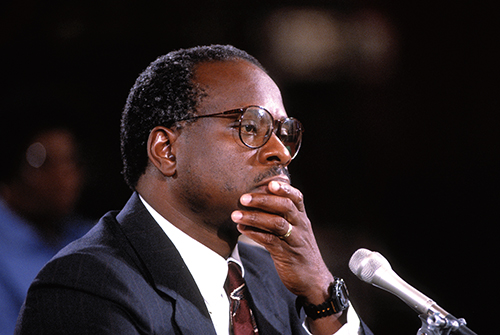
Among the stories from the Supreme Court's last term that have not received attention are the radical positions taken by Justice Clarence Thomas. Having been on the Court since 1991, everyone is used to his being very conservative, including his always voting in favor of President Donald Trump. Still, some of the positions he took last year were truly astounding and frightening.
For example, my biggest surprise in reading the decisions from last term was a concurring opinion by Thomas in Mullin v. Doe, arguing that equal protection does not apply to the federal government. The case involved Trump suspending Temporary Protected Status for individuals from Haiti and Syria. One of the issues in the case was whether this was based on race as to Haitians, with Justice Elena Kagan in dissent quoting statements from Trump that clearly expressed racial animus. Justice Samuel Alito wrote the majority opinion and said that there was no overt racism and that even if Trump expressed a racist motive, there was an adequate alternative explanation for the President's action.
Thomas, in his concurring opinion, said that equal protection does not apply to the federal government at all. He wrote: "Respondents' equal protection claim also has no basis in the Constitution. The Constitution has only one Equal Protection Clause, and it applies only to the 'State[s],' not the Federal Government." He said: "Because the Fifth Amendment has no Equal Protection Clause, this Court was wrong to read equal protection into it in Bolling v. Sharpe (1954)."
It is stunning to imagine that the Court would say that there is no constitutional limit on the federal government's ability to discriminate. Even before Bolling v. Sharpe, the Court assumed that equal protection applied to the federal government. Korematsu v. United States (1944) was tragically wrong in upholding the evacuation of Japanese Americans from the West Coast during World War II, but Justice Hugo Black's majority opinion left no doubt that it was applying equal protection to the federal government.
In Bolling v. Sharpe, a companion case to Brown v. Board of Education, the Court declared unconstitutional the segregation of the District of Columbia public schools. Chief Justice Earl Warren's opinion for a unanimous Court held that equal protection applies to the federal government through the Due Process Clause of the Fifth Amendment. Had it followed Thomas' reasoning, it would have ruled that segregated schools are unconstitutional when mandated by state governments, but constitutional when imposed by Congress.
Thomas is surely right in his assertion that the Fourteenth Amendment was originally meant to apply to the states and not to the federal government. But this is a powerful example of what is profoundly wrong with originalism.
Another example of Thomas taking a radical position was his repeated assertion that Congress, under its power to regulate interstate commerce, can only regulate commercial transactions and not activities that have a substantial effect on commerce. The Court has rejected that view, without exception, since 1937. It would make unconstitutional countless federal laws, including every federal environmental statute, most federal criminal laws, and federal regulations of everything from broadcasting to product safety.
In Monsanto Co. v. Durnell, the issue was whether a federal statute--the Federal Insecticide, Fungicide, and Rodenticide Act (FIFRA) --expressly preempts state tort liability based on a failure to warn theory. The case involved whether a cancer survivor could sue Monsanto for its marketing of the weedkiller, Roundup, and the failure to warn users of the cancer risk. The Supreme Court, in a 7-2 decision with the majority opinion written by Justice Brett Kavanaugh, found that the federal statute expressly preempted such state tort liability.
Thomas, in a concurring opinion, said that Congress lacked the power to adopt the federal statute. It is puzzling, then, why he found that it preempted the state tort law claim. He wrote that the commerce "power allows Congress to regulate 'selling, buying, and bartering' across state lines." "It does not allow Congress to regulate 'agriculture' or 'manufacturing,' activities entirely 'separate' from 'commerce.'" This is the approach the Supreme Court took in the early twentieth century in striking down many federal laws, but has expressly rejected without exception since 1937.
Thomas repeated this in United States v. Hemani. The case involved a federal statute, 18 U.S.C. Section 922(g)(3), which prohibits possession, use, reception, exportation, or sale of a firearm by anyone who "is an unlawful user of or addicted to any controlled substance." The Court unanimously declared it a violation of the Second Amendment to apply it to a person who admitted to regularly using marijuana.
Thomas wrote a concurring opinion in which he argued that Section 922 was unconstitutional as exceeding the scope of Congress's commerce power. He said, "§922(g)(3) appears to exceed Congress's enumerated power to regulate interstate commerce." He repeated his view that "the Commerce Clause authorizes Congress only 'to regulate the buying and selling of goods and services trafficked across state lines.'" This, of course, would make not only Section 922(g)(3) unconstitutional, but also the other provisions of the law, including provisions prohibiting felons from possessing guns and prohibiting gun possession by certain individuals subject to domestic violence restraining orders. No other justice since 1937 has taken such a radical, limited view of Congress's commerce power.
These, of course, are not the first instances of Thomas urging astounding changes in constitutional law. In a dissent in Garza v. Idaho (2018), Thomas said the Sixth Amendment does not require that government provide an attorney to a criminal defendant who cannot afford one. In 1932, in Powell v. Alabama, the Supreme Court held that a state is obligated to provide counsel to a criminal defendant facing a possible death sentence. In Gideon v. Wainwright (1962), the Court ruled that state governments must provide a lawyer to anyone being tried for a crime facing a possible prison sentence.
No one has questioned these landmark rulings. But Thomas argued in Garza v. Idaho that the Sixth Amendment simply means that a criminal defendant has the right to bring an attorney to court if he or she can afford one. He said the Sixth Amendment "ensures fairness in a single respect: permitting the accused to employ the services of any attorney." Thomas further argued that the Court was wrong in holding that ineffective assistance of counsel violates the Constitution.
Another example is that Thomas, alone among all justices who have served on the Supreme Court since 1947, has taken the position that the Establishment Clause of the First Amendment--the provision forbidding any law respecting the establishment of religion--does not apply to state and local governments. In Everson v. Board of Education (1947), the Court unanimously held that the Establishment Clause applies to state and local governments through the due process clause of the Fourteenth Amendment.
But Thomas has repeatedly argued that the Establishment Clause of the First Amendment should not apply to state and local governments. Thomas has said that the "Establishment Clause is a federalism provision, which, for this reason, resists incorporation." His view is that the Establishment Clause was meant to prevent the federal government from establishing a church that could rival state churches. He says that it was not meant to limit state and local governments. He wrote: "On its face, this provision places no limit on the States with regard to religion."
These are just a few examples of the many instances in which Thomas has urged radical changes in constitutional law. Because they are in concurring opinions joined by no other justice, it is easy to overlook them. But viewed together, they present a view of constitutional law that is truly frightening in what it would mean.
Submit your own column for publication to Diana Bosetti
For reprint rights or to order a copy of your photo:
Email
Jeremy_Ellis@dailyjournal.com
for prices.
Direct dial: 213-229-5424
Send a letter to the editor:
Email: letters@dailyjournal.com