


Labor/Employment,
Civil Litigation
Aug. 11, 2026
The safety valves are failing as ordinary cases produce extraordinary verdicts
Two verdicts, one summer: What Byrne v. Ameris Bank and Glick v. City of Los Angeles should teach every employment lawyer, mediator and GC.


Leonid M. Zilberman
Partner
Wilson Turner Kosmo LLP
Phone: (619) 236-9600
Email: lzilberman@wilsonturnerkosmo.com
Lonny practices employment law, diversity, equity, and inclusion as well as mediation and alternative dispute resolution and provides anti-harassment and other employment-related training to California Employers.
Every few years a verdict or appellate opinion comes along that detonates the legal assumptions we all keep in our back pockets like expired coupons. This summer, two of them arrived within three days of each other on opposite ends of the litigation lifecycle and merit both a postmortem and deeper dive because the lessons learned can inform lawyers on both sides of the "v" to obtain better outcomes.
On July 27, 2026, a Los Angeles federal jury's unanimous verdict against Ameris Bank was entered as a final judgment for $79,548,170.80 in Byrne v. Ameris Bank. Three days later, on July 30, the California Court of Appeal handed down Glick v. City of Los Angeles, reinstating a $13.1 million jury verdict that a trial judge had cut by 97% because emotional distress damages were "garden variety." Different courts, different theories, different defendants and yet together the cases read like a matched pair of cautionary tales, each one dismantling conventional wisdom about how "big" a case can get.
The $79.5 million judgment is a trial-court outcome, so the 9th Circuit could either affirm, reverse or send the case back. Glick, by contrast, is a published opinion from California's Second Appellate District, which will likely become the darling and new "hot citation" for any plaintiffs' lawyer at mediation starting next week, if not sooner.
The facts, stripped of drama
Patrick Byrne founded Balboa Capital, an equipment-finance company Ameris Bank bought in December 2021, retaining Byrne as CEO and layering in a Long-Term Cash Incentive Plan, which was essentially an earn-out dressed up as a bonus plan for all employees. Byrne came to believe Ameris was quietly recalibrating the metrics behind that plan for himself and other Balboa employees, in a way that happened to keep bonus payouts lower than the contract contemplated. He raised the issue. He was fired in June 2024, sued, and a federal jury handed him a clean sweep: wins on wrongful termination, whistleblower retaliation, unpaid wages and a finding of malice, oppression or fraud sufficient to support $62.9 million in punitive damages on top of $16.6 million in compensatory damages and penalties. These are claims more associated with minimum wage employees and not typical for a highly paid CEO.
Glick is a stranger case and more instructive reaffirming how damages are calculated. LAPD officers Stephen Glick and Alfred Garcia arrested a driver who later accused unknown officers of humiliating him in a holding cell. Internal Affairs searched the male officers' phones, lockers and cars more aggressively than their female partners' who had also been present and a police union representative was told, on the record, that the conduct was "something guys would do, not females." Glick and Garcia sued for gender discrimination and retaliation under FEHA but stipulated that they were claiming only "garden-variety" emotional distress without a psychiatric diagnosis, and no expert witnesses. A Los Angeles jury nonetheless awarded Glick $8.6 million and Garcia $4.5 million, for a combined $13.1 million. The trial judge thought that amount was absurd for undiagnosed distress and ordered a new trial unless the officers accepted a reduction to $250,000 and $125,000; a haircut of roughly 97%. Not surprisingly, they refused. Both sides appealed, and it took nearly three years for the Court of Appeal to reverse the trial judge, holding that California law "does not establish a numerical cap" for garden-variety emotional distress, that lay testimony alone can support an eight-figure award when the harm is within common jury experience, and that the trial judge had improperly substituted his own damages ceiling for the jury's discretion.
That three-year odyssey matters as much as the dollar figure. A verdict that looked, for a moment, like a defense, with a 97% reduction turned out to be nothing more than a very expensive three-year delay. The exposure the city thought it had negotiated down with a favorable trial judge came roaring back, with post-judgment interest and appellate costs riding along for the trip.
Four common assumptions we all make, now dead-on arrival
· "Federal court is safer." We remove cases to federal court like people who carry umbrellas, as a hedge against a storm we assume is worse elsewhere. The theory: federal juries, drawn from a wider and more conservative venire, with a judge appointed for life and a unanimous verdict requirement, are less prone to runaway verdicts than their state-court cousins. Byrne says the storm doesn't care what building you're standing in. The lesson isn't that federal court is bad--it's that venue is a variable, not outcome determinative.
· "Rich plaintiffs don't get sympathy." The conventional wisdom says jurors don't cry for a CEO. Nobody's starting a GoFundMe for the guy who used to run the company. But sympathy isn't about net worth, it's about narrative. Jurors don't punish wealth; they punish betrayal dressed up as legitimacy. A bank quietly moving the goalposts on a contractual bonus formula, then firing the man who caught it, isn't a story about an overpaid executive. It's a story about a company that cooks its books and then fires the accountant who noticed. That story plays in any courtroom, with any plaintiff, because it's really a story about the jury's own employer, their own paycheck, their own fear of being the next person shown the door for asking an inconvenient question.
· "Under-the-radar cases stay small." Byrne generated almost no press before verdict. Glick began as a single-week trial that nobody ever noticed until the Court of Appeal made it precedent three years later and that's when it made the front page. Neither case's obscurity predicted its size. These cases never trended. There were no salacious facts or #MeToo evidence. And yet Byrne, represented by a law firm that doesn't typically represent plaintiffs in employment cases, produced one of the largest employment verdicts of the year. The simple takeaway is that we cannot price cases as if "a quiet case means a safe case."
· "A 'garden-variety' stipulation caps exposure." This is the biggest assumption Glick killed. Defense lawyers encourage and often negotiate for a plaintiff's stipulation to garden-variety emotional distress, on the theory that it trades away expert testimony in exchange for an artificial ceiling on damages. Glick confirms there is no such ceiling. The stipulation limits how a plaintiff proves distress, not how much a jury can award for it once proven through ordinary human testimony about humiliation, sleepless nights or a marriage under strain.
The analogies every GC and defense lawyer needs to hear
Think of an incentive-compensation formula like a bank vault combination: you don't get to quietly change it after the customer has already made the deposit, then act surprised when the door won't open the way they expect. Ameris didn't just allegedly shortchange one executive, it allegedly recalibrated a formula touching 140-plus employees, then fired the one person who clearly had the most to lose, who said so out loud. That's not a pay dispute; it's a whistleblower case wearing a pay dispute's clothing, and juries can smell the difference.
"Garden-variety" is a phrase lawyers use as though it describes a size. It doesn't. It describes a category--ordinary, undiagnosed distress, as opposed to the clinically documented kind. Calling emotional distress garden-variety is like calling a tasting menu at a Michelin restaurant a "snack." The label tells you what's on the plate, not what the check will say. In Glick the Judge treated "garden-variety" as a price tag; the Court of Appeal reminded everyone it's just a menu category and the jury still sets the final price.
What this means for mediation
Since about 99% of cases go through mediation, somebody at Ameris Bank almost certainly saw a mediator's proposal before trial. My instinct, built on years of watching parties talk themselves into a verdict, says it wasn't Byrne who walked away from real money but rather the defense concluding a federal jury wouldn't buy a "retaliation theory" dressed as a compensation dispute. That's the single most expensive mistake a trial lawyer can make; mistaking confidence in your legal theory for the jury's willingness to believe it.
The City of Los Angeles ran a version of the same play twice. It presumably didn't settle Glick for what a jury eventually valued it at, and then--having lost at trial--it leaned on the trial judge's remittitur as a second bite at the apple instead of resolving the case for a reasonable amount. The Court of Appeal took that bite back, and added three years of interest, fees and appellate costs. A mediator's proposal and a remittitur motion serve the same psychological function: both let you defer accepting a number you don't like in the hope that some other authority will lower it for you. Glick is proof that the deferral itself carries a price, and that price compounds every year.
Practical takeaways
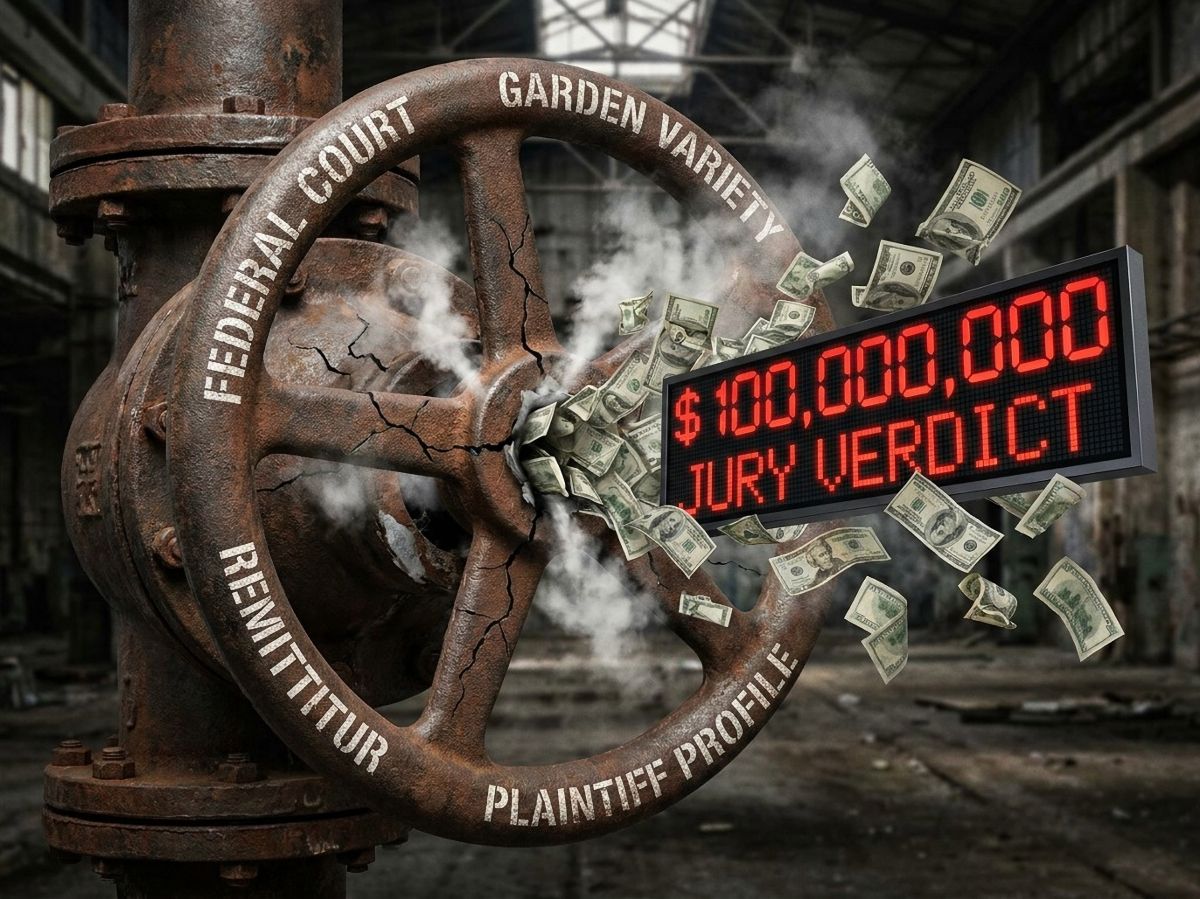
First, we probably should stop treating a garden-variety stipulation as a damages cap and price emotional distress claims based on the facts a jury will hear, not the label negotiated in discovery. Second, don't count on a friendly trial judge's remittitur to survive appellate review because Glick shows that a reviewing court's deference to the jury is stronger than its deference to a judge. Third, case value doesn't always depend on a client's net worth because even a successful client can be sympathetic, and don't discount emotional distress just because there's no expert attached to it. Finally, the "new normal" isn't only that verdicts are getting bigger with each passing year. It's that the safety valves we've relied on for decades like venue, a plaintiff profile, publicity, damages labels, even a sympathetic trial judge are proving less reliable than the number a jury reaches in a few hours of deliberation.
Submit your own column for publication to Diana Bosetti
For reprint rights or to order a copy of your photo:
Email
Jeremy_Ellis@dailyjournal.com
for prices.
Direct dial: 213-229-5424
Send a letter to the editor:
Email: letters@dailyjournal.com