


Technology
Aug. 7, 2026
No box for robot
When a driverless car breaks the law in California, the violation now goes to the manufacturer's regulator instead of to a driver. That works until someone dies, because homicide still requires a mind, and the law has spent two thousand years looking for one.


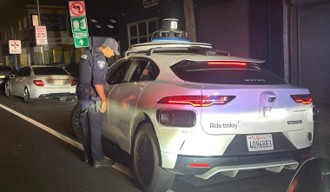
Last September, officers in San Bruno were working a late DUI operation when a white Jaguar made an illegal U-turn directly in front of them. They lit it up. The car pulled over at once, politely, without argument. As anyone who has worked a DUI shift will tell you, that's suspicious. Then the officers looked through the window and found the driver's seat empty.
The department wrote up the encounter on social media: "That's right ... no driver, no hands, no clue." Our citation books, the post added, don't have a box for "robot."
A sergeant later explained the difficulty, better than most of the law review literature has. An officer may cite a human driver for a moving violation. A parking ticket can simply be left on the windshield, because a parking ticket has never much cared who you are. The moving violation is different. It is an accusation, and an accusation has to be made to somebody.
The Legislature had seen it coming and had already acted. Assembly Bill 1777 became operative on July 1 of this year. An officer who watches an autonomous vehicle break the Vehicle Code, while the technology is engaged, may now issue a "notice of autonomous vehicle noncompliance." The manufacturer has 72 hours to report it to the Department of Motor Vehicles. Twenty-four, if the officer marks it for priority review because the driving looked dangerous. The Department holds the manufacturer's deployment permit, and may suspend it, revoke it or restrict how the fleet operates: where it may drive, at what hours, on what kinds of road, in what weather.
It is not a fine. Not a citation. It sends the violation to the agency that controls the manufacturer's permit. A citation accuses. A notice informs.
---
I ride in these. Last month I was in the back of one crossing the city at night, missing my daughter, and it struck me that there was nobody in the car the law could reach. Not the empty seat in front of me. Not me. I was cargo with opinions.
The vehicle stopped. A trash bag whipped by.
---
Classical Athens maintained multiple homicide courts. One for intentional killings, one for unintentional, one for the justified. And at the Prytaneion, they tried animals, unknown persons and inanimate objects. Its jurisdictional test had admirable economy. The court sits when the lethal object is plainly a stone or something of the kind, and there is no human perpetrator. The question it decides is whether the object should be cast beyond the borders.
This is generally offered as a curiosity. But look at the second half of the test. The Prytaneion took the case only where no human perpetrator could be found. The Athenians did not put the stone on trial because they thought the stone had a guilty mind. They put it on trial because a citizen was dead, the city was polluted by the death, and there was nobody else in the room. Given those constraints, they built the most rational institution available: a proceeding whose remedy was not punishment but expulsion.
On Thasos, Pausanias tells us, a statue fell and killed a man. It may have had its reasons. The man hated the athlete the statue honored and went to it nightly to whip the bronze. The dead man's sons prosecuted the statue for murder, and the Thasians sank it in the sea, following Draco, who had banished inanimate things that killed by falling.
---
We passed over a set of streetcar rails still sunk in the asphalt, from a system that has not run in decades. The last transport technology that killed people faster than the law could devise an adequate remedy.
---
The English took the next step, and it is the one we are still standing on. They called an object that had caused a death a deodand, and it was forfeited to the Crown. The theory had nearly died of neglect by 1800. Then came the railways, and with them a volume of sudden death that Victorian law was wholly unequipped to absorb. Under Baker v. Bolton, decided in 1808, the relatives of a person killed by another's wrongdoing had no civil action for the loss caused by the death itself. So the law did what it does when handed an inadequate remedy. It improvised. Coroner's juries used the deodand to render spectacular valuations against locomotive engines.
Parliament abolished the trial of objects in 1846 and enacted the Fatal Accidents Act, which gave the family of the deceased, for the first time in English law, an action against the wrongdoer. In railway cases, that meant the company. The bargain was not wholly altruistic; railway interests wanted juries to stop placing ruinous values on their engines. But the object stopped being the defendant. The enterprise behind it started being one.
But every locomotive still had a human hand on the throttle.
---
We stopped at a light. A delivery robot crossed in front of us, unhurried, with a name on its flank.
The Greeks prosecuted a stone; we give them names, then faces, and we called the whole field intelligence before anyone had settled what that meant. They did their animism through law and religion. We do ours through marketing and take it for progress.
Somebody in a marketing department decided the delivery robots should have names. Utah has decided they can never be anybody. Both of these decisions were made by adults.
Utah's House Bill 249, now Utah Code § 63G-32-102, forbids any governmental entity from granting or recognizing legal personhood in artificial intelligence, an inanimate object, a body of water, land, atmospheric gases, weather, a plant, a nonhuman animal or any other member of a taxonomic domain that is not a human being. The Nonhuman Rights Project has challenged it, arguing that a legislature cannot tell courts in advance what they may ever recognize.
Athens addressed the object. England stopped. Then it addressed the company behind it. Utah has legislated against something nobody has requested, which is how you know it is coming.
---
Everything described so far found a remedy without locating a guilty mind. A permit restriction can be imposed on a manufacturer's fleet without asking what the vehicle intended, and nothing is lost by mailing a moving violation to a corporation, because no mental state was ever an element of it.
Homicide is different. Above criminal negligence, California's homicide laws require a subjective mental state in a particular defendant. When an offense requires a guilty mind, the law must locate that mind in a defendant. We don't mail notices of noncompliance for manslaughter.
---
The dashboard screen showed the car's picture of the street. My own vehicle in the center, the traffic around it rendered in soft grey shapes. Somewhere underneath, a number governing how much room it would insist on.
---
Tesla's supervised self-driving system offers speed profiles. Sloth, Chill, Standard, Hurry, and Mad Max. Tesla added Mad Max in October 2025. Owners posted videos of cars exceeding speed limits and making aggressive lane changes. Within days, federal regulators were asking about it.
This June, in Harris County, a Tesla left the road and killed a woman inside her home. According to the arrest affidavit, the car was traveling 73 miles an hour in a residential neighborhood, and the driver had been overriding the system with the accelerator. He is charged with manslaughter. The case is pending.
He will say the car was driving. The state will say he was. Both will be partly right. Investigators also recovered searches from his phone, from the month before, asking whether Full Self-Driving was aggressive enough.
Prosecutors may use his documented preference for more aggressive machine behavior as evidence of his state of mind. But that preference is now a menu item, designed by engineers, named after a movie, built into a product, and sold. When a state of mind becomes a setting, whose state of mind is it?
So far there has been someone to charge. There was a man in that car, with his foot on the pedal. What happens when there isn't?
---
The car took me across the bridge without incident. It signaled early. It yielded to a cyclist I had not seen. It did everything right. Which is why the time to work this out is now, and not in a courtroom, at a sentencing, with a family in the gallery.
I got out at the curb. There was nobody to thank.
Submit your own column for publication to Diana Bosetti
For reprint rights or to order a copy of your photo:
Email
Jeremy_Ellis@dailyjournal.com
for prices.
Direct dial: 213-229-5424
Send a letter to the editor:
Email: letters@dailyjournal.com