


Family
Jul. 30, 2026
Divergence, not deficit: What family law must learn about neurodiversity and disability
The 14th Annual Cultural Competency in Family Law Practice Seminar urged lawyers and judges to view disability and neurodivergence as differences requiring understanding and accommodation to ensure fairness in family law.


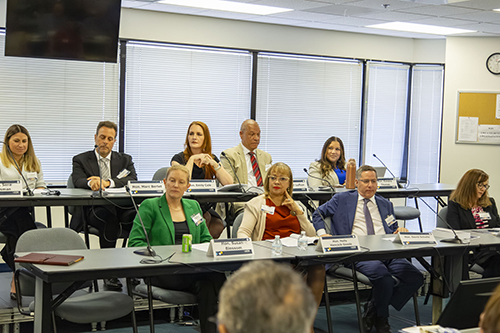
"Breakfast in Paris, lunch in Tehran, and law in Los Angeles" was the invitation to the 14th Annual Cultural Competency in Family Law Practice Seminar. The program promised an around-the-world experience in five hours--without a passport, security line, jet lag or the dangers that now accompany travel. The humor welcomed participants, but the subject was serious: how disability, mental health conditions and neurodivergence affect families, lawyers, judges and the administration of justice.
Presented by the Los Angeles County Bar Association's Family Law Section in association with the University of West Los Angeles School of Law, the July 25 program carried the theme "Divergence, Not Deficit: Invisible Differences, Visible Impact." More than 100 people attended, including active and retired judicial officers, psychologists, lawyers, law clerks, externs and students. More than 27 sponsors supported three panels and a judges' roundtable.
Central lesson
The central lesson was easily overlooked: difference is not necessarily disorder, and unusual behavior may be a form of communication, adaptation or neurological variation. Across cultures, divergence has been misunderstood as illness, instability, moral failure, sin, demonic possession or "craziness." Those labels can follow a person into the courtroom, where unfamiliar behavior may be mistaken for dishonesty, indifference, hostility, poor parenting or lack of insight.
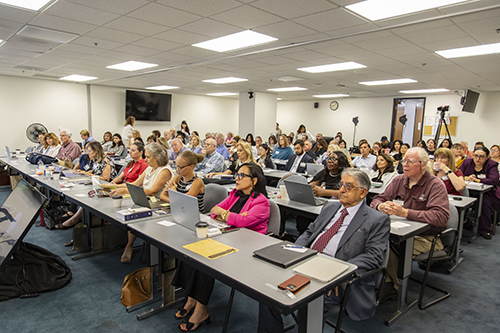
The seminar also emphasized that neurological divergence may be visible or invisible and may involve autism, deafness, attention-deficit/hyperactivity disorder, bipolar disorder or other conditions. Several speakers discussed professional expertise alongside personal and family experiences. Their contributions showed that accomplished people may experience the world differently and that divergence can affect communication, sensory processing, emotional regulation and institutional navigation. Shelly L. Kaufman, Los Angeles County supervising judge, Family Law Division, and attorneys Tigran Palyan, Steve Zand and Abbas Hadjian welcomed the attendees.
Daniel Pickar, Ph.D., ABPP, addressed neurodivergent parents and children in family court. He cautioned that developmentally based timeshare arrangements, although useful as general guides, "may not serve the neurodivergent or disabled child well." That observation has direct consequences for best-interest determinations. Equality does not always mean identical treatment. A parenting plan should not be measured solely by mathematical symmetry, nor should an accommodation be treated as favoritism. The question is whether an order recognizes the needs of the actual child and family before the court. Michael Kretzmer, a co-panelist and past chair of the California Chapter of AFCC, commented that everyone should make greater use of available mental health professionals when assessing and understanding cultural diversity issues. This remains an underutilized resource.
Allison Freeman, Ph.D., a clinical psychologist, noted that people with disabilities (PWD) constitute the nation's largest minority, numbering approximately 50 million in the United States. Roughly 15-20% of the U.S. population has at least one disability; one million live with severe disabilities, and two million have a functional limitation. Lorna A. Mouton Riff, CPA, CFF, a co-panelist, shared her personal experience of being raised by parents with congenital and acquired deafness and discussed the emotional and financial difficulties caused by misunderstandings and misinterpretations of disabilities, expressed and implied bias, and negative treatment. Dr. Gitu Bhatia, a co-panelist and co-organizer, expressed a recurring reaction: "I wish we could have heard more from each person." Her hope that the conversations continue is an important conclusion. A single seminar cannot answer every question raised by disability and neurodiversity, but it can change the questions lawyers and judges ask. Mark A. Juhas, a Los Angeles County Superior Court family law judge and co-panelist, observed that lawyers must share their observations with the court at the earliest opportunity.
Carol Hirshfield, Ph.D., urged attorneys to "always do your homework" by confirming that a provider's expertise matches the psychological or developmental issue involved. Attorney Sophia Bliziotis put the point memorably: "Help the picker make an informed pick by doing your homework." The wrong expert can be as damaging as no expert. Michael J. Convey, a Los Angeles County Superior Court judge and co-panelist, endorsed these sentiments.
Firdaus F. Dordi, assistant supervision judge, Family Law Division, who moderated the judicial roundtable, captured the principle: "Accommodations are not exceptions; they are fundamental in achieving justice for all." He explained that treating accommodations as tools of equal access, rather than special treatment, strengthens public confidence. Commissioner Kendra Thomas observed: "Justice begins with listening; cultural competency ensures we hear what is truly being said, not merely what we expect to hear." Commissioner Marc A. Bertet added: "Cultural competency means understanding the individual needs of neurodivergent children and parents in custody disputes. There is no 'one-size-fits-all' order. Judges must listen and work with attorneys to craft orders that truly serve children and families with special needs."
For lawyers
The program offered three immediate lessons for lawyers.
First, counsel must recognize signs that a disability or neurodivergent condition may be affecting a client, the opposing party or a child. Lawyers are not diagnosticians, but they are issue spotters. When conduct does not fit ordinary expectations, the response should not automatically be criticism or accusation. Competent representation may require consultation with a properly qualified professional.
Second, lawyers must investigate the qualifications of those professionals. "Mental health expert" is not a universal credential.
Third, the issue must be raised early. An accommodation requested after a damaging hearing, failed evaluation or misunderstood testimony may come too late. Counsel should consider communication needs, sensory conditions, hearing or language assistance, scheduling, breaks, remote appearance, the structure of questioning, and expert input before temporary orders harden into a long-term status quo.
For judges
Judges also have an essential role. Some cases require the court to slow the ordinary pace of litigation long enough to understand what is actually occurring. Temporary and final rulings should account for neurological, developmental and physical realities rather than forcing every family into a standard model.
That is the heart of cultural competency. It requires more than courtesy or familiarity with holidays, languages, food or national traditions. It asks legal professionals to examine the assumptions through which they interpret conduct. The challenge is not merely to see difference, but to avoid converting difference into deficiency.
Continued education
The response confirmed the need for continued education. Retired judge Christine Byrd said: "This year's seminar gave me an education and a new perspective on an issue that had never caught my attention before."
Keith M. Klemens, Commissioner (Ret.), said: "I hadn't thought about neurodiversity and disability as a dimension of cultural competency, but it certainly is. I learned a lot, and of course, it is always nice to see old colleagues and meet a few new ones."
Tigran Palyan, a co-host and chair of LACBA's Family Law Section, observed: "Families arrive at our doorstep not only in conflict, but carrying differences that are easy to miss. Our job as advocates and officers of the court is to recognize those differences and translate them--not argue past them."
Dena A. Kleeman, a former chair of the Section, described the program as timely and useful because it addressed "the breadth and scope of individuals with disabilities, and how the Court responds." She noted that recent judicial bias training reflected the continuing difficulty people with disabilities face in navigating the court system, particularly those with physical disabilities.
Steve Mindel, a former chair of the Section and a member of the American Academy of Matrimonial Lawyers, emphasized the program's practical nature. Cultural competency, he observed, requires lawyers and judges to face challenges that occur in daily practice. "Having a deep understanding of the differences between all of us," he said, "makes us closer." That understanding affects how a lawyer interviews a client, selects an expert, prepares testimony and explains conduct to the court.
Christine D. Gille, a family law specialist, shared her view that the lawyers who attended heard discussions of some of the most interesting and challenging legal and factual issues in high-conflict family law cases. She picked up nuances that she will use in both settlement and trial. Live seminars like this are increasingly rare, and this one was especially valuable.
Steve S. Zand, associate dean at UWLA and a co-host of the program, described cultural competency not as an aspiration, but as an essential professional skill--one that enables lawyers and judges to understand the individuals before them, strengthen public confidence and promote fair, informed decision-making.
Traveling beyond
The seminar's title therefore deserves to travel beyond the program: divergence, not deficit. Family law deals with people at moments of profound stress, when differences may become more pronounced and misunderstandings more damaging. The profession cannot eliminate every error, but it can replace reflexive judgment with informed inquiry, verify expertise rather than rely on labels, request accommodations before harm occurs, and craft orders for the family that exists--not the family we expected to see.
When lawyers do their homework, judges take time to listen, and professionals recognize that dignity does not depend on conformity, cultural competency becomes more than a seminar topic. It becomes a method of justice.
Submit your own column for publication to Diana Bosetti
For reprint rights or to order a copy of your photo:
Email
Jeremy_Ellis@dailyjournal.com
for prices.
Direct dial: 213-229-5424
Send a letter to the editor:
Email: letters@dailyjournal.com