


Litigation & Arbitration
Jul. 31, 2026
Preparing for the first procedural hearing in arbitration: What counsel should know
Successful arbitration depends on thorough early case management, with attorneys carefully navigating AAA procedural requirements and preparing key information before the hearing to ensure an efficient, fair and binding resolution.


Tricia Bigelow
Neutral
Signature Resolution
As Presiding Justice and Associate Justice of the Court of Appeal, and as a trial court bench officer for a combined total of 26 years, Justice Bigelow presided over complex cases involving high-profile companies and public figures. She has authored three books on California law and procedure and lectured extensively on judicial ethics and fairness, civil motions and trials, and other topics. She chaired the Los Angeles Superior Court Civil Education Committee, served on the CACI jury instruction committee, and from 2006 to 2008 was Dean of the Bernard E. Witkin California Judicial College, where she oversaw the education of all new judges in California. She was awarded the California Judicial Council Ronald M. George Award for Judicial Excellence in 2014. In 2015 she was co-recipient of the Bernard S. Jefferson Award for distinguished service to judicial education from the California Judges Association.
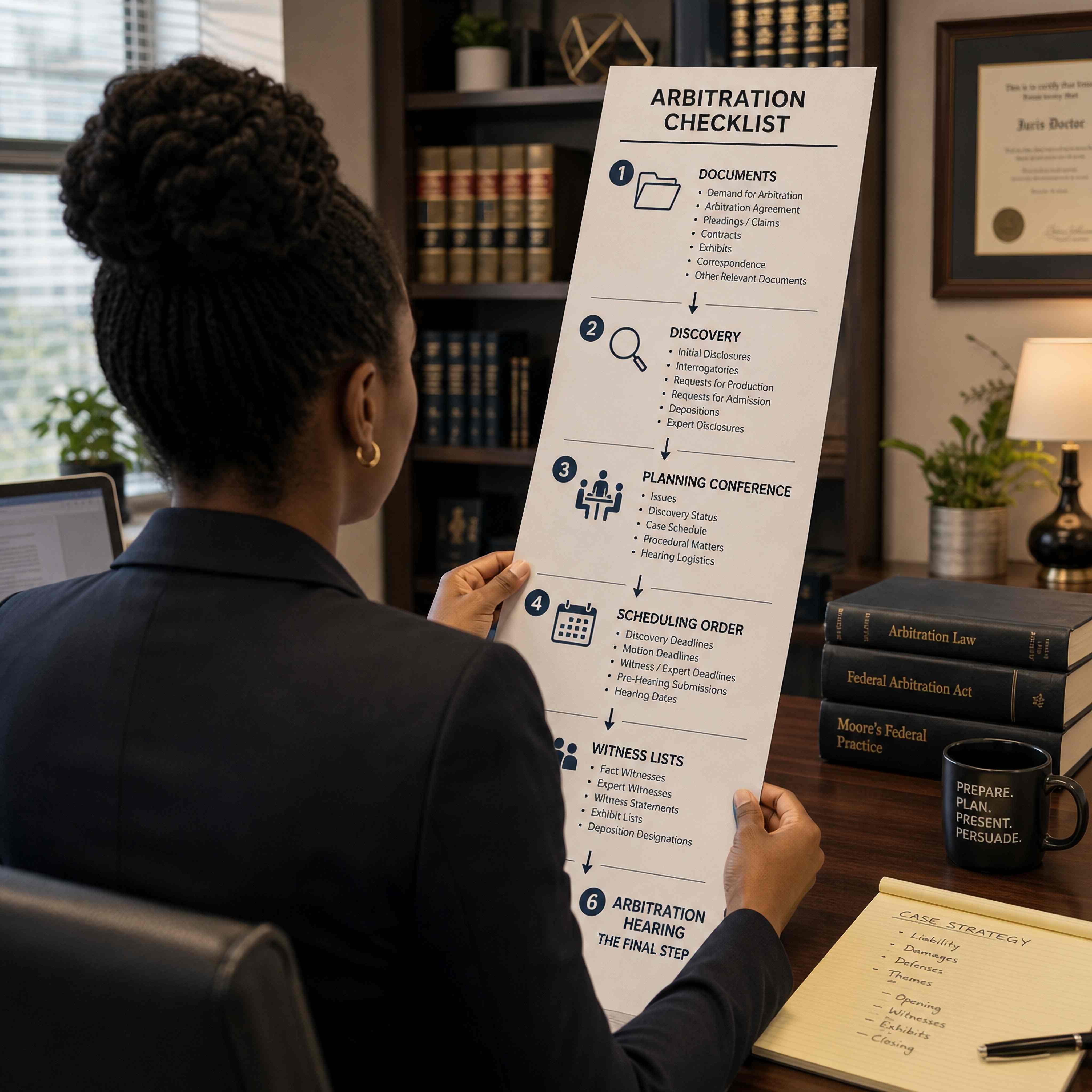
Before parties arrive at arbitration, ready to make their cases and receive their verdicts, their attorneys must jump through some procedural hoops. There may be many benefits to forgoing a trial and going to arbitration; unfortunately, forgoing preparatory work isn't one of them. If anything, getting ready for arbitration might involve more steps than would be required for a full-blown trial.
This actually makes sense. Arbitration is less rule-bound and more expeditious than litigation, but an arbitrator's decision is generally considered binding and non-appealable. If critical information is missing or incorrect, that decision could result in an injustice to one or both parties.
For this reason, the American Arbitration Association (AAA) has established rules for both commercial and employment arbitration that call for detailed preparatory work. Before the parties can bring their disputes to arbitration, their attorneys must perform a number of opening moves, all of which are critical to the process.
Every arbitrator will have his or her own way of managing the opening gambit, but all will adhere to the letter and intent of the rules. The better prepared counsel is to navigate these steps, the better the entire process will go.
Initial planning hearing
The most important preparatory step is the initial planning hearing, also known as a preliminary hearing or case management conference. This hearing is the first opportunity for the parties and the arbitrator to begin shaping how the process will unfold. The intent is to streamline the case, to avoid delays and missteps that can occur during trials, but also to ensure that the arbitrator has the information he or she needs to render a well-considered decision at the end of the process.
According to the AAA, the earlier this preliminary hearing takes place, the better it will be for most cases. The parties and the arbitrator can begin the task of organizing the proceeding to maximize efficiency and economy, while giving each party a fair opportunity to present its case. AAA rules typically call for this hearing to take place within 14 to 30 days after the arbitrator is appointed.
The hearing provides the first opportunity for the parties to clarify the specific legal issues, defenses, and damages that each side is claiming. Attorneys for both parties attend the hearing, via phone or video platform, and the hearing concludes when the arbitrator issues a binding scheduling order for the case. To reach this point, however, the arbitrator must gather critical information. This information will allow the arbitrator to schedule the exact dates, estimated duration, and location or virtual format for the final trial-style hearing.
During the preliminary hearing, therefore, both attorneys should be prepared to answer a series of questions posed by the arbitrator. The answers to those questions will help the arbitrator schedule the proceeding, prepare for the introduction of evidence, and anticipate additional procedural steps. At the conclusion of the preliminary hearing, the arbitrator issues a written order memorializing all decisions made and agreements reached during or following the hearing.
AAA checklist
The AAA has created an official checklist to ensure that no scheduling details are missed in the run-up to arbitration. The AAA's case management resources can be accessed at the AAA Rules and Forms portal.
The items that must be addressed in a particular case will, according to the AAA, lie within the hands of the arbitrator. The nature of such items will be dictated by the size, subject matter, and complexity of the dispute, but they will typically include a look at what other methods of dispute resolution, such as mediation, are possible; whether the right parties have been included; if a party might ask for a more detailed statement of claims, counterclaims, or defenses; if amendments will be made to the parties' claims, counterclaims, or defenses; and what rules, procedures, and law will govern the arbitration. Further, the parties indicate if they intend to file a dispositive motion, and the dates for filing those papers as well as the precursor motion thereto.
The parties might also be asked whether any threshold or dispositive issues can be decided without considering the entire case; whether any claim or counterclaim falls outside the arbitrator's jurisdiction or is otherwise not arbitrable; if any claims or counterclaims can be consolidated with another arbitration; or if the proceeding should be bifurcated. They may need to decide how to exchange documents required for the arbitration; the scope of any such document production requests; procedures for obtaining material information; and how to apportion the costs of any such document production.
The arbitrator may also ask about expert witnesses that will be called by the parties, including a date for disclosing their identity and anticipated testimony. This allows the arbitrator to schedule appropriately, based on whether written statements or direct testimony will be accepted. The parties might be required to exchange and pre-mark documents and other materials that they intend to submit during the hearing.
My opening gambit
When I've been appointed to arbitrate a case, my first priority will always be to learn as much as I can about the matter. To do so, I will send a letter to counsel for both sides seeking information and instructing them about how the process will work.
Questions
My questions to counsel are as follows:
· Have all the parties to the arbitration been served?
· Is there any related litigation going on?
· Will either party seek a more detailed statement of claims, counterclaims, or defenses?
· Are there any threshold or dispositive issues that can efficiently be decided without considering the entire case, including, without limitation:
a) any preconditions that must be satisfied before proceeding with the arbitration;
b) whether any claim or counterclaim falls outside the arbitrator's jurisdiction or is otherwise not arbitrable;
c) consolidation of the claims or counterclaims with another arbitration; or
d) bifurcation of the proceeding.
· Do the parties agree to participate in direct exchange communication? [The parties may jointly speak directly with the arbitrator as necessary for resolution of matters after an email request for a conference.]
· How long do you expect the arbitration to last? What dates would you like to reserve for the hearing? Where would you like to hold the arbitration hearing?
· By what date will the parties exchange documents, including electronically stored documents, on which they intend to rely in the arbitration?
· Does either party intend to file a dispositive motion?
· Have the parties executed a protective order? If not, when will they do so?
· Do the parties have any other issues to bring up?
Instructions
I want counsel to be well prepared for the demands of the process. To avoid any surprises, I provide them with the following guidelines and directives:
· The arbitrator requires all cancellations to be made 45 days before the hearing to avoid being charged for the entire hearing.
· The parties should agree on the number of witnesses each side may depose.
· If you have a discovery dispute, please first meet and confer. If that is unproductive, I prefer you to contact me via email, and we can then set up a conference call to attempt to resolve the matter informally. If that is unproductive, the parties can file a motion on the matter.
· The following should be exchanged no later than three weeks before the hearing: final witness lists; two joint exhibit notebooks; at least one WebEx Hearing Exhibit notebook (If there are any objections to the exhibits, please separate them from the exhibits to which there is no objections); in limine motions; prehearing briefs; and any stipulated facts.
· Please plan to hire a court reporter for an official record of the proceedings. I prefer the court reporter to have real time capabilities. I ask that the parties .please advise the AAA of the request for a reporter three weeks prior to the hearing. Further, that they order a stenographic transcript of the proceedings and provide a copy for the arbitrator.
· The arbitrator will set a schedule for post-hearing briefing at the conclusion of the hearing. The arbitrator will issue an interim award and thereafter the parties may file a motion for attorney's fees. The arbitrator will set a schedule for those briefs at the conclusion of the hearing.
· The award will be a reasoned opinion, setting forth findings of fact and conclusions of law.
Conclusion
Arbitration is intended to be a just and efficient way to resolve disputes, but it is only as good as the information provided to the arbitrator. The arbitrator's principal obligation is to render a decision that fairly and reasonably balances facts and applicable law.
If party counsel fails to provide timely and critical information or otherwise neglects to adequately prepare for arbitration, the client could be disserved. Expedited resolution could end up being costlier than an attenuated trial verdict.
Submit your own column for publication to Diana Bosetti
For reprint rights or to order a copy of your photo:
Email
Jeremy_Ellis@dailyjournal.com
for prices.
Direct dial: 213-229-5424
Send a letter to the editor:
Email: letters@dailyjournal.com