


Administrative/Regulatory
Jul. 10, 2026
Can the Administrative Procedure Act limit rapid executive policy change?
The Administrative Procedure Act requires agencies to engage in reasoned decision-making before changing policy. Recent cases show how that requirement has become a key legal check on executive action.



Stephen Kaus
Stephen Kaus is a retired judge of the Alameda County Superior Court, where he served for 12 years until 2024. He is now a private arbitrator and mediator. Prior to that, he was a public defender in Contra Costa County and civil litigator in San Francisco.
During the present administration, many institutional constraints long assumed to limit presidential action have turned out to be political norms rather than judicially enforceable rules. In some instances, the Administrative Procedure Act (APA) transforms important norms of good administration into enforceable legal duties.
It remains to be seen how effective the APA is in at least slowing the abandonment of norms, both in trial court and on appeal.
Last month, in a case involving immigration enforcement at courthouses, a California federal court used the APA to require Immigration and Customs Enforcement (ICE) to roll back new immigration policies adopted without the reasoned decision-making the act requires. In another case earlier in the month, a Massachusetts judge used the APA to order a halt to the government's revision of the history presented to visitors in national parks.
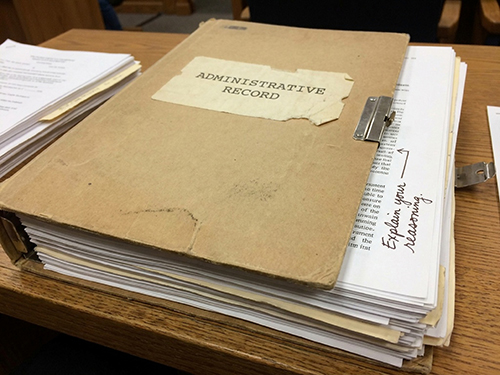
The APA, enacted in 1946, does not bar agencies from changing course. Instead, it requires agencies to explain themselves. When an agency adopts a new policy, it must show--through the administrative record--that it considered the relevant factors and offered a reasoned explanation for its choice.
That obligation can slow rapid executive pivots even when courts avoid the underlying policy merits. Because the APA imposes procedural obligations independent of policy outcomes, it often makes it impossible to "move fast and break things" as one might outside the government.
The APA as a check on executive speed
On June 23, Northern District of California Judge P. Casey Pitts held in Sequen v. Albarran that two ICE policy changes relating to arrest and detention were impermissibly "arbitrary and capricious" because they were not the product of "reasoned decisionmaking." The court granted class certification and partial summary judgment against policies governing arrests at immigration courts and the length of detention in ICE "short-term holding facilities."
Similarly, on June 12, Massachusetts Judge Angel Kelley ruled in National Parks Conservation Association v. Department of the Interior that changes to historical exhibits in national parks--ordered by President Trump and implemented through the secretary of the interior--likely were "arbitrary and capricious." The court found the changes lacked a reasoned explanation, departed from prior practice without adequate justification and were not supported by the evidence.
Judge Kelley issued an injunction against further implementation and ordered the restoration of removed exhibits pending a final decision, an interim order that has been stayed by the 1st Circuit.
These decisions are consistent with several other recent successful APA challenges to significant executive policy changes, including rulings striking down the National Science Foundation's cap on indirect-cost reimbursements to universities (Association of American Universities v. National Science Foundation (D. Mass. 2025) 788 F.Supp.3d 106 and invalidating anti-DEI restrictions on teen-pregnancy-prevention grants (Planned Parenthood of Greater New York v. U.S. Department of Health and Human Services (D.D.C. 2025) 2025 WL 2840318.)
In all these APA cases, the courts did not purport to decide whether the challenged policies were wise. The problem, instead, was that the administrative record did not demonstrate that the agencies had considered the relevant factors required to comply with the APA.
Supreme Court approved
The U.S. Supreme Court's modern articulation of arbitrary-and-capricious review traces back to Motor Vehicle Manufacturers Ass'n v. State Farm in 1983. Under that framework, an agency changing policy must "articulate a satisfactory explanation" for its action, including a rational connection between the facts found and the choice made, and must consider all important aspects of the problem.
The APA does not require the "best" policy. It requires a policy that is explained and logically justified. Courts should not speculate whether agency officials actually deliberated. The issue is whether the administrative record demonstrates that they did.
Thus, a court can set aside agency action without addressing the substance of immigration enforcement or historical interpretation. The policies are voided because the administrative record failed to demonstrate the reasoned decision-making required by the APA.
Last month's cases
In last month's ICE case, one issue was a policy shift toward making it easier to justify arrests at immigration courts. Previously, such arrests were confined to special circumstances, such as threats to public safety or associations with terrorism, espionage or gangs. The reason for the previous restraint was to maintain the functioning of the immigration courts by not scaring off participants.
In 2025, the Trump administration instructed ICE to increase enforcement activity in or near courthouses. The result, for example, included a sharp increase in weekly arrests at San Francisco immigration courthouses--from "very few" to "nearly 50."
Judge Pitts did not resolve the policy debate between enforcement priorities and court access. Instead, he found that the change--along with a second policy change extending the time an arrestee could be held in a courthouse holding cell--was not supported by the "reasoned decisionmaking" mandated by the APA.
More pointedly, the court found ICE's shift was not merely explained inadequately, but actually reflected "a complete lack of decisionmaking." ICE didn't even acknowledge that it was changing position and, as a result, did not address the central factor that had motivated the prior approach: the chilling effect of courthouse arrests on noncitizens' attendance at court.
In the national parks case, Judge Kelley found that the secretary's order did not "grapple with" three relevant statutes. The court also found no indication that the agency considered "relevant facts and evidence," including public reaction to the deletion by those with "diverse viewpoints and marginalized voices." On that record, the court concluded the changes likely could not survive arbitrary-and-capricious review.
Rocky road ahead?
APA review is not without its critics. Determining whether an agency has adequately considered relevant factors inevitably requires judges to examine the substance of the agency's reasoning, raising concerns that courts may, at times, come close to substituting their own policy judgments for those of the executive.
These trial court APA-based rulings may not survive a trip to higher courts. However, the Supreme Court twice used the APA to invalidate executive branch actions during the first Trump administration. Chief Justice Roberts authored the decisions that used the APA in unexpected ways to invalidate controversial executive branch policies.
In 2019, in Department of Commerce v. New York, Justice Roberts authored a decision that eliminated a citizenship question from the census, not because the Trump administration did not give a good reason, but because the court believed the given reason was never subjected to the APA's requirement of reasoned decision-making.
In 2020, Department of Homeland Security v. Regents of the University of California, another APA ruling, found the Trump administration's rescission of President Obama's DACA (Deferred Action for Childhood Arrivals) program was arbitrary and capricious.
Since those 5-4 decisions, Justice Coney Barrett has replaced Justice Ginsburg, so similar support for the APA today is far from certain. The experience since the 2024 election has been that reasoned, evidence-based district court decisions often have not been long-lived.
Be that as it may, increasingly, the legal system is falling back on the APA in the absence of substantive restraints. Whether the APA can continue to at least slow an administration committed to governing at high speed may become the defining question of administrative law in the second Trump presidency.
Disclaimer: The content is intended for general informational purposes only and should not be construed as legal advice. If you require legal or professional advice, please contact an attorney.
Submit your own column for publication to Diana Bosetti
For reprint rights or to order a copy of your photo:
Email
Jeremy_Ellis@dailyjournal.com
for prices.
Direct dial: 213-229-5424
Send a letter to the editor:
Email: letters@dailyjournal.com