


U.S. Supreme Court,
Constitutional Law
Jul. 6, 2026
The 2nd Amendment meets the front door of private property
In Wolford v. Lopez, the Supreme Court upheld Hawaii's law requiring concealed-carry permit holders to obtain express permission before entering publicly accessible private property, deepening the post-Bruen divide over whether the Second Amendment turns on historical tradition or state authority to regulate armed access to property.


William Slomanson
Distinguished Professor Emeritus
Thomas Jefferson School of Law
Email: bills@tjsl.edu
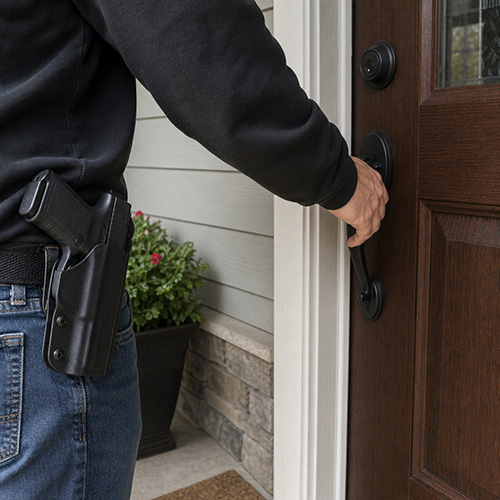
Three Hawaiian residents with concealed weapons permits, along with an organizational plaintiff consisting of members with like permits, sued Hawaii. They sought an injunction against Hawaii law, arguing that its landowner authorization-to-enter requirement violated the Second Amendment. Wolford v. Lopez, 609 U.S. __, 2026 WL 1825723 (2026) (hereinafter Wolford). Few cases could be less reader-friendly than this six-to-three, split-along-party-lines, four-opinion case--where the justices could not agree on whether they were deciding a gun case or a property case.
The number of concealed handgun permits has been growing exponentially. In 1999, there were 2.7 million concealed handgun permit holders in the U.S. There are now at least 21.8 million permits in the U.S. John R. Lott, Jr., Concealed Carry Permit Holders Across the United States: 2023, file:///C:/Users/User/Downloads/ssrn-4648999.pdf. The article tracks the number of concealed carry permits. As of 2022, California issued these licenses to "more than 200,000 permit holders." Long Beach Post, California Department of Justice Facebook post (June 29, 2022), https://www.facebook.com/longbeachpost/posts/the-california-department-of-justice-recently-published-data-on-how-many-conceal/436073145191459.
The ubiquitous common-law rule is that opening private property to the public implies a license for those who wish to enter. One is not a trespasser when merely entering such property unless the property owner has given "due notice" that entry is prohibited. Id., *7 (citing authorities). Hawaii flipped this default property-law rule. Rather than allowing entry to private property open to the public unless specifically prohibited, state law provided that no one carrying a firearm may enter such property without express authorization. Haw. Rev. Stat. § 134-9.5(a) (2023).
California's (also challenged) law emulated Hawaii's express permission requirement. Compare Haw. Rev. Stat. § 134-9.5(b)(1) requiring "[u]nambiguous written or verbal authorization; or (2) the posting of clear and conspicuous signage ..." (2023), with Cal. Penal Code § 26230, which provides that "places where carrying [a] firearm [is] prohibited ... include any privately owned commercial establishment that is open to the public, unless the operator of the establishment clearly and conspicuously posts a sign ... indicating that license holders are permitted to carry firearms on the property." Cal. Penal Code § 26230(a)(26) (2026).
Unlike Bruen, the Wolford Court did not expressly make its ruling applicable to all 50 states. But Wolford signals that the Supreme Court may likewise scrutinize legislation that restricts a gun owner's right to enter private property open to the public without authorization.
Prior to Wolford, California statutorily identified almost three dozen locations where concealed-carry gun owners could not freely enter without express authorization. These included school zones, hospitals, mental health facilities, nursing homes, establishments where intoxicating liquor is sold for consumption on the premises, playgrounds, stadiums, polling places--and perhaps most significantly, "any other privately owned commercial establishment open to the public." See Cal. Penal Code § 26230(a)(1)-(26) (2026). Wolford is unclear about the extent to which such restrictions and similar state statutes are affected by its Hawaii decision.
Hawaii's main defense of its express authorization requirement triggered analysis under Bruen's historical-analogue test. Hawaii relied on its long history of prohibiting private possession of firearms. One of the first written laws of the Kingdom of Hawaii was issued in 1833, when King Kamehameha III prohibited possession of all deadly weapons. Later laws, before and after Hawaii became part of the U.S., continued to restrict firearm possession and carriage. Wolford, *11.
The Wolford majority countered that, a la Bruen, "overwhelming evidence" shows an "enduring American tradition permitting public carry." Id., *11. Fact-checking historical accounts of the "Wild West," some scholars note that "[c]arrying any kind of weapon, guns or knives, was not allowed other than outside town borders and inside the home. When visitors left their weapons with a law officer upon entering town, they'd receive a token, like a coat check, which they'd exchange for their guns when leaving town." Matt Jancer, Gun Control Is as Old as the Old West, Smithsonian Magazine (Feb. 5, 2018).
In another passage, the Wolford majority states that people "on the premises will not even notice a person peacefully carrying a concealed weapon in the manner demanded by Hawaiian law." But the majority's claim overstates the obvious. Peacefulness is not the scenario envisioned by Hawaii's now-defunct express consent law.
Wolford's concurring opinion offers yet another resolution: "While most Hawaiians might prefer that no one carry firearms in public places, a majority's opposition to a constitutional right is not a permissible basis for restricting it." Id., *20 (Barrett, Thomas, and Gorsuch, concurring). One might conclude that this rebuttal is grounded in political quicksand. It does not reflect the 60 percent of Americans who favor more gun control as of 2025. Gallup, Guns, chart three, https://news.gallup.com/poll/1645/guns.aspx.
As Justices Ketanji Brown Jackson and Sonia Sotomayor's dissent urges, this case is about property rights, not gun rights. They quote a 2013 Supreme Court case: "[O]ur law holds the property of every man so sacred, that no man can set his foot upon his neighbour's close without his leave." They also cite a 1979 Supreme Court case stating that the right to exclude is "one of the most essential sticks in the bundle of rights" and "universally held to be a fundamental element of the property right." Id., *23 (Jackson and Sotomayor, dissenting). Justice Elena Kagan adds: "I would uphold the challenged Hawaii law because ... it is a modern-day analogue of colonial and founding-era laws that similarly prohibited carrying firearms onto private property without the owner's affirmative consent." Id., *20 (Kagan, dissenting).
Justices Jackson and Sotomayor argue that Hawaii's express-consent law vindicates property rights by regulating the scope of the license to enter--requiring gun owners to obtain express consent rather than relying on implied consent. States have historically adjusted the scope of implied licenses in the context of armed entry onto private property, particularly through hunting regulations. During the Founding and Reconstruction eras, multiple states passed laws requiring affirmative consent for armed entry onto private property. Id., *25 (Jackson & Sotomayor, dissenting).
One is thus left with the question whether the Bruen and Wolford decisions were correctly decided. Perhaps the strongest critique is that the majority's gun-rights framework "further bind[s] the hands of modern legislatures attempting to balance and protect their residents' interests. With this [Wolford] decision, the Court has now manipulated Bruen into a free-for-all that lets the judiciary thwart the will of state legislatures by privileging access to firearms above all else." Id., *21.
Wolford's dissenting justices have consistently disagreed with the application of Bruen's historical test. They now argue that the Court should at least follow its own precedent. Wolford "alters the Bruen test and overrides Hawaii's considered--and ... constitutionally sound--judgment that the property interests of its residents should be protected against unauthorized armed entry." Id., *35 (Jackson & Sotomayor, dissenting).
As Justice Robert Jackson once observed: "We are not final because we are infallible ... but we are infallible only because we are final." Brown v. Allen, 344 U.S. 443, 540 (1953) (Jackson, concurring).
Submit your own column for publication to Diana Bosetti
For reprint rights or to order a copy of your photo:
Email
Jeremy_Ellis@dailyjournal.com
for prices.
Direct dial: 213-229-5424
Send a letter to the editor:
Email: letters@dailyjournal.com