


Law Practice
Jun. 22, 2026
Inconceivable! Judges mangling famous lines from literature
A Shakespearean phrase commonly used to describe ignored rules originally meant the opposite and its evolution illustrates how legal language can drift far from its original meaning.


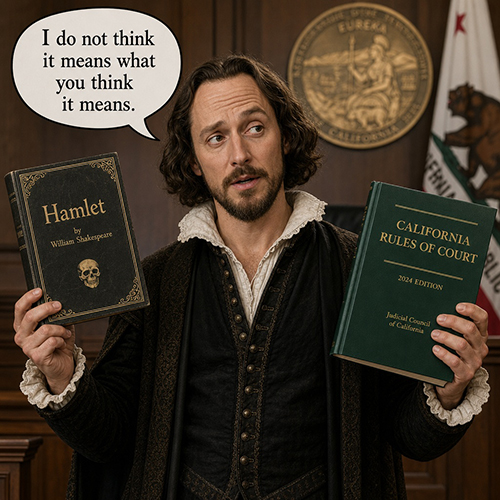
Stepping away from the Evidence Code for the time being, I've decided to try to write a few columns about our use of language in the law. Today's phrase: "more honor'd in the breach than the observance," from Hamlet, act 1, scene 4, line 16.
I confess to often resorting to this phrase when I'm referring to a Rule of Court that's often ignored (see, e.g., Cal. Rules of Court, rule 3.714(b) [civil case-disposition time goals]), but I do usually try to acknowledge that I'm mangling the line.
(Also with regard to Rule 3.714(b), when discussing it with counsel, I often also allude to the portion of Hamlet's "To be or not to be" soliloquy where he cites "the law's delay" as yet another reason to "shuffle[ ] off this mortal coil . . . .") (Shakespeare, Hamlet, act III, scene 1, lines 66-71.)
The "more honor'd" line is from early in Hamlet, where Hamlet is moping around after the death of his father, complaining to his friend Horatio about his mother Gertude's recent wedding to his uncle Claudius. (Cf. Updike, Gertrude and Claudius (2000).) Hamlet is complaining about Claudius sounding the trumpets and "drain[ing] his draughts of Rhenish [wine] down." (Hamlet, act I, scene 4, line 10.) Horatio asks him if this is what always happens in the Danish court:
"Hor. Is it a custom?
Ham. Ay, marry is't.
But to my mind, though I am a native here
And to the manner born, it is a custom
More honor'd in the breach than the observance.
This heavy-headed revel east and west
Makes us traduc'd and tax'd of other nations.
They clip us drunkards, and with swinish phrase
Soil our addition . . . ."
(Id., act I, scene 4, lines 13-20.)
Hamlet's meaning is that the custom (that is, carousing and heavy drinking to celebrate a new king) is an old tradition that would be better left behind than continued, given that neighboring countries make fun of the Danish for being drunkards.
Over time, the phrase has taken on a different meaning, usually referring to a rule that is frequently acknowledged and gestured to, but then essentially ignored or broken. (See, e.g., Cal. Rules of Court, rule 3.1332 [setting out standards for continuance of a trial date].) We can find frequent examples of this (mis)use in legal writing. (See, e.g., Rhodes v. Sargent (1911) 17 Cal.App. 54, 57 ["As this section stood originally, it was deemed directory only; and, as is too often the case where a law is thus regarded, it was 'more honored in the breach than the observance'"]; Perry v. Wallner (1962) 206 Cal.App.2d 218, 220 ["Defendant's first contention is, for all practical purposes, nothing more than an attack upon the sufficiency of the evidence to support the judgment. We are therefore first confronted with the traditional rule on review that is more honored in its breach than in its observance"]; Deponce v. System Freight Service v. Rodriguez (1944) 66 Cal.App.2d 295, 302 ["For the benefit of the bar in general, as well as counsel for appellant in particular, we wish to call attention to Rule 5, and to subdivision "b" of Rule 10 of Rules on Appeal which places on counsel the burden of proceeding to get the exhibits before the reviewing court. In this court these rules are more honored in their breach than in their observance"].)
In passing, it's worth noting that this passage from the play produced another often distorted turn of phrase--"to the manor born," with the suggestion that someone was born with a silver spoon in a mansion, whereas Hamlet is saying he was born into the custom he's talking about, or "manner."
Credit to Justice Van Dyke of the Supreme Court of California, who used the phrase very precisely back in 1899 in Wright v. Eastlick, where the issue on a motion for new trial was whether some of the jurors in the mining community had been drunk during deliberations. The circumstances there were oddly similar to the ones Hamlet was complaining about in the play:
"The conduct of these two jurors,--principally Foreman Neville,--visiting saloons, and going to dance houses, and drinking and carousing with parties to the action, is not controverted by respondents' counsel, but they seek to extenuate the same. They say: 'The parties, the witnesses, and some of the jurors were miners; they were away from home, and the trial lasted over the holidays; and, while these things were not to be encouraged, still all that is shown in this case is the following out of the very general custom throughout the mining districts; and we think that no one who is at all familiar with the custom of miners in this state will say that because one or two jurors happened to be present and joined when the crowd was invited up to take a social drink during the holidays, that the verdict was tainted thereby.' It is scarcely to be credited that such misconduct on the part of the jurors as the record in this case discloses is but following out the custom, either general or local, throughout the mining districts of this state. If there were such a custom, surely it 'would be more honored in the breach than the observance.' It is to be presumed that when jurymen are selected and sworn to try a cause, either in the mining or other districts in this state, they realize the obligation of their oath, and their duty as good citizens towards the community, and act accordingly."
(Wright v. Eastlick (1899) 125 Cal. 517, 519 [emphasis added].) This passage from Wright is also a vivid reminder that the conditions in our state in the late 19th century were often like something straight out of Mark Twain's Roughing It (1872).
Obviously, language changes over time (look up the current definition of "podium"), and there's no reason phrases like this one can't take on a new life. Perhaps it should. But if you are feeling ornery or pedantic, you can point to the play and note, like Inigo Montoya to Vizzini in the classic Rob Reiner film The Princess Bride (Twentieth Century Fox 1987): "You keep using that [phrase]. I do not think it means what you think it means."
Submit your own column for publication to Diana Bosetti
For reprint rights or to order a copy of your photo:
Email
Jeremy_Ellis@dailyjournal.com
for prices.
Direct dial: 213-229-5424
Send a letter to the editor:
Email: letters@dailyjournal.com