


Insurance
Jun. 19, 2026
Title insurance law improvement could provide greater 'peace of mind'
California could improve the peace-of-mind protection promised by title insurance by allowing title insurers to substitute their financial obligation for undisclosed judgment liens, freeing insured property owners from clouds on title and unnecessary participation in litigation while preserving lienholders' rights.



Douglas W. Stern
Judge (ret.), Neutral
Alternative Resolution Centers
UCLA School of Law, 1978
Hon. Douglas W. Stern (Ret.) is a neutral with Alternative Resolution Centers. He was appointed to the Los Angeles County Superior Court in mid-2013 and retired in March 2025. Prior to his appointment to the Superior Court, he practiced civil business litigation for 35 years largely with a major national law firm, handling all aspects of pre-trial, trial, and appellate work in both California state and federal courts. His practice included a broad range of complex commercial, business, real estate, contract and tort litigation for both plaintiffs and defendants. He also served as the Southern California Litigation Manager for Fidelity National Title Group, the nation's largest title insurance company.
"You're in good hands with Allstate." "Like a good neighbor, State Farm is there." "Nationwide is on your side." "We've got you under our wing." (Aflac). These insurance slogans reflect not only a sales pitch but a concept embedded in the law of insurance: protecting the insured's peace of mind. In Lambert v. Commonwealth Land Title Ins. Co. (1991) 53 Cal.3d 1072, 1081, the California Supreme Court observed: "[T]he contract of insurance is unique in that the purchaser seeks not commercial advantage, but rather peace of mind and security in the event of unforeseen calamity."
Virtually every homeowner and other real property owner in California has title insurance. This insurance protects owners against the risk that there is a defect in the owner's title. The nature of the insured defects is wide-ranging. It can include claims that another person has an interest in the property such as an easement, claims of forgery of a deed, invalid or defective deeds, missing or undisclosed heirs or claims of prior owners, boundary disputes, unmarketable title and lack of right of access.
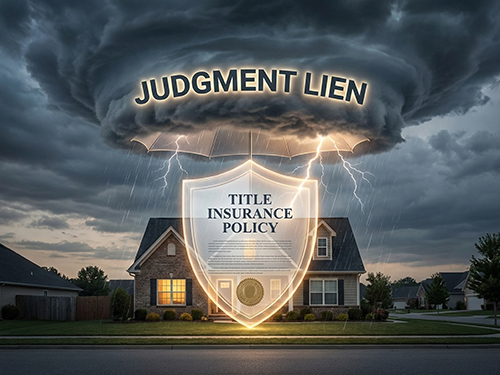
It also protects the owner from monetary liens of various sorts. Monetary claims may include judgment liens and homeowner association charges, among others. For these types of claims, greater peace of mind can be achieved by a relatively simple addition to the law or, in the absence of a statute, by stipulation of the parties.
Title insurance is unique in that instead of insuring an owner against future events such as an auto accident, a fire, flood or earthquake, as most insurance does, it insures the individual against something that happened in the past. The risks insured against arose from an event that took place prior to the date of the insurance policy. One such event may be a monetary lien that attached to the property prior to the date the owner obtained title that was not satisfied and eliminated prior to the owner acquiring title. Generally, such monetary liens are noted in the preliminary report of the title company and paid through escrow to eliminate them.
But sometimes monetary liens are not noted by the title company, not paid-off through escrow and not listed as "exceptions" to coverage on Schedule B of the title insurance policy. When such monetary liens exist, a property owner may wake up one day to a big surprise.
The summons and complaint
You've moved into your newly acquired home, painted the walls and enjoyed the warm weather on the patio. You have plans to remodel the kitchen by obtaining a second mortgage. Then you hear a knock on the door. You've been served a summons and complaint. After the initial rush of adrenaline, you scan the complaint. The plaintiff is claiming that she is entitled to enforce a judgment lien against the property you purchased. She alleges that the prior owner had an unpaid judgment and that she had recorded an abstract of judgment. (See CCP § 697.310.) That claimed judgment lien remains, notwithstanding the fact that you are now the owner of the property, and the plaintiff is entitled to enforce her judgment lien against your property. (See CCP § 697.390.) You also received a Notice of Pending Action, or lis pendens. (CCP § 405 et seq.)
You first locate your title insurance policy. The very first words of the "Owner's Coverage Statement" states: "This Policy insures You against actual loss, including any costs, attorneys' fees and expenses provided under this Policy." After reading the "Covered Risks" section you note that it covers the type of claim alleged in the complaint, so long as that specific claim is not on the Schedule B list of "exceptions." Turning to Schedule B you see that the claimed lien is not listed as an "exception." (Perhaps for the first time you take note of the various easements granted to utility companies listed on Schedule B.)
You feel some level of relief, reduced anxiety. Because the amount of the judgment (with accrued interest) is well within the coverage limits set forth in the policy, your anxiety level goes down even more. You review how to notify the title insurance company and make a claim.
After its review, the title company notifies you that you are covered and it will assign an attorney and defend the action. It is fulfilling its legal obligations under the title policy. It is giving you "peace of mind."
But what will become of your kitchen remodel? What if interest rates continue to drop and you want to refinance your property? Your relief turns to concern. What is the impact of the lawsuit and lis pendens? You continue to fret about your involvement in a lawsuit with which you have no relationship, other than via the threat to your ownership.
A proposed legislative improvement
How can an insured owner be given greater peace of mind while not adversely impacting the rights of the monetary lien holder to collect the debt? How might some of the adverse impacts of a lien on the property owner be mitigated? With appropriate legislation, two adverse impacts on insured property owners could be reduced or eliminated.
The first of these is the cloud on title, which impacts the owner's ability to obtain additional financing, refinance or possibly sell the property. So long as the litigation exists, this cloud on title hamstrings the owner. The second impact that could be mitigated is the continued burden on the owner of involvement in the litigation.
Harm caused by the cloud on title could be mitigated by adopting a process analogous to the posting of an appeal undertaking under CCP § 917.1(b). That tool provides for a stay on enforcement of a money judgment through the posting of an undertaking. A stay allows a judgment debtor to deal with its property unencumbered by any enforcement liens or proceedings. The surety then becomes obligated to satisfy the money judgment but obtains the right to recover against the judgment debtor should it have to satisfy the money judgment.
Drawing on that model but tweaking it to recognize that title insurance companies have a contractual obligation to satisfy monetary liens, the Legislature could require title companies to timely file and record a "Substitution of Security." Such a filing would directly impose on the title company the obligation to satisfy any judgment rendered in the case while simultaneously releasing the real property from any liability. The title company would be required to take timely steps to determine that there was coverage for the monetary lien, that the amount of the potential judgment was within the policy amount and that there was no risk that the plaintiff's monetary lien would go unpaid should she prevail in the litigation.
In line with the CCP § 917.1(b) process, the amount available from the title insurance company under the policy should be one and one-half times the amount of the monetary lien, creating a cushion for costs and interest. The legislation should provide that the title insurance filing must be made within 30 or 60 days after receipt of notice of the lawsuit by the title insurance company. There might also be a short time period for the monetary lienholder to file an objection seeking to continue the lien on the real property, based on an assertion that substitution of the insurance policy is insufficient to satisfy the monetary lien. The court would then conduct a hearing to determine if substitution of the insurance policy is adequate to provide a full monetary recovery for the plaintiff.
Insured owners should also be spared the burden of remaining defendants in litigation. In an analogous situation, the Legislature has recognized that a nominal defendant can be effectively removed from litigation without adversely impacting the real parties in interest. In CC § 2924(l), dealing with mortgages, the law recognizes that trustees named in a deed of trust have no real interest in the real property. They merely serve as a tool to effectuate foreclosure, if necessary.
Because such trustees have no real interest under the deed of trust, the Legislature has provided a mechanism allowing them to remove themselves from litigation involving the deed of trust. If a trustee determines that it has been named solely in its capacity as trustee and not arising out of any alleged wrongful acts on its part, it may file a "declaration of non-monetary status" under CC § 2924(l)(a). The trustee must agree to be bound by the judgment but is relieved of any potential monetary judgment. (CC § 2924(l)(d)). The trustee is no longer obligated to participate in the litigation and is treated as a non-party for purposes of discovery.
Similarly, the Legislature could provide that the "Substitution of Security" filed by the title insurance company results in the owner being removed from the litigation. That owner already has no monetary obligations beyond what has attached to the real property, so the "Substitution of Security" would simply eliminate the owner's obligation to participate in the litigation and substitute the title company on the obligation. As in CC § 2924(l)(d), the owner would be subject to discovery as a non-party.
Conclusion
A statute along the lines suggested above could increase the "peace of mind" of an insured real property owner, while not adversely impacting the rights of the monetary lienholder to obtain the monetary recovery he or she claims. In the absence of legislation, nothing prevents parties to this type of litigation from fashioning a stipulation to obtain the same outcome and provide the owner a little more "peace of mind."
Submit your own column for publication to Diana Bosetti
For reprint rights or to order a copy of your photo:
Email
Jeremy_Ellis@dailyjournal.com
for prices.
Direct dial: 213-229-5424
Send a letter to the editor:
Email: letters@dailyjournal.com