


Civil Rights
Jun. 18, 2026
The assault on civil rights
A Justice Department opinion seeks to dismantle decades of employment discrimination protections by making it far harder for workers to prove race and sex bias and easier for employers to escape liability.


Erwin Chemerinsky
Dean and Jesse H. Choper Distinguished Professor of Law
UC Berkeley School of Law
Erwin's most recent book is "Worse Than Nothing: The Dangerous Fallacy of Originalism." He is also the author of "Closing the Courthouse," (Yale University Press 2017).
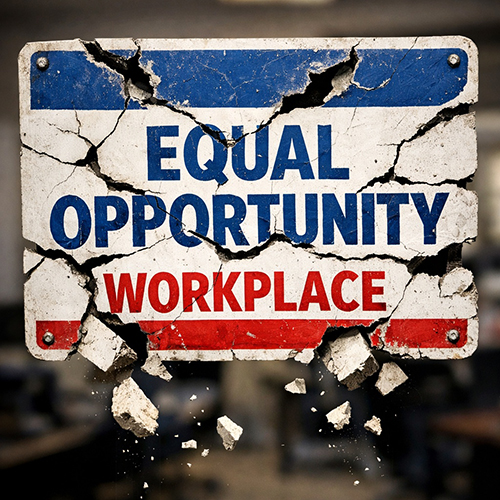
A stunning opinion from the Justice Department on Tuesday, June 9, seeks to gut federal protections against employment discrimination. If allowed to stand, it would override a 55-year-old Supreme Court precedent and nullify a 35-year-old federal statute protecting workers from race and sex bias. Although it will change the practices of the Equal Employment Opportunity Commission and Justice Department enforcement efforts, it is not binding on the courts and they must reject this assault on civil rights.
In 1971, in Griggs v. Duke Power Company, the Supreme Court held that Title VII of the 1964 Civil Rights Act--which prohibits employment discrimination based on race, sex, or religion--creates liability when there is disparate impact. The Court concluded that even if there is not discriminatory intent, an employer may not use a job requirement that functionally excludes members of a certain race or sex if it has no relation to measuring performance of job duties. The Court rightly interpreted Title VII as saying that tests or measures used in hiring are not permissible if they have a discriminatory effect unless they have some proven connection to the job.
In a series of cases in 1989, the Supreme Court interpreted Title VII to make it more difficult to create liability based on discriminatory impact. In response, Congress adopted the Civil Rights Act of 1991. This law was explicit that disparate impact was sufficient for liability for employment discrimination under Title VII. The 1991 Act said that if there was proof of disparate impact, the employer had the burden to demonstrate that a challenged practice is "job related for the position in question and consistent with business necessity." The law requires employers to show the practice genuinely relates to job performance, not merely that it serves some legitimate business interest.
This is crucial because proving discriminatory intent is so difficult. Decision-makers rarely express racism or sexism as their motives for action. Moreover, voluminous literature documents that we all have unconscious biases that influence our choices. And we should be concerned when our laws or practices have the effect of perpetuating discrimination.
Although the Supreme Court has said that proving an equal protection violation requires demonstrating discriminatory intent, statutes can provide more protection of rights than have been found in the Constitution. Thus, many federal and state laws create liability based on proof of disparate impact.
In 2009, in a concurring opinion in Ricci v. DeStefano, Justice Antonin Scalia questioned disparate impact liability. In a case involving employment discrimination, Justice Scalia said that disparate impact liability under Title VII could cause employers to consider race to ensure that their practices did not have a discriminatory effect. He argued that effectively requiring consideration of race raises serious equal protection concerns. He said that the Supreme Court would need to address the issue. It has not done so, but that did not keep the Trump Department of Justice from doing so on its own.
The Justice Department's Office of Legal Counsel, in a 25-page opinion, took the position that disparate impact liability no longer should be sufficient for liability under Title VII; there must be proof of discriminatory intent. And the opinion made it much easier for employers to show "business necessity," saying that this "requires employers demonstrate only that the challenged practice rationally serves a valid business purpose." The opinion says: "Workplace requirements and selection procedures--such as background checks, aptitude tests, and SAT score--are presumptively job related. Only irrational or arbitrary practices with no plausible job-relatedness can create disparate impact liability."
In other words, the Justice Department opinion makes it much harder for plaintiffs to prove discrimination and much easier for employers to avoid liability. It completely nullifies the provisions of the 1991 Civil Rights Act.
This is not the first time the Trump administration has attacked disparate impact liability. On April 23, 2025, Trump issued an Executive Order, "Restoring Equality of Opportunity and Meritocracy." It declares: "It is the policy of the United States to eliminate the use of disparate-impact liability in all contexts to the maximum degree possible to avoid violating the Constitution, Federal civil rights laws, and basic American ideals."
The Justice Department opinion is directed to the Equal Employment Opportunity Commission. It says that the "EEOC's existing interpretations ... embrace an unconstitutional reading of Title VII." Of course, it is not the Supreme Court that has held this. Rather, it is just the very conservative Justice Department on its own saying that the federal government will no longer follow the Supreme Court's 1971 decision in Griggs v. Duke Power Company or the provisions of the 1991 Civil Rights Act.
The Justice Department opinion relies heavily on the concurring opinion from Justice Antonin Scalia from 17 years ago in Ricci v. DeStafano. The Justice Department repeatedly refers to the Supreme Court's recent opinion in Louisiana v. Callais, which interpreted Section 2 of the Voting Rights Act. Congress had amended that provision in 1982 to allow for liability upon proof that a state or local government had an election practice that had a discriminatory effect against voters of color. The Court said that the government could not use race as a predominant factor in drawing election districts even if needed to avoid a racially disparate impact.
But Louisiana v. Callais was entirely a decision about voting rights. There is a crucial difference between it and employment discrimination. In the voting rights context, prior Supreme Court precedents held that the government cannot use race in drawing election districts. But there is no such Supreme Court precedent that private employers cannot consider race or sex to avoid disparate impact liability. Quite the contrary, the only Supreme Court cases about affirmative action in employment--United Steel Workers of America v. Weber (1979) and Johnson v. Santa Clara County (1987) --allowed voluntary programs to increase participation of racial minorities and women in the workforce. Perhaps the conservative Supreme Court will reconsider these decisions, but they remain the law.
Most important, even if the Supreme Court extends Louisiana v. Callais to employment and even if the Court overrules its earlier decisions about affirmative action in employment, that does not provide a basis for the Justice Department's making it very easy for any employer to win an employment discrimination case by asserting a business necessity.
Nor is there any basis for the Justice Department saying that proving employment discrimination under Title VII requires that the plaintiff demonstrate that there is an "equally effective alternative" that would have less discriminatory effect. The federal employment discrimination statute is explicit that if an employment practice has a disparate impact, it is illegal unless the defendant can show a business necessity. There is absolutely nothing in the law that creates the additional burden imposed by the Justice Department that the plaintiff must show another way to achieve the employer's goals.
It is not surprising to see the Trump Justice Department trying to push the law in a very conservative direction. But it is astounding to see it disregard long established Supreme Court precedent and nullify a federal statute. Hopefully, the courts--and even this Supreme Court--will say the Justice Department has gone too far in gutting the protection for workers in this country to be free from race and sex bias in employment.
Submit your own column for publication to Diana Bosetti
For reprint rights or to order a copy of your photo:
Email
Jeremy_Ellis@dailyjournal.com
for prices.
Direct dial: 213-229-5424
Send a letter to the editor:
Email: letters@dailyjournal.com