


Constitutional Law
Jun. 18, 2026
Proposition 50's gerrymander worked exactly as designed
Post-primary analysis of Proposition 50's redistricting shows a near-elimination of competitive California congressional districts and a strong projected Democratic advantage in the state's House delegation.


James R. Bozajian
Mayor
City of Calabasas
Email: jbozajian@cityofcalabasas.com
Bozajian is a former prosecutor and Calabasas City Councilmember
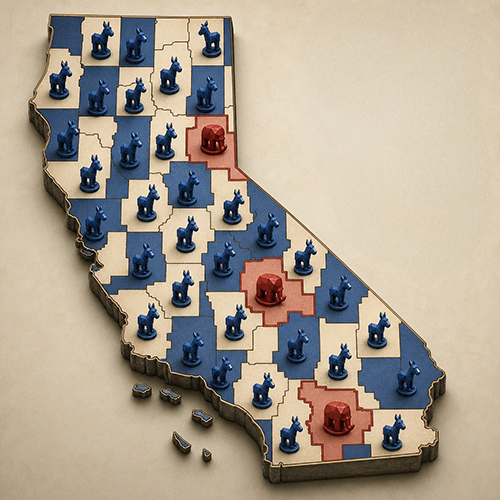
With the long-anticipated California Primary Election finally over, we can now more clearly measure the impacts of last year's drastic alteration of the State's 52 U.S. congressional districts. In November 2025, State voters approved Proposition 50, a Democrat-sponsored initiative that sought to bypass the California Citizens Redistricting Commission in order to gerrymander districts in the Democrats' favor.
Republicans currently hold only nine of the State's Congressional seats. Proposition 50 was designed to further reduce Republican representation after the 2026 election cycle. In order to reach this goal, the Democratic authors of the initiative re-drew political lines to pack as many Republican voters as possible into just four districts, while adding more Democrats to the other Republican-held and swing jurisdictions.
The result is that California now has four overwhelmingly Republican districts and only a couple of potentially competitive ones. The rest are safely Democratic, absent a huge Republican "wave" (that is unlikely to materialize this year). The expectation was that this restructuring would yield a tremendous Democratic edge over Republicans in California's delegation to the U.S. House of Representatives--perhaps upwards of 90% to 10%--in a State where the Democrats' typical advantage in the two-party vote hovers around 60% to 40%.
And based on the Primary Election returns, Proposition 50 worked exactly as planned. While there are no hard-and-fast rules about how to assess Congressional Districts in an open primary system such as California's, there are certain principles that can provide some guidance.
The easiest calls are the political "shut-outs"--those races where the top two candidates proceeding to the General Election are from the same party. In these situations, the political party in question is guaranteed of victory. The recent Primary produced nine shut-outs. Eight of them feature two Democrats in the General Election, while one of them features two Republicans.
For the remaining races, one formula that has been fairly accurate over time involves adding up all votes cast for Democratic candidates in a given district, and comparing that number to all votes cast for Republican candidates running for the same office. If the difference is 10 percentage points or less, the race could become an electoral battleground, depending upon the many other variables that often make politics so unpredictable. Conversely, if the spread between the two parties is greater than 10 percentage points, the race is unlikely to be hotly contested.
Aside from the shut-outs, there are 38 additional districts where the combined vote for Democratic candidates exceeded the combined vote for Republican candidates by more than 10 percentage points, while there are three districts where the total votes for Republicans topped the total votes for Democrats by more than 10 points. This leaves only two races that are even marginally competitive, and in both of them there were more votes cast for Democrats than for Republicans. If we go one step further and look at districts where the partisan divide is less than five percentage points (the sign of a true swing district), there are precisely ... zero.
Proposition 50 faces no further legal impediments. The U.S. Supreme Court determined several years ago that partisan gerrymandering is not unconstitutional per se. [Rucho v. Common Cause, 588 U.S. 684 (2019)] And earlier this year, the Court specifically rejected a challenge to the constitutionality of Proposition 50 [Tangipa v. Newsom, 25A839 (2026)]
All of which means two things. First, that the goal of limiting California Republicans to a scant four Congressional seats is well within reach for the architects of Proposition 50. Second, that at least until the next redistricting cycle, California's Congressional elections will be largely devoid of competition.
Submit your own column for publication to Diana Bosetti
For reprint rights or to order a copy of your photo:
Email
Jeremy_Ellis@dailyjournal.com
for prices.
Direct dial: 213-229-5424
Send a letter to the editor:
Email: letters@dailyjournal.com