


Environmental & Energy
Jun. 15, 2026
Paper water markets and the future of the Colorado River
As worsening drought strains the Colorado River, Western states are exploring "paper" water trades--using desalination, recycling, and accounting mechanisms to swap water across state lines--even though existing laws may not clearly allow it.


In early May, Arizona, California and Nevada proposed a plan to stabilize the drought-stricken Colorado River through 2028. In mid-May, the federal government proposed a longer (10-year) plan for the Colorado River that could cut up to 40% of current supplies to those three states.
Meanwhile, in an effort to find creative solutions to pressures on the Colorado River, in February, the board of San Diego County Water Authority (Authority) approved a draft Memorandum of Understanding (MOU) to explore interstate water transfers.
Other potential signatories are Southern Nevada Water Authority, Arizona Department of Water Resources, Central Arizona Water Conservation District/CAP, the Bureau of Reclamation (Reclamation), and Metropolitan Water District of Southern California (Metropolitan).
If approved by all parties, the MOU would create a preliminary framework to explore the legal, regulatory, accounting and operational mechanisms for future water transfers between these states.
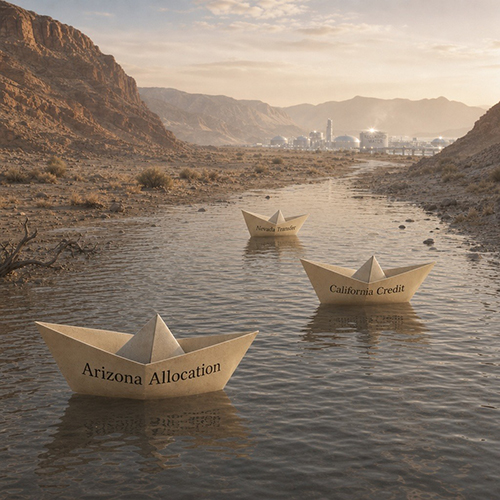
The Authority Staff Memorandum envisions a potential tool to monetize unused water in certain years and enhance flexibility during drought. The memo notes the 2007 Colorado River Operating Guidelines expire at the end of 2026, making this the right time to shape new frameworks, noting growing interest among basin partners and Reclamation in market-based tools. Under one scenario, Nevada or Arizona would purchase a right to water desalinated by the Authority but, instead, use a portion of the Authority's Colorado River allocation. This could avoid a physical transfer, in favor of an accounting mechanism or "paper transfer." Using recycled or "new" desalinated water could avoid infringing water rights within California.
This type of water banking or transfer raises an interesting question as to whether a new legal framework is needed to allow these arrangements across state lines.
The apportionment and transferability of Colorado River water allocations are governed by the "Law of the River," a body of law that includes the 1922 Colorado River Compact, the 1928 Boulder Canyon Project Act (BCPA), the Colorado River Front Works and Levee System Act of June 18, 1946, and the Supreme Court's decision and decrees in Arizona v. California (1963) 373 U.S. 546, 579. In addition, under a 1944 treaty, among other provisions, the U.S. makes 1.5-million-acre feet in annual flows available to Mexico. Mexico shares in cutbacks when Lake Mead is low. The Court in Arizona v. California held the U.S. also has a reserved amount of Colorado River water for the Native American reservations to satisfy their present and future needs, referred to as present perfected rights. (373 U.S. at 600.)
The Compact divides the basin into Upper and Lower Basins with fixed apportionments, and the Lower Basin states (Arizona, California, Nevada) receive specified shares. The Supreme Court in Arizona v. California recognized Congress' constitutional authority to apportion interstate waters and authorized the Secretary of the Interior to manage allocations during shortages or surplus.
The Colorado River Compact guaranteed each basin allocations, treating those allocations as state-level claims. The Colorado River Compact does not address trades between regional water agencies located within different states. Whether transfers are characterized as "accounting mechanisms" or "paper transfers," the contemplated transfer arrangements would require federal approval.
On its face, the BCPA's apportionment scheme creates state-specific allocations that cannot be unilaterally transferred between states. (43 U.S.C. § 617c.) This limitation is tied to use in the State, indicating that a portion of California's allocation cannot be transferred for use in other states. "Nothing in federal law shall be construed as interfering with such rights" as the States had on Dec. 21, 1928, except as modified by the Colorado River compact or other interstate agreement. (43 U.S.C. § 617q.)
Congressional consent would be required for any interstate compact that would "provide for the construction of dams, headworks, and other diversion works or structures for flood control, reclamation, improvement of navigation, division of water, or other purposes." (43 U.S.C. § 617r.) Such a compact could also require approval "by the legislature of each of such States." (43 U.S.C. § 617r.) Though addressing a different compact, the Supreme Court emphasized interstate water compacts do not easily permit cross-border transfers absent express authorization. (See Tarrant Regional Water Dist. v. Herrmann (2013) 569 U.S. 614.)
However, there is evidence of openness to creative solutions to River shortages at both the federal and state level. Reclamation is a possible signatory to the MOU.
Since 1999, regulations have created Intentionally Created Surplus (ICS) programs allowing entitlement holders to bank and possibly transfer unused water, under the Secretary's oversight. (43 C.F.R. Part 414; 2019 Drought Contingency Plan.)
Nevada and Arizona are partnering with Metropolitan, which has an ICS storage account in Lake Mead, to build a plant in California to treat sewage water for the benefit of the three states.
California's and Utah's governors have commented positively on the idea of Utah investing in desalination projects, with the aim of securing more River water.
New Operating Guidelines are being drafted, and some stakeholders may advocate for market tools while pushing back on proposed cuts to allocations. The comment period for the draft Environmental Impact Statement for potential approaches to the Operating Guidelines closed in March 2026. If the Secretary selects operations options that rely on congressional action and Congress does not act, the Secretary may be forced to limit post-2026 activities to those available under existing authorities and funding. (See Cong. Research Serv., R45546, Management of the Colorado River: Water Allocations, Drought, and the Federal Role (Mar. 31, 2026).)
For reprint rights or to order a copy of your photo:
Email
Jeremy_Ellis@dailyjournal.com
for prices.
Direct dial: 213-229-5424
Send a letter to the editor:
Email: letters@dailyjournal.com