


Ethics/Professional Responsibility
Jun. 15, 2026
Small habits that lead to big legal trouble
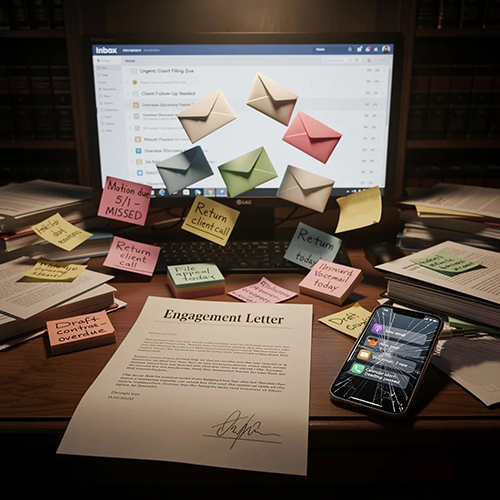
Common law practice habits such as disorganized email management, weak mobile device security, failure to use engagement letters, inadequate docket control and insufficient attention to malpractice insurance can increase exposure to legal malpractice risk, while improving these practices can reduce that risk.


There is an entire industry dedicated to personal growth and self-improvement, offering programs and strategies to support every aspect of wellness--from improving health and achieving fitness goals to strengthening relationships.
Lawyers, too, can develop professional habits that undermine their practices. Some of these habits can make it more difficult to avoid legal malpractice claims or even create additional risk. Fortunately, there are simple steps lawyers can take to break these patterns and reduce exposure to claims.
There is an entire industry dedicated to personal growth and self-improvement, offering programs and strategies to assist with all aspects of wellness--from improving health and achieving fitness goals to improving relationships.
Lawyers, too, can develop professional habits that undermine their practices. Some of these bad habits can make it harder to avoid legal malpractice claims or can even create risk. Fortunately, there are simple steps lawyers can take to break these patterns that can lead to claims.
Organize emails
It is common for lawyers to use their email inbox as essentially one massive file or task list. But leaving emails unattended in an inbox, with the goal of "getting to them later," can create a never-ending stream of missed deadlines, especially at times when email volume is high.
It can be difficult to later confirm key events in a matter, especially if the representation has been inactive for some time.. Lawyers may then spend critical time searching for communications when an organized mailbox (with folders dedicated to each matter) can help reduce that frustration. Moreover, a lawyer may inadvertently miss a deadline or an important communication because of delays in processing or reading emails. Some law firms will even limit the number of emails that can be kept in an inbox in an effort to encourage lawyers to process their emails timely.
Different lawyers may have their own methods of reviewing or organizing emails, but the important thing is to maintain some level of organization so that materials aren't inadvertently missed.
Safeguard cell phones!
Lawyers rarely go anywhere without their mobile phones, which allow them to stay in contact with clients, send and receive emails, and access client confidential information. But lawyers who do not safeguard their phones face significant risk, particularly if a device is lost or if appropriate security measures are not in place.
Most law firms require the use of complex passcodes that must be changed on a periodic basis. In that way, if a phone is left in a restaurant or in the back of a rideshare, the firm's files and network are still protected. In addition, law firms may use programs that allow them to "remote wipe" data from smartphones in the event phones are lost or stolen. Others use programs that ensure smartphone data is encrypted or employ features such as GPS tracking and secure file sharing.
The necessary level of protection may vary by firm or by client, but lawyers can take care to protect their data.
Use engagement letters
Another bad habit too many lawyers adopt is failing to use engagement letters. In some cases, lawyers simply get wrapped up in a new matter and forget to issue one. Others purposely avoid them because they worry that providing such terms for the client could make the client think about all the things that could go wrong in a representation. But engagement letters are one of the best risk management tools available to lawyers.
An engagement letter that clearly identifies the client, describes the scope and duration of representation, or confirms the fees to be charged for the firm's services can provide a defense against a later claim that misstates these terms.
Get back-up support on deadlines
Time is often the most precious commodity for a lawyer. But missing a deadline, forgetting a court appearance or failing to attend to client interests or demands are among the most common bases for legal malpractice claims. Such errors can also be easy for a legal malpractice plaintiff to explain to a jury, which creates risk.
Even the most vigilant or experienced lawyers may inadvertently fail to comply with a deadline, particularly if a systematic approach is not used to keep track of important dates. By implementing and using a computer-generated system for docketing, lawyers are more likely to prevent time-related errors. The use of a docketing system also means that lawyers do not have to keep deadlines in their mental datebooks. To avoid any errors or missing deadlines, lawyers can employ and then reevaluate their calendar or docket control system. Effective docket control systems should help, not hinder, the practice of law.
If a docket control system is not helping a lawyer track and manage deadlines, there may be a better system for the practice. A resourceful docketing system is user-friendly, accurate and reliable. Further, once a docketing system is established, it is important to actually use it. Failure to do so defeats the purpose of establishing such a system and potential risks remain. If documents or deadlines are not fed into the docketing system, there is still a significant risk of missing a deadline--and receiving a claim.
Get insured
Legal malpractice insurance coverage is a necessity of the modern law practice, even where the jurisdiction does not specifically require lawyers to carry insurance. (In California, for example, lawyers who are uninsured may have an obligation to inform their clients in certain circumstances.) Professional liability coverage is a benefit to all lawyers, even those who do not anticipate receiving malpractice claims.
Further, for those lawyers who do carry insurance, it is good practice to periodically review the existing professional liability policy before a claim is made to identify any potential gaps and to fully consider whether the policy provides coverage that meets the needs of the firm and its lawyers.
Identifying and working to break these bad habits can reduce both the likelihood and severity of a legal malpractice claim.
Submit your own column for publication to Diana Bosetti
For reprint rights or to order a copy of your photo:
Email
Jeremy_Ellis@dailyjournal.com
for prices.
Direct dial: 213-229-5424
Send a letter to the editor:
Email: letters@dailyjournal.com