


Criminal,
Civil Rights
Jun. 12, 2026
Badges and bombs: How the 1938 Harry Raymond attack still informs police reform, legal ethics
The Harry Raymond car bombing remains one of the darkest chapters in Los Angeles' legal history, offering a nearly century-old warning about the dangers of unchecked police power, retaliation and failed accountability.


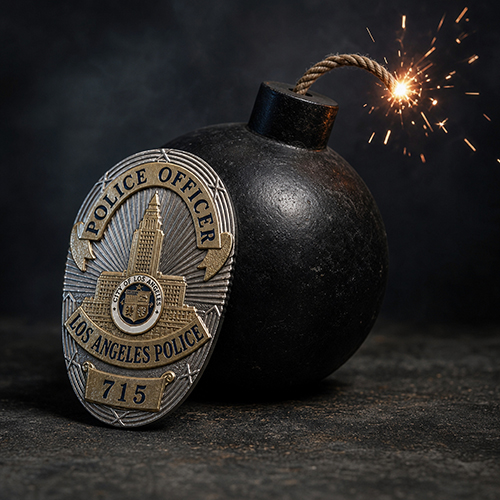
On the morning of Jan. 14, 1938, former LAPD detective Harry Raymond slid
behind the wheel of his car in the garage of his Boyle Heights home, turned the
ignition key and unleashed hell. A powerful dynamite bomb wired to the starter
exploded with devastating force. The engine was blown through the hood. More
than 150 pieces of shrapnel tore into Raymond's body. He survived--barely--but
the message was unmistakable: the Los Angeles Police Department's own
Intelligence Unit had tried to assassinate one of its own for daring to investigate
City Hall and the department itself.
This was not the work of underworld triggermen. The bombers wore badges. They
operated under orders from within the LAPD command structure, protecting a
corrupt political machine that had turned Los Angeles into a protected
playground for vice and graft. The Harry Raymond car bombing remains one of the
darkest chapters in the city's legal history--and a cautionary tale whose
lessons about police power, retaliation and accountability remain painfully
relevant nearly nine decades later.
The Raymond case exposed a systemic collapse of legal ethics at the highest
levels of municipal government and law enforcement. Under Mayor Frank L. Shaw
and LAPD Chief James E. "Two-Gun" Davis, the line between public service and
organized protection rackets had virtually disappeared.
From insider to target: Harry Raymond's dangerous mission
Raymond was no idealistic outsider. Born in 1881, he was a
seasoned LAPD detective who had risen through the ranks with a reputation for
toughness. In 1933, he briefly served as Chief of Police in San Diego, lasting
only about 90 days after aggressively pursuing vice operations and resisting
political pressure. Back in Los Angeles, he worked as a private investigator.
In 1936, Raymond was hired by Clifford E. Clinton, the progressive owner of
Clifton's Cafeteria and founder of the Citizens Independent Vice Investigating
Committee (CIVIC). His mission: document ties between organized crime, the LAPD
and the Shaw administration. What he uncovered--alleged protection payoffs for
gambling, prostitution and bootlegging--made him a marked man. The LAPD's
secretive Intelligence Unit (the "Spy Squad") placed Raymond and Clinton under
continuous surveillance.
The bombing and LAPD's internal conflict
On Jan. 14, 1938, at approximately 10:00 a.m., Raymond started
his car at 955 Orme Street. The expertly wired dynamite bomb detonated. He
sustained over 150 shrapnel wounds, a punctured chest and broken bones. Doctors
initially gave him little chance of survival.
The attack exposed deep conflicts within the LAPD itself. The Intelligence
Unit, operating with little oversight and direct loyalty to Chief Davis and the
mayor's political machine, had become an instrument of retaliation rather than
law enforcement. Officers tasked with protecting the public were instead
deployed to intimidate reformers and silence investigations into departmental
corruption. This internal rot--where one faction of the department weaponized
its power against perceived enemies--represented a profound betrayal of public
trust and legal ethics.
Badges on trial
The case proceeded to trial in the spring of 1938. Captain Earl E. Kynette, head of the Intelligence Unit, along with Lieutenant Roy Allen and Sergeant Fred Browne, stood accused. The proceedings had a distinctly noir atmosphere. Kynette invoked the Fifth Amendment and, in a dramatic gesture, reportedly read portions of the U.S. Constitution in open court. Chief Davis's testimony was so unpersuasive that Judge Fletcher Bowron dismissed parts of it as "a debris of words."
The prosecution relied on forensic evidence linking the bomb to
LAPD sources and extensive documentation of the surveillance operation. Raymond
testified despite his injuries. On June 16, 1938, the jury convicted Kynette of
attempted murder, assault with intent to commit murder and malicious use of
explosives. Allen was also convicted. The California Supreme Court later upheld
the convictions in People v. Kynette, 15 Cal.2d 731 (1940).
Kynette received a sentence of two years to life. The outcome represented a
rare victory of accountability over official impunity.
Political earthquake: The recall of Mayor Frank Shaw
The trial's revelations fueled public outrage. On Sept. 16, 1938, Los Angeles voters took historic action: Mayor Frank L. Shaw became the first mayor of a major American city to be successfully recalled. Judge Fletcher Bowron, who had presided over key aspects of the case, was elected as his replacement on a reform platform. Chief Davis resigned shortly afterward.
Modern echoes: Lessons for legal ethics and police reform
The Raymond case offers more than historical drama. It provides a foundational reference point for contemporary debates on legal ethics and police accountability.
First, it illustrates the persistent danger of retaliation against whistleblowers and investigators. While physical bombs are rare today, subtler forms of intimidation--career retaliation, strategic litigation and targeted leaks -- continue. California's whistleblower protections exist precisely because of historical abuses like this one. Recent controversies involving LAPD whistleblowers and surveillance of protest movements demonstrate that these tensions have not been fully resolved.
Second, the rogue Intelligence Unit foreshadows later failures, most notably the Rampart scandal that led to a federal consent decree. Modern parallels include concerns over surveillance technologies, fusion centers and the monitoring of journalists and activists. Legal ethics demand that specialized units serve legitimate purposes, not political ones.
Third, the case highlights the critical importance of institutional independence within law enforcement. When loyalty to leadership or political patrons overrides the oath to uphold the law, the entire system is compromised.
Finally, the successful 1938 recall demonstrates both the power and the limits of public accountability. Today's mechanisms--the LAPD Police Commission, civilian oversight, body cameras and inspector general reviews--are more sophisticated, yet cycles of scandal and reform persist. The core question remains: Has Los Angeles built safeguards strong enough to prevent the next Harry Raymond?
Raymond's story is more than classic Los Angeles noir. It serves as a foundational case study in the fragility of institutional integrity. When law enforcement weaponizes its power against those who seek to hold it accountable, public trust collapses. Nearly 90 years later, the central question for Los Angeles remains unanswered: Have we built systems strong enough to ensure that the next Harry Raymond is protected rather than targeted?
The views expressed here are the author's and not those of the California Military Department or the Los Angeles County District Attorney's Office.
Submit your own column for publication to Diana Bosetti
For reprint rights or to order a copy of your photo:
Email
Jeremy_Ellis@dailyjournal.com
for prices.
Direct dial: 213-229-5424
Send a letter to the editor:
Email: letters@dailyjournal.com