


Intellectual Property
Jun. 9, 2026
FIFA's brand police gearing up for the 2026 World Cup
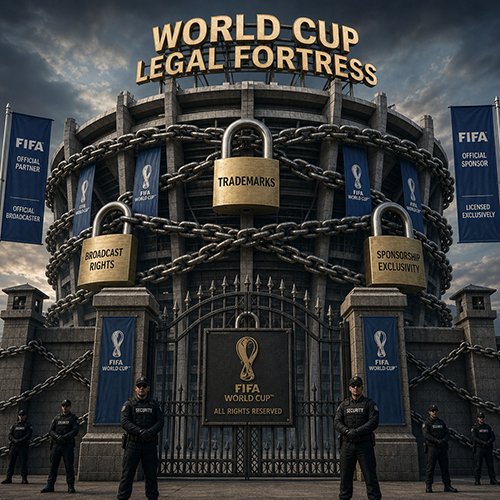
FIFA aggressively protects its World Cup intellectual property and commercial rights, creating significant legal risks for advertisers and sponsors around ambush marketing, trademark use, player endorsements and cross-border advertising compliance.





More than 1.5 billion viewers watched the 2022 World Cup final between Argentina and France. The 2026 edition promises to be even bigger. Hosted across the United States, Canada, and Mexico and fueled by surging North American interest in soccer, the tournament represents a once-in-a-generation commercial opportunity for brands.
But the opportunity comes with guardrails. Brand protection sits at the core of FIFA's business model, and the organization aggressively defends its commercial rights. Advertising that implies an official relationship with FIFA or the World Cup where none exists can draw swift enforcement action.
FIFA's commercial fortress
FIFA guards its commercial turf with 13,000 registered trademarks worldwide and a track record of using them.
During the 2014 World Cup, it held approximately 1,116 registered marks in the host country alone and confiscated 274 items at the Maracanã across just four group-stage matches. It sent cease-and-desist letters to Decolar, a Brazilian travel company, for using the Portuguese word for "World Cup" in ways suggesting it was an official travel partner.
FIFA sued Puma in 2022 over the marks "PUMA WORLD CUP QATAR 2022" and "PUMA WORLD CUP 2022," winning cancellation of all contested marks.
FIFA's reach extends into the broadcast booth. Stadium naming-rights deals go dark during World Cup telecasts unless the rights holder is an official FIFA partner. A match at Lumen Field or NRG Stadium, for instance, will simply air as "Seattle Stadium" or "Houston Stadium."
For 2026, FIFA has signaled it will pursue any advertisement that implies a brand connection to the tournament. Using general terms like "football" or "World Cup" is no shield. If the messaging creates confusion with official marks or suggests an official FIFA relationship, enforcement will follow.
Ambush marketing: The biggest trap for non-sponsors
Ambush marketing is the art of riding an event's buzz without paying for a seat at the table. It takes two main forms. Ambush by association involves messaging that suggests an official connection to the event. Ambush by intrusion involves unauthorized brand activations in or near the event environment to capture audience attention without paying for official access.
The textbook World Cup ambush case dates to South Africa 2010. Bavaria Brewery, a Dutch beer brand with no FIFA sponsorship, dispatched women in matching orange dresses to a match to steal visibility from Budweiser, the tournament's official beer sponsor. Bavaria never used a single FIFA trademark. It simply put bodies in seats wearing brand-associated colors. FIFA responded by removing every woman in orange from the stadium.
Ambush marketing does not require use of an official logo or protected trademark. A brand can avoid every FIFA mark and still face enforcement if it uses football imagery or tournament-adjacent language that implies an association with the World Cup. Whether non-sponsors can safely use the term "World Cup" remains a gray area, but clever wordplay offers no guarantee of safety. In 2010, FIFA forced South Africa's Kulula Airline to pull an ad campaign describing itself as the "Unofficial National Carrier of the You-Know-What."
Sometimes FIFA's enforcement backfires. At Brazil 2014, Neymar was photographed wearing Blue Man boxer shorts under his Brazil kit during a match against Cameroon. FIFA investigated the Brazilian beachwear brand, but the publicity only boosted demand: Blue Man reported a 25% spike in sales.
FIFA's latest enforcement tactic enlists its own fans. The organization has deployed 2026 World Cup volunteers to tournament sites to photograph advertisements near venues, enabling FIFA to identify and pursue non-sponsor ambush marketing in real time.
Player deals, digital plays and media rights
Featuring a recognizable player in a campaign can trigger claims from the player, FIFA, or both. Three separate rights converge: state-level name, image, and likeness rights; federal false endorsement claims; and FIFA's own participation agreements restricting endorsement activity during the tournament. Even if a player wants to do a deal, they may be contractually barred, and an arrangement that looks clean to the player and the brand can still spark a dispute with FIFA or tournament sponsor.
Geotargeting around World Cup venues is another emerging issue. Advertisers can use stadium GPS coordinates to deliver digital marketing directly to fans attending matches. Sponsors associated with the NFL's Super Bowl have already pushed for "digital clean zones" designed to restrict this practice, and similar pressure is likely around World Cup venues in 2026.
Broadcast rights for 2026 have been carved up on an exclusive, territory-by-territory basis: FOX Sports holds the English-language U.S. rights, Telemundo the Spanish-language U.S. rights, and separate licensees cover Canada and Mexico. Direct use of match footage is tightly controlled, but brands can align with a broadcaster's coverage as a broadcast sponsor or through digital integrations: a route that can unlock creative activations at a fraction of official FIFA sponsorship costs. Delta Air Lines offers a case study: rather than competing for FIFA sponsorship, Delta partnered with Fox Sports, giving SkyMiles members complimentary access to Fox One via in-flight service and the ability to redeem miles for subscriptions.
Three countries, three rulebooks
Hosting the World Cup across three countries means navigating three distinct legal regimes governing advertising claims, privacy, language requirements, and consumer protection.
Mexico recently amended its Federal Law for the Protection of Industrial Property to expressly restrict ambush marketing around major international events. By contrast, neither the U.S. nor Canada has adopted event-specific anti-ambush laws, meaning enforcement generally relies on existing trademark, copyright, competition, and municipal laws.
Notably, U.S., Canadian, and Mexican authorities have launched a joint initiative to monitor unfair commercial practices surrounding the tournament, signaling a coordinated cross-border approach to enforcement.
The bottom line
The brands that succeed at the 2026 FIFA World Cup will be those that build legal strategy into their activations from the outset, enabling them to capture the tournament's enormous commercial opportunity while avoiding the legal and reputational risks that come with the world's most protected sporting event.
Submit your own column for publication to Diana Bosetti
For reprint rights or to order a copy of your photo:
Email
Jeremy_Ellis@dailyjournal.com
for prices.
Direct dial: 213-229-5424
Send a letter to the editor:
Email: letters@dailyjournal.com