


Torts/Personal Injury,
Ethics/Professional Responsibility
Jun. 9, 2026
Deja vu: Lawyer's mistakes might mean retrying the same PI case
Legal malpractice claims arising from personal injury cases generally require plaintiffs to prove, through a "trial-within-a-trial," that the attorney's negligence caused actual harm and that the underlying case would have produced a better outcome absent the attorney's error.



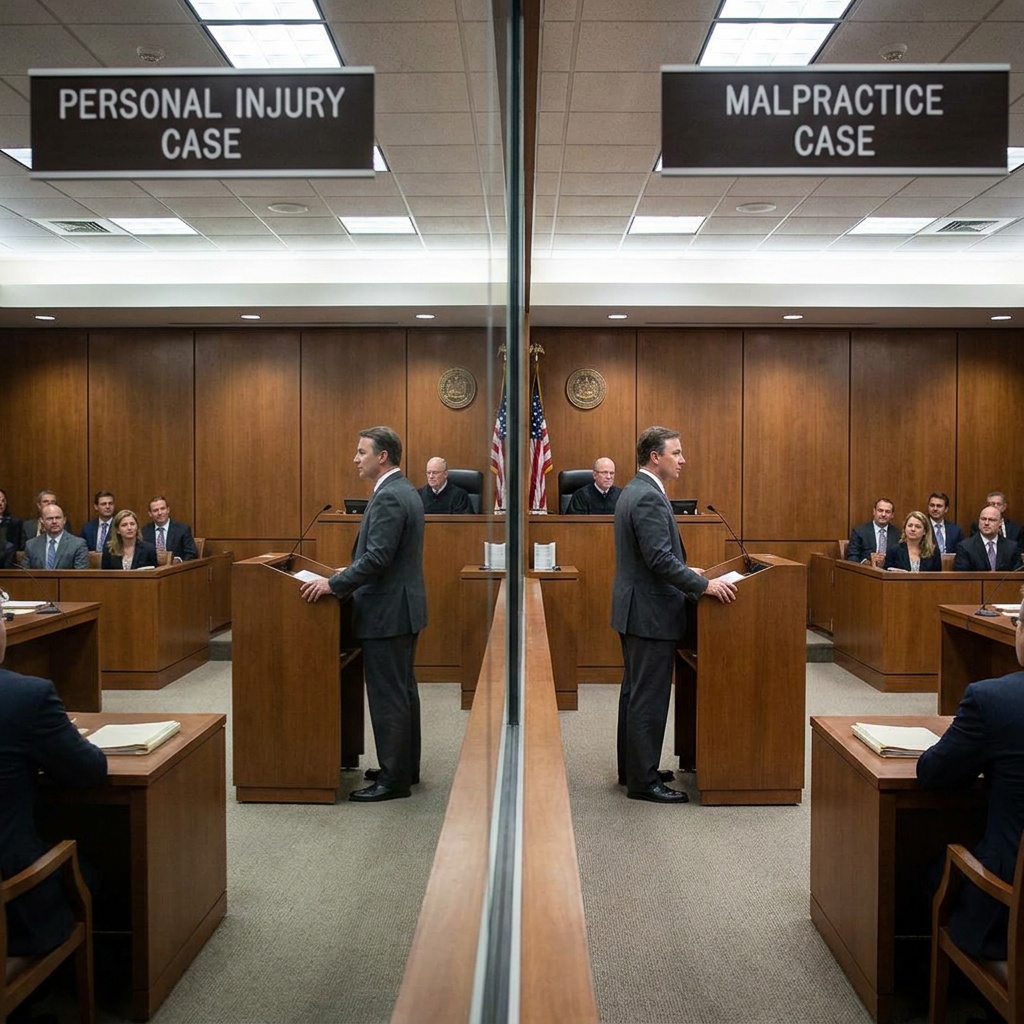
What could be worse than going through a lengthy, complicated personal injury trial? How about going through it a second time?
That can happen if a disappointing PI verdict is attributed to attorney malpractice. The attorney might have neglected to file required motions, missed the deadline for submitting important documents or waited so long to file the complaint that the statute of limitations ran. The plaintiff asserts that, but for those mistakes, the verdict would have been far more favorable to him or her.
Those are all serious errors, but not necessarily an open-and-shut malpractice case for the plaintiff. Even when an attorney's mistake is the clear reason for the loss, plaintiffs are often left uncompensated by their errant lawyers. How is that possible?
The law tells us that malpractice requires actual proof, and the only way to establish that proof is to try the personal injury case all over again. If the underlying case was a dud, the malpractice claim will likewise be a dud.
Professional malpractice 101
A second trial may be a huge headache, but it's the only way to validate the plaintiff's assertions. The whole point of the new trial is to establish or disprove the plaintiff's claim that he or she is entitled to damages because of what the attorney did or failed to do the first time around.
California law establishes four elements that must be proven in every legal malpractice case:
Duty: The attorney owed a legal duty based on an attorney-client relationship;
Breach: The attorney breached that duty by an act or omission that fell below the applicable standard of care;
Causation: The breach directly caused a negative outcome in the case or transaction;
Damages: The client suffered actual harm as a result of the attorney's acts or omissions.
Injury
Before malpractice damages can be awarded, there must have been an injury entitling the plaintiff to those damages. The mere fact that the attorney didn't handle matters correctly will not by itself be enough to state a malpractice claim. California Code of Civil Procedure Section 340.6(a)(1) provides that even when a client discovers facts to support a claim of negligence against the attorney, the statute will be tolled until the client can prove that he or she has sustained "actual injury."
In Budd v. Nixen (1971) 6 Cal.3d 195, the California Supreme Court held that "actual injury" occurs when "the client suffers appreciable harm as a consequence of his attorney's negligence." (Id. at 200-01.) "The mere breach of a professional duty, causing only nominal damages, speculative harm, or the threat of future harm - not yet realized - does not suffice to create a cause of action for negligence," and does not rise to the level of actual injury. (Ibid.)
Actual injury is generally a question of fact, but if the material facts are undisputed, the court may decide when actual injury occurred as a matter of law. (Adams v. Paul(1995) 11 Cal.4th 583, 585-86.)
Causation
There must also be causation--a link between the attorney's acts and the harm suffered by the client. California Civil Jury Instructions (CACI) Series 600 outlines the burden of proof in legal malpractice actions, and CACI No. 601 establishes the requirements for proving causation:
"To recover damages from [name of defendant], [name of plaintiff] must prove that [he/she/nonbinary pronoun/it] would have obtained a better result if [name of defendant] had acted as a reasonably careful attorney. [Name of plaintiff] was not harmed by [name of defendant]'s conduct if the same harm would have occurred anyway without that conduct."
In other words, the plaintiff must show that but for the attorney's negligent acts or omissions, he or she should have obtained a more favorable result. (Viner v. Sweet (2003) 30 Cal.4th 1232, 1244 [135 Cal.Rptr.2d 629, 70 P.3d 1046].) "If the allegedly negligent conduct does not cause damage, it generates no cause of action in tort. The mere breach of a professional duty, causing only nominal damages, speculative harm, or the threat of future harm - not yet realized - does not suffice to create a cause of action for negligence." (Jordache Enterprises, Inc. v. Brobeck, Phleger & Harrison (1998) 18 Cal.4th 739, 749-750 [76 Cal.Rptr.2d 749, 958 P.2d 1062].)
Trial-within-a-trial
Quite simply, professional malpractice claims must be tested against this question: "If the attorney had not erred, should the client have obtained a better result?" This is commonly referred to as the "case-within-a-case" or the "trial-within-a-trial"; the same methodology and causation standards will apply not only to personal injury claims, but also to transactional and other types of disputes. (See Loube v. Loube (1998) 64 Cal.App.4th 421, 426 ["The question is not what might or even what would have happened absent the alleged malpractice, but what should have happened.'], italics in original.)
"[The trial-within-a-trial method] is the most effective safeguard yet devised against speculative and conjectural claims in this era of ever expanding litigation. It is a standard of proof designed to limit damages to those actually caused by a professional's malfeasance." Mattco Forge, Inc. v. Arthur Young & Co. (1997) 52 Cal.App.4th 820, 834 [60 Cal.Rptr.2d 780].)
For legal malpractice experts, the mantra is simple: "The malpractice case will never be worth more than the underlying case was worth." As long as the malpractice claims are limited to professional negligence, this is absolutely accurate. Cases alleging other causes of action, such as breach of fiduciary duty or intentional misconduct could expose counsel to additional potential liability.
A personal injury case worth $50,000 is still only worth $50,000 against the errant attorney. It doesn't get better just because the lawsuit is now against a lawyer. The original case must be re-litigated to determine its merits, but if it turns out to have little or no value, there will be little or no recovery on the malpractice claim.
The botched PI case
Imagine a straightforward two-car collision with disputed liability. The alleged mistake by the former lawyer may have been obvious (failing to file the case on time, resulting in a successful statute of limitations defense), or it might have been more complicated (not calling a particular eyewitness to the accident, or not introducing a potential piece of outcome-determinative evidence). The nature of the purported error will typically not alter the fundamental question: Should there have been a different outcome?
The former lawyer lost the case; the plaintiff must now sue that lawyer to get any recovery. It should be a simple matter of suing the attorney and using an expert to testify about damages attributable to the attorney's error, correct? Alas, it isn't that simple.
The principle of "no harm, no foul" applies in this situation. If the lawyer had done everything in accordance with the applicable standard of care but the jury still would have ruled for the defense, professional negligence didn't cause harm to the plaintiff. He or she would have lost the case regardless. Suppose the plaintiff alleges that his or her lawyer's mistake caused the verdict to be lower than it should have been. If the second jury finds that he or she should get that same amount--or less--the plaintiff wasn't harmed by the attorney's error.
But even if the underlying case is proven to have a value that was "lost" because of the attorney's error, the plaintiff might nevertheless be left holding the bag. He still has the burden of proving thattried,more likely than not, he would have collected the judgment from the original defendant. "Collectibility" can be as simple as showing that the underlying defendant had an insurance policy worth "x" or had assets worth "y," but without such proof the professional malpractice case is doomed even if all other proof is present.
Bifurcation
Courts require that causation in these types of cases be proven through the "trial-within-a-trial" methodology. The professional negligence allegations are typically bifurcated, with the underlying PI case tried first, and the lawyers representing the allegedly negligent attorney standing in the shoes of the underlying defendant. Those lawyers will now be advancing arguments directly opposite the arguments that would or should have been made by their client in the original case.
Case law, however, does not clearly mandate bifurcation in these circumstances. In many instances and for a variety of reasons, including judicial efficiency, courts will allow plaintiffs to try both the professional negligence case and the underlying case simultaneously. Defense counsel might argue that injecting negligence claims into the proceeding will result in an automatic bias against their client, with the jury confused about which evidence applies to which case, but no case law or statute requires the court to sever claims for purposes of trial.
Retrying the PI case
Whether tried at the same time or not, the personal injury case still has to be "valued," and the only way for this to happen, absent stipulation, is for the original case to be tried --or re-tried --in front of a new jury. The second jury will now make a second decision about the value of the case.
The same witnesses who would have testified at the first trial must be called to testify at the "trial-within-a-trial": police officers, eyewitnesses, treating physicians, causation experts, and damages experts. The attorneys representing plaintiffs in malpractice cases must therefore be competent to try personal injury cases or they must retain counsel with PI experience to handle that aspect of the claim.
Nothing about the "trial-within-a-trial" should be any different than what would have transpired but for the alleged error or omission of the former attorney. Counsel must have particularized knowledge of the principles involved in the underlying case - duty, breach, causation, comparative fault and damages.
Retrial out of court
Plaintiffs cannot ordinarily short-circuit the difficult process of putting on the underlying case in its entirety, whether or not bifurcation is permitted. This makes such cases complex on at least two levels, heightening the challenges of trying them in a courtroom.
For this reason, professional malpractice cases involving personal injury claims are often ideal candidates for alternative dispute resolution with a qualified neutral. The mediator or Settlement Conference Judge chosen to oversee the process should have the requisite experience to identify and explore the strengths and weaknesses of both the underlying claim and the professional negligence claim.
Conclusion
Attorney malpractice in PI cases can be a real and serious matter, but it isn't a lottery ticket that automatically pays big rewards. The underlying case must have merit, the plaintiff must be able to establish harm, and there must be proof tying that harm to the attorney's errors. If he or she can't do this, the malpractice claim will have no merit.
As painful as it seems, the best and only way to prove a compensable malpractice claim is to relive the original trial all over again. But that pain can be considerably lowered by experiencing deja vu out of court, such as through mediation.
Submit your own column for publication to Diana Bosetti
For reprint rights or to order a copy of your photo:
Email
Jeremy_Ellis@dailyjournal.com
for prices.
Direct dial: 213-229-5424
Send a letter to the editor:
Email: letters@dailyjournal.com