


Technology
Jun. 10, 2026
The structural shift: How AI and automation are redefining opportunity for women in the legal profession
See more on The structural shift: How AI and automation are redefining opportunity for women in the legal profession



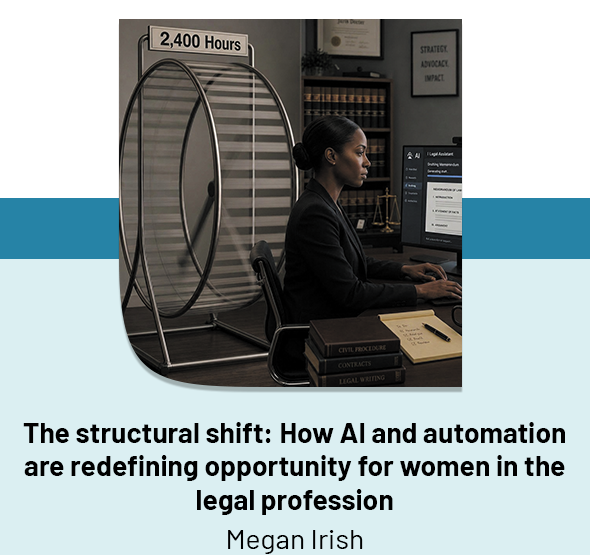
The conversation about women in the legal profession has, for decades, centered on familiar terrain: pay equity, partnership pipelines, mentorship and unconscious bias. Those issues remain real and unresolved, but a different and less-examined force is now reshaping the legal landscape in profound ways--that force is technology, and more specifically, the convergence of artificial intelligence, automation and a restructuring of the economic model of legal services delivery.
The old leverage model and its limitations
Traditional law firm economics, typically used in defense firms, rested on the leverage pyramid: partners generated business, associates provided labor-intensive hours and profitability was tied directly to headcount and billable time. This model, while effective at generating revenue, was structurally inhospitable to flexibility. The attorneys who advanced were those who could work without constraint, at any hour, for any client demand. For many women, the years when that kind of availability was expected coincided precisely with competing personal and family obligations. The structure did not bend, and careers were often shaped accordingly.
That model is now under serious economic pressure, and the pressure is coming from technology.
What automation is actually displacing
The tasks that AI is most aggressively absorbing are, not coincidentally, the same tasks that defined associate-level existence for generations: document review, contract analysis, legal research, due diligence and routine drafting. While the specific AI tools and their abilities are changing rapidly, tools like Ivo AI now allow an attorney to take an 80-page contract and have it analyzed against a playbook in an hour. Platforms like Amazon Quick enable legal teams to surface relevant case law, precedents and statutes in minutes. Eve, an AI Legal Assistant, is a tool to investigate and analyze cases, review documents, create timelines and organize evidence. A good AI tool will draft legal documents, letters, notes and internal memos. AI even assembled the first draft of this article! AI systems now can extract deadlines directly from court documents, automate billing, assist with drafting and keep matter activity organized across an entire firm.
The economic implication is significant. If the work that once required armies of junior associates can be performed by a single lawyer with well-deployed AI tools, the pyramid flattens. As AI tools allow lawyers to spend more time on high-value legal strategy and less on administrative tasks, they foster improved productivity and career growth. In short, the model is shifting from one that rewards hours to one that rewards judgment, relationships and expertise.
The opportunity hidden in the disruption
This structural shift creates an opening that deserves serious attention. The leverage that a lawyer brings to a firm is no longer defined solely by the hours she can bill, it is increasingly defined by her ability to deploy technology effectively, deliver high-quality analysis efficiently and build client relationships.
These are areas where women have historically demonstrated competitive advantage -- in client communication, collaborative problem-solving and nuanced judgment -- yet were often structurally disadvantaged when competing in a pure hours-driven model. AI does not care about hours. It compresses the time cost of lower-value work, which means the premium shifts to precisely the kind of lawyering that does not depend on unlimited availability.
Equally important is the changing economics of firm structure itself. Solo and small firm practitioners have access to the same research, drafting and management tools as major firms, although at a price. This democratization of legal infrastructure means that a woman who has the expertise, the client relationships, and the technological fluency can build a competitive practice without navigating the traditional hierarchies that have historically constrained advancement.
The risks that must be managed
The optimistic framing carries real caveats. AI displaces not just tedious work but entry points. If junior associate positions shrink in volume, the pipeline into senior roles narrows-- and pipelines that narrow tend to narrow unequally. The profession must ensure that AI-driven restructuring does not simply eliminate the pathways for young lawyers.
Selecting the right AI tool requires careful attention to privacy obligations, security standards and the risks of sharing confidential information with systems that use inputs for training purposes. Attorneys and firm leaders who engage seriously with this infrastructure question--who understand not just how to use these tools, but how they work and where they fail--will hold disproportionate influence in the next generation of legal practice. Women who invest in that fluency now will be positioned accordingly.
The moment for structural engagement
The restructuring of the legal profession is not a future event. It is happening now, and its contours are still fluid. The firms, practitioners and institutions that define how AI is integrated into legal work--what it replaces, what it elevates and how value is measured going forward--are making those decisions now. Women who are at the table for those decisions, and who approach them not as passive recipients of change but as architects of the new structure, stand to gain in ways that were simply not available before.
The traditional gender conversation in law has often asked how women can succeed within an existing structure. The more consequential question, for this moment, is what structure women will help build--and whether it will be one better suited to the full breadth of talent the profession has to offer.
Megan Irish is an attorney at the Dolan Law Firm.
For reprint rights or to order a copy of your photo:
Email
Jeremy_Ellis@dailyjournal.com
for prices.
Direct dial: 213-229-5424
Send a letter to the editor:
Email: letters@dailyjournal.com