


Guide to Legal Writing
May 29, 2026
How figurative language makes complex ideas more persuasive
Figurative language is the food processor of persuasion: It purees emotional resistance, slices through entrenched positions and breaks down complex ideas into digestible nuggets.



Jamie A. Jacobs-May
Mediator, arbitrator and court-appointed neutral
JAMS
Hon. Jamie Jacobs-May (Ret.), is a highly regarded mediator, arbitrator and court-appointed neutral with JAMS, based in Silicon Valley. With more than 31 years of judicial and ADR experience, including 21 years on the Santa Clara County Superior Court bench and service as Presiding Judge, Judge Jacobs-May handles a broad range of complex matters, including business and commercial disputes, employment, wage and hour and PAGA claims, class actions, probate and trusts, professional liability and personal injury cases.

Great news. This is not an article that requires the reader to learn (or relearn) the distinctions between metaphors, similes and analogies. Indeed, for our purposes, they all do the same thing, along with other linguistic devices, and will collectively be called figurative language.
Figurative language uses words or phrases to imply meanings beyond their literal definitions. It takes an object or action and compares it to something refreshingly familiar but completely unrelated. Consequently, ordinary language is transformed into something far more creative, engaging and memorable.
Compare these two opposing ways of expressing the same idea:
· A committee is a questionable mechanism for making decisions or solving problems.
· A committee is a cul-de-sac down which ideas are lured and then quietly strangled (Sir Barnett Cocks).
Here is another example:
· Adolescence is a time of great turmoil.
· Adolescence is a kind of emotional seasickness (Arthur Koestler).
Figurative language is also a powerful tool to help deal with uncomfortable and complex feelings. By connecting these feelings with unrelated but familiar experiences, they become easier to handle because we feel less threatened. For example, comparing the feeling of hopelessness to a storm can help: A storm does not mean the sky is broken and the sun will never shine. Like the storm, these feelings will pass, too.
The law deals with abstract concepts and is a big consumer of figurative language. Legal doctrine is full of metaphors because they put these abstract ideas into concrete terms. Indeed, their use is so commonplace that they no longer feel like metaphors at all, but rather take on the principle behind the metaphor and occupy all areas of the law. Examples include fruit of the poisonous tree, piercing the corporate veil, the long arm of the law, black letter law, eggshell plaintiff, wall of separation between church and state and meeting of the minds. For an overview of the use of metaphor and the law, see, Michael R. Smith, "Levels of Metaphor in Persuasive Writing," 58 Mercer L. Rev. 919 (2007).
In short, figurative language is a powerful tool in any mediation, negotiation or other circumstance where you want to be persuasive and understood.
The use of figurative language in mediation
In a mediation, figurative language can be used to bypass emotional triggers and provide access to new perspectives. One theme that is often difficult to grapple with is each party comes to the mediation with very different views of what happened and what motivations existed. It is often difficult for the parties to fathom how the other party can look at the same set of events and see things so differently, attributing it to bad faith, dishonesty and the like. One way to illustrate and normalize this very human phenomenon is to analogize it to the optical illusion of the young woman and old woman.
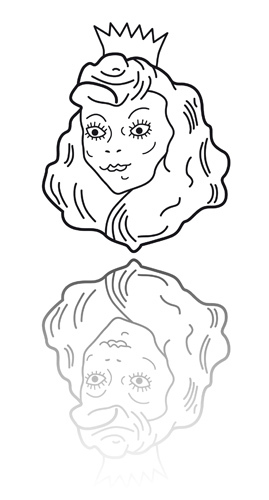
Some look at this picture and see only an old woman. Others see only a young lady. And some can ultimately see both. This becomes a metaphor for the human capacity to see the same things and interpret them so differently.
It is also common for emotions to run high. Because of the events that brought a case to mediation, the parties can be traumatized, feel very angry and desire retribution above all else. Here, the use of analogies might be helpful. For example, being angry and wanting to hurt the other side is like taking a poison pill and hoping the other person dies. Or, you are allowing the other party to occupy space in your mind rent free. Letting go of anger is like shaking off the sand that clings to your feet and causes discomfort or taking the weight out of the backpack to make the journey easier.
Sometimes, the parties seem not to be able to get past their need to recount and replay the bad acts of the other side. Addressing this perseveration requires a light touch. Enter a metaphor: If you keep looking in the rear-view mirror, you're not going to be able to get to your next destination. This comparison to driving makes the point in an easy-to-understand and non-threatening way.
Another common theme is that one side is providing offers or demands that the other side views as ridiculous because they are much too high or much too low. Accordingly, the exchange of numbers is stalling or stalled, and frustration builds. Another metaphor can sometimes help get the numbers to move: You have to hang the meat in sniffing distance of the dogs if you want to get their interest. Or, if you want the dancing to start, you have to play some music.
While there may be common themes in a mediation, it is also true that the challenges that come up are unique to the parties and to the legal and factual issues they face. It is critical to be sensitive to the very specific needs and options available to the parties and to use language that does not offend or otherwise undermine trust and confidence.
The use of figurative language by Supreme Court justices
Supreme Court justices, aware of the punch that figurative language delivers, have used this linguistic style in oral argument, majority opinions and dissents to make their points.
Consider Justice Ruth Bader Ginsburg's comment during oral argument in United States v. Windsor (2013) 570 U.S. 744, the landmark case concerning same-sex marriage. Addressing the unconstitutionality of the 1996 Defense of Marriage Act (DOMA), which defined a marriage as between a husband and wife and denied federal benefits to same sex couples, Ginsburg contested the position of the lawyer defending DOMA, who argued that DOMA did not interfere with a states' recognition of same-sex marriages. She responded in oral argument that if it's the "states' decision that there is a marriage between two people, for the federal government then to come in to say no joint return, no marital deduction, no Social Security benefits; your spouse is very sick but you can't get leave; people--if that set of attributes, one might well ask, what kind of marriage is this?"
After a lengthy discussion between the attorney defending DOMA and the justices, Ginsburg summed it up by saying the impact is pervasive--1,100 statutes--and they affect every area of married life. By denying federal recognition and benefits to same sex couples, you are saying there are two kinds of marriage; "the full marriage, and then this sort of skim milk marriage."
Justice Neil Gorsuch, while sitting on the 10th Circuit Court of Appeals, wrote an opinion in Dudnikov v. Chalk & Vermilion Fine Arts, Inc., (2008) 514 F.3d 1063, resolving whether Colorado had jurisdiction over the defendant, which threatened plaintiffs, retail sellers of fabric on eBay, for infringing on its copyrights. Defendant argued that its actions to stop plaintiffs' eBay auction were aimed at eBay in California and not at plaintiffs in Colorado.
Gorsuch wrote that defendant's action to stop the eBay auction "can be fairly characterized as an intended means to the further intended end of cancelling plaintiffs' auction in Colorado. In this way, it is something like a bank shot in basketball. A player who shoots the ball off of the backboard intends to hit the backboard, but he does so in the service of his further intention of putting the ball into the basket ... Their 'express aim' thus can be said to have reached into Colorado in much the same way that a basketball player's express aim in shooting off of the backboard is not simply to hit the backboard, but to make a basket." Id. at 1075
Finally, Justice Elena Kagan, in Descamps v. United States (2013) 570 U.S. 254, held that a past conviction for a violent felony can be used as an enhancement only when the statutory violation is a divisible statute--one that sets out one or more of the elements in the alternative--and the sentencing court can determine from documents which alternative formed the basis of the defendant's prior conviction. For example, if burglary is statutorily defined as entering a building or an automobile, the sentencing judge may consult an indictment or jury instructions to determine which alternative element the defendant was convicted of violating. By contrast, she argued, a sentencing court cannot engage in fact-finding beyond determining defendant's crime of conviction; e.g., trying to discern what a trial showed or what a plea proceeding revealed about the defendant's underlying conduct. "In fact, every element of every statute can be imaginatively transformed as the Ninth Circuit suggests--so that every crime is seen as containing an infinite number of sub-crimes corresponding to 'all the possible ways an individual can commit' it. [Citation omitted.] (Think: Professor Plum, in the ballroom, with the candlestick?; Colonel Mustard, in the conservatory, with the rope, on a snowy day, to cover up his affair with Mrs. Peacock?)." Id. at 273.
The use of figurative language by commentators and authors
In anticipation of writing this article, I jotted down some uses of figurative language that piqued my interest and made a point, well, more pointed. Here are 10 examples:
· It wasn't a cloud of confusion. It was a fog of deception.
· Failure is the condiment that gives success its flavor.
· (Blank) has only a passing relationship with the truth.
· We are wasting our time arguing about what kind of tourniquet to put on the hemorrhaging.
· There was a U-turn in their (blank).
· Different waiter, same menu.
· Sell the brownie, not the recipe. (Focus on the key points, not the tedium.)
· The juice isn't worth the squeeze.
· The (blank) is circulating in the bloodstream of the (blank).
· Your (blank) will only serve to add starch to their resolve.
Warning: Use with caution
First, avoid using figurative language that is used so frequently it has no kick whatsoever; e.g., it's raining cats and dogs. Next, there is the mixed metaphor, which conflates two metaphors and undermines your persuasiveness; e.g., it's not rocket surgery. Then there are metaphors with cultural references that may be unknown to many; e.g., Darmok and Jalad at Tanagra" (a reference from an episode of "Star Trek: The Next Generation" that means working together). Finally, figurative language should be used sparingly, more like a seasoning than the main course. Not everyone likes their food well-seasoned. If the parties you are dealing with find figurative language confusing or manipulative, or simply prefer literal speech, honoring their style may be the most persuasive thing you can do.
But remember, many people learn best through the judicious use of figurative language. As Aristotle is credited with writing, in about 330 B.C., "The greatest thing by far is to be a master of metaphor; it is the one thing that cannot be learnt from others; and it is also a sign of genius, since a good metaphor implies an intuitive perception of the similarity in the dissimilar."
Submit your own column for publication to Diana Bosetti
For reprint rights or to order a copy of your photo:
Email
Jeremy_Ellis@dailyjournal.com
for prices.
Direct dial: 213-229-5424
Send a letter to the editor:
Email: letters@dailyjournal.com