


Law Practice
May 15, 2026
The Puka Theory: Why the lawyers who get ahead stop waiting to be asked
The lawyers who advance fastest aren't waiting for assignments--they're scanning every situation for unmet needs and filling them before anyone asks, and the legal profession's AI disruption makes that habit more consequential now than it has ever been.


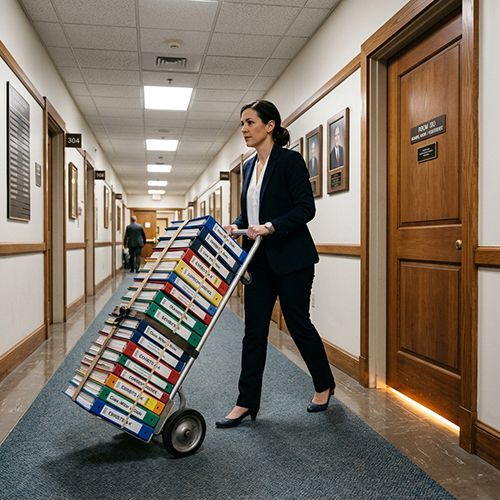
I was a first-year associate who had just spent four days organizing medical records when I borrowed a dolly, loaded up my color-coded binders and wheeled them to the door of the war room I had no business being in.
And then I just stayed.
It was a major medical device trial, a Fortune 500 client, the kind of case that consumes every person it touches. The trial team had been carefully assembled--partners and senior associates who had been building this case for years. I was not on the list. I was the fresh associate with time on my hands and a pile of disorganized medical records that nobody wanted to deal with. So I dealt with them. Organized everything by condition, by date, by treating physician. Built color-coded binders for every significant medical issue. Decoded thousands of pages of chart abbreviations (HTN is hypertension, SOB is shortness of breath, in case you were wondering).
When the binders were done, I did not send them with a messenger or leave them outside the door. I loaded them on a dolly, wheeled them to the door of the war room, walked them in myself, and found the partner working on her cross-examination of a medical expert. I started walking her through my color-coded tabs.
That was day one.
The thing about a trial team in full preparation mode is that there is always more to do than there are people to do it. When someone couldn't find a medical record, I knew exactly where it was--I built the system. When an outline needed someone to translate complex medical terminology into language a jury could understand, I decoded the abbreviations. When something needed doing that nobody had time to do, I did it. I never announced myself. I never asked for credit. I just kept seeing what was needed and providing it before anyone had to ask twice.
Six weeks later, I was a vital member of a trial team I was never supposed to be on. The question of whether I belonged had answered itself.
The lead partner left the firm not long after the trial concluded. He took a small, carefully chosen group with him--the people whose contributions had been undeniable. I was a first-year associate with no business being on that list.
I was on that list.
That partner moved again to a larger firm and brought me a second time. A chain of events that started with a dolly and a stack of binders nobody wanted to touch ended at one of the largest global law firms in the world.
There's a word for that mindset: Puka
You already know it, even if you don't know you know it. A puka shell has a natural hole through it--strung together into necklaces that everyone wore in the 1990s. In Hawaiian, puka means hole, gap, opening. My volleyball coach used to yell it when she spotted a space on the court nobody was covering. It stuck. It sits in the back of my mind like a mantra, the word I return to constantly, in every matter, every meeting, every situation I walk into.
See the gap. Move.
The Puka mindset is the habit of asking, in any room you walk into, not what have I been assigned but what does this actually need--and then doing something about it before anyone asks. It may be one of the most underrated skills in the legal profession.
What it actually looks like in practice
The Puka mindset runs on two things.
The first is awareness. Most lawyers move through their professional lives in a narrow band of focus--their cases, their clients, their billable hours, their own lane. Understandable. But the narrower the focus, the fewer gaps you see. And what you cannot see, you cannot fill.
Widening that lens looks different depending on where you sit. For a junior associate, it might be noticing that a partner is buried on a matter and jumping in before being asked, owning a research issue nobody claimed, or being the person who always knows exactly where the case stands when everyone else has to check. For a senior attorney, it might be seeing that clients are asking questions about artificial intelligence risk management and nobody has a clean answer yet--and deciding to be the one who develops it.
And here is the part people talk themselves out of most often: don't let seniority stop you in either direction. Not too junior, not too senior. The only question worth asking is whether you can do it. If the answer is yes, do it.
The second part is genuine investment. This is what most professional development advice leaves out. You fill the gap because it needs filling--not because someone is watching, not because it will look good in your self-evaluation, not because you have calculated the return. You do it because it needs doing.
Lawyers are trained to detect insincerity in depositions. We do the same thing with each other. We know the difference between someone genuinely trying to make things better and someone performing helpfulness for an audience. And when we find someone doing it for real--not for the credit, not for the optics, just because something needed doing -- we remember them. We advocate for them. We bring them into the room the next time, and the time after that.
That is the loyalty the Puka mindset creates. Not a transaction. Something much harder to manufacture and much more durable.
Why this matters more right now than it ever has
The legal profession is mid-disruption. AI is reshaping how legal work gets done, clients are asking questions nobody has clear answers to yet, and entire categories of work are being renegotiated. The firms that thrive will be the ones already moving--and the lawyers who define that moment will not be the ones who waited to be told what to do with the new landscape.
They will be the ones who looked at it and asked the same question I asked standing outside that war room with a dolly.
What does this situation actually need--and can I be the one to provide it?
I moved toward the AI gap the same way I moved toward those medical records. Learned the tools, ran the experiments, wrote the articles, built the workflows, taught colleagues through informal sessions designed to lower the fear barrier and get people moving. Nobody assigned me that territory. I just saw the puka was there.
The dolly was different. The mindset was identical.
The question worth asking
You do not need a different title or a better moment or anyone's permission. Pick up your next file, walk into your next team meeting, take your next client call and ask a question most lawyers never think to ask.
Not what is my assignment. What does this situation actually need?
The gap is there right now--in your practice, on your team, across your industry. It has been there this whole time. Someone is going to fill it.
It might as well be you.
Submit your own column for publication to Diana Bosetti
For reprint rights or to order a copy of your photo:
Email
Jeremy_Ellis@dailyjournal.com
for prices.
Direct dial: 213-229-5424
Send a letter to the editor:
Email: letters@dailyjournal.com