


Constitutional Law
Apr. 3, 2026
The National Guard in America's neighborhoods
Illinois v. Trump highlights the clash between federal power and state control over the National Guard, showing how the Posse Comitatus and Insurrection Acts restrict presidential use of military force at home.


4th Appellate District, Division 3
Eileen C. Moore
Associate Justice
California Courts of Appeal
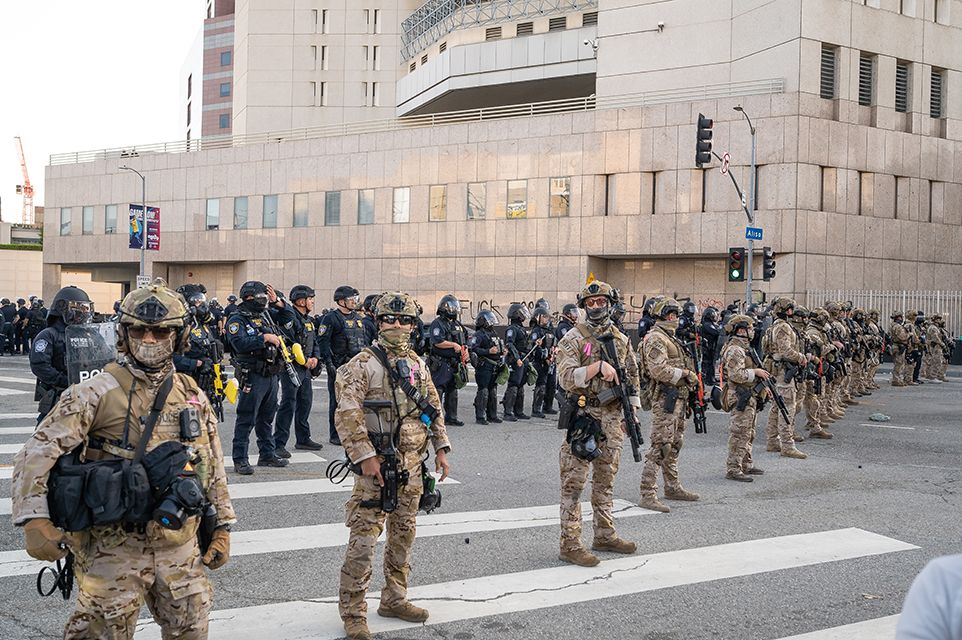
In early Oct. 2025, the president announced plans to federalize members of the Illinois National Guard, citing a need to address crime in Chicago. The governor and mayor immediately sued to block the deployment. On Oct. 9, a federal district court issued an order barring the administration's actions. On Oct. 25, in Illinois v. Trump, the 7th Circuit Court of Appeals denied the administration's request for a stay of the injunction. In Dec. 2025, the Supreme Court also denied the federal government's application for a stay.
Let's see what that case is all about, but first, a bit of history.
The Posse Comitatus Act
The Latin phrase posse comitatus translates to power of the county. It refers to a group of citizens summoned by a sheriff to assist in law enforcement. The Posse Comitatus Act was signed into law by President Rutherford B. Hayes in 1878. The updated version reads: "Whoever, except in cases and under circumstances expressly authorized by the Constitution or Act of Congress, willfully uses any part of the Army, the Navy, the Marine Corps, the Air Force, or the Space Force as a posse comitatus or otherwise to execute the laws shall be fined under this title or imprisoned not more than two years, or both." 18 U.S.C. § 1385
It's not exactly clear what prompted its enactment. Many say it was in response to the military occupation of the former Confederate States by the U.S. Army during Reconstruction following the Civil War.
Others point to the disputed presidential election of 1876 when federal troops were dispatched to polling locations in southern states by President Ulysses S. Grant to protect Blacks who voted. There had been no clear winner in the presidential election and a congressional commission was appointed. The commission announced that Hayes won the election over Democrat Samuel Tilden. Southern Democrats received a number of concessions when Republican Hayes became president. One of them was that federal troops would be withdrawn from the South. 24 WMMBRJ 1235; 26 OHNULR 171
The Act has some exceptions. Congress has allowed the use of the military in cases of violence domestically, protection of federal property and enforcement of some federal laws and court orders. But the military has concerns about its use in civilian matters, including funding and readiness issues. 15 JCJ 375
The National Guard
Although the title "National Guard" was not actually used by militia units until 1824, it is nonetheless said the National Guard began on Dec. 13, 1636, when the Massachusetts Bay Colony organized three regiments of militia to defend against local Indians.
In grammar school, we learned about the Minutemen fighting British troops during the Revolutionary War. When our Founding Fathers prepared our documents, they feared a standing army, preferring that citizens be ready to defend the country instead. In Federalists No. 46, Madison argued that a standing army could be offset by a militia of citizens with arms in their hands. When the Constitution was written, Article 1, section 8, clauses 15 and 16 granted Congress the power to "provide for organizing, arming, and disciplining the militia" and "To provide for the calling of the militia to execute the laws of the Union, suppress insurrections, and repel invasions." Each state has its own National Guard.
In the Militia Act of 1792, Congress mandated that all free, able-bodied male citizens between 18 and 45 years old enroll in the militia in their respective states. For a long time, there were disputes over whether the National Guard was under the control of the federal or state governments.
During the Spanish-American War of 1898, President William McKinley individually swore members of the militia into federal service. Under those circumstances, the troops were, in effect, volunteers. This procedure avoided the restriction of sending National Guard troops to serve on foreign soil. A few years later, the Militia Act of 1903 codified when the National Guard of the states may be federalized.
The National Defense Act of 1916 allowed the president to draft state Guard troops into the regular Army, permitting the federal government to rely on Article I, section 8, clause 12's power to raise and support armies, rather than the militia clauses. Thus, as federalized troops, they could be sent anywhere in the world. Timing is everything, of course. Shortly thereafter, President Woodrow Wilson sent National Guard troops to Europe when the United States entered World War I.
In 1986, after Governors George Deukmejian of California and Joseph Brennan of Maine refused to allow the deployment of their states' National Guard units to Central America for training, Congress passed the Montgomery Amendment, 10 U.S.C.672(b)(d), which prohibited state governors from withholding their consent to overseas deployments for training without the declaration of a national emergency. The governor of Minnesota, Rudy Perpich, challenged the law, arguing it violated Article 1, section 8 of the Constitution. The case ended up in the U.S. Supreme Court.
In Perpich v. Department of Defense (1990) 496 U.S. 334, the high court held the fact that Guard units also have an identity as part of the state militia does not limit Congress' plenary authority to train the units as it sees fit when the Guard is called to active federal service. In 2006, Congress enacted the National Defense Authorization Act, Public Law 109-163, containing a provision that gives the president the authority to mobilize National Guard units without the consent of state governors.
Today, persons enlisting in a state National Guard unit simultaneously enlist in the National Guard of the United States. State governors accept allotments of military personnel and equipment from the Department of Defense to train the National Guard. The enlistees retain their status as state Guard members unless and until ordered to active federal duty, and revert to state status upon being relieved from federal service. When joining the National Guard, soldiers and officers swear to obey the orders of both the state governor and the president of the United States.
Examples of use of National Guard for domestic concerns
Little Rock
A few years after the 1954 U.S. Supreme Court decision in Brown v. Board of Education (1954) 347 U.S. 483, holding that racial segregation in public schools was unconstitutional, national attention focused on Central High School in Little Rock, Arkansas. In 1957, Gov. Orval Faubus ordered Arkansas's National Guard to preserve the peace by turning away Black students who sought to integrate the school. Just how the federal government should respond was complicated by the 1878 Posse Comitatus Act, which, as noted, generally prohibits the domestic use of federal troops to enforce civil law. Attorney General Herbert Brownell issued an opinion to President Dwight D. Eisenhower that enabled Eisenhower to federalize the entire Arkansas National Guard, ordering it to protect rather than reject the nine students integrating Central High School.
Rodney King riots
Over 10,000 California National Guard troops were deployed to restore order following the Rodney King verdict in 1992. They were mobilized by Governor Pete Wilson on April 29, but the state guard had loaned out its riot gear to other agencies and was low on ammunition. On May 1, President George H.W. Bush invoked the Insurrection Act, federalized the state National Guard, and deployed additional active-duty federal troops to Los Angeles to quell the civil unrest.
Sept. 11, 2001
Following the terrorist attacks on Sept. 11, 2001, the National Guard was called upon to help in many different ways. Within minutes, two Massachusetts Air Guard F-15 Eagle fighter jets were the first to arrive at the World Trade Center. By the end of the day, more than 8,000 National Guard troops were mobilized by the governor of New York. National Guard troops from numerous states provided security at several major airports after the attacks. Following the attacks, the National Guard Bureau required all states to operate a Joint Emergency Operations Center, JEOC, on a continuous basis. Thus, when a state's emergency management operations fail for some reason, the National Guard and JEOC are designed to assist and augment a state's response to a disaster.
Hurricane Katrina
When the levees in New Orleans were breached during Hurricane Katrina in 2005, the Louisiana National Guard troops evacuated their headquarters. Offers of help from the New Mexico National Guard, packed and ready to go to New Orleans, went unanswered. Louisiana Governor Kathleen Blanco resisted relinquishing control of the Louisiana National Guard to the federal government. Eventually, President George W. Bush ordered National Guards from other states to go to New Orleans.
Operation Jump Start
In 2006, President George W. Bush federalized National Guard troops to increase U.S.-Mexico border security in a program known as Operation Jump Start. California Governor Arnold Schwarzenegger and New Mexico Governor Bill Richardson opposed using their Guard troops in Operation Jump Start in this law enforcement capacity since the troops were already stretched to their limits due to deployments to Iraq. This disagreement highlighted the question of just how much authority governors still have over their National Guards when the federal government calls for state troops. As noted, shortly thereafter, Congress gave the president the authority to mobilize National Guard units without the consent of state governors.
Coronavirus crisis
President Donald J. Trump deployed some National Guard units during the pandemic, sending them to the particularly hard-hit states of New York, California and Washington. However, the president did not federalize the troops in the usual manner pursuant to 10 U.S.C. § 12301 (d), known as Title 10 status. Instead, he left them under the control of the governors pursuant to 32 U.S.C. § 502, known as Title 32 status. Nonetheless, the deployments were federally funded by the Federal Emergency Management Agency, FEMA.
Illinois v. Trump
The State of Illinois and the City of Chicago brought an action against Trump in his official capacity as President of the United States in a federal district court in Illinois. In the action, plaintiffs contended; "At the Pentagon on September 30, 2025, Trump pitched his plan to use American soldiers to punish his political enemies to hundreds of United States military leaders. He told them that they must prioritize 'defending the homeland' against the 'invasion from within' in American cities run by 'radical-left Democrats,' specifically including Chicago. He stated his intention to use our neighborhoods "as training grounds for our military." 2025 WL 2886645
They contended in their pleadings and arguments that 10 U.S.C. § 12406 limits the ability of a president's use of the National Guard.
A federal district court granted plaintiffs' requested temporary restraining order on Oct. 9, 2025, stating in part that defendants "are temporarily enjoined from ordering the federalization and deployment of the National Guard of the United States within Illinois." On Oct. 16, 2025, the 7th Circuit Court of Appeals found the administration had not shown a likelihood of success on the merits. 2025 WL 2937065
The next day, Oct. 17, 2025, the defendants applied to the United States Supreme Court for a stay of the injunction. On Dec. 23, 2025, the Supreme Court denied the application for stay. 146 S.Ct. 432. In its denial of a stay, the Supreme Court stated that the president had not invoked a statute that provides an exception to the Posse Comitatus Act. The high court found that at least at that early stage 10 U.S.C. § 12406(3) did not provide authority to federalize National Guard forces to protect federal property.
On Jan. 21, 2026, the parties stipulated to dismiss the appeal concerning the restraining order. The matter continues in a federal district court in Illinois.
The Insurrection Act may be the next step
The Insurrection Act, 10 U.S.C. §§ 251-255, was first enacted in 1792; it grants the president the authority to deploy U.S. military domestically and use it against Americans. In § 252, it states in part: "Whenever the President considers that unlawful obstructions, combinations, or assemblages, or rebellion against the authority of the United States, make it impracticable to enforce the laws of the United States in any State by the ordinary course of judicial proceedings, he may call into Federal service such of the militia of any State, and use such of the armed forces, as he considers necessary to enforce those laws or to suppress the rebellion."
According to the Brennan Center, the Insurrection Act, despite being an outdated law, is another emergency power available to the president. The Center says: "The Insurrection Act is among the most powerful emergency powers at the disposal of a president, who can use it to deploy the U.S. armed forces and the militia to suppress insurrections, quell civil unrest or domestic violence, and enforce the law when it is being obstructed."
On Jan. 15, 2026, CBS NEWS reported that the president wrote on Truth Social: "If the corrupt politicians of Minnesota don't obey the law and stop the professional agitators and insurrectionists from attacking the Patriots of I.C.E., who are only trying to do their job, I will institute the INSURRECTION ACT, which many Presidents have done before me, and quickly put an end to the travesty that is taking place in that once great State."
Conclusion
Beside Illinois v. Trump, other states sued the federal government over its use of National Guard forces. California is one of those states.
In Newsom v. Trump, California's governor challenged the use of National Guard troops in Los Angeles. 786 F.Supp.3d 1235; 141 F.4th 1032 On Dec. 31, 2025, the California State Portal stated: "Trump and his cabinet cronies finally bowed to the rule of law -- returning the California National Guard to state control after illegal federalization -- showing he is not above the U.S. Constitution. Governor Newsom directs leadership work quickly to return state service members back home to their families."
We await what more is to come regarding the National Guard in our nation's neighborhoods. According to the LA Times, at a Cabinet meeting on March 26, Trump pointed to purported successes in reducing crime in Washington, New Orleans and Memphis, and said, "We could do that for L.A. and we could do that for frankly, San Francisco."
Submit your own column for publication to Diana Bosetti
For reprint rights or to order a copy of your photo:
Email
Jeremy_Ellis@dailyjournal.com
for prices.
Direct dial: 213-229-5424
Send a letter to the editor:
Email: letters@dailyjournal.com