


Mar. 24, 2026
Chief justice warns of threats to judges, potential clash with White House
California Chief Justice Patricia Guerrero called for increased court funding and remote access and signaled a potential clash with federal immigration enforcement agencies in her annual State of the Judiciary address.


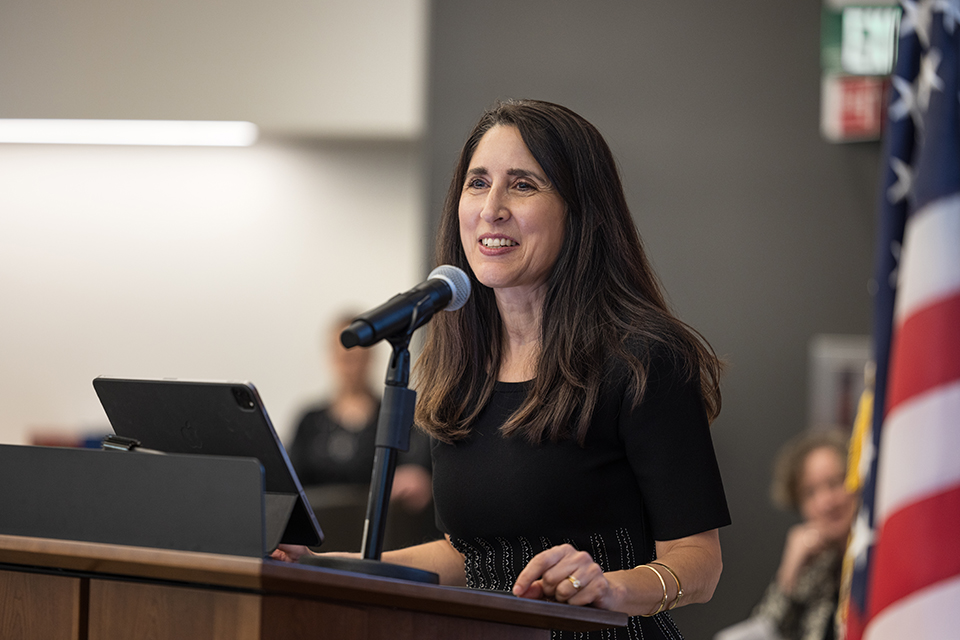
California Chief Justice Patricia Guerrero cast the courts as a beacon of normalcy in her State of the Judiciary address to the Legislature, while also warning of a potential clash with the Trump administration.
Guerrero also highlighted the need to protect judges from a rising tide of verbal and physical threats, praised the rollout of CARE Court across the judicial branch, called for greater investment in remote proceedings, and warned of an increasingly severe shortage of judges.
"With so much going on in our nation--so much controversy, division, uncertainty, and chaos--I've decided to offer you something different," Guerrero told lawmakers Monday afternoon. "If anyone is looking for controversial statements or divisive rhetoric, you will not get it. Instead, I offer you normalcy and a calm and measured report regarding some of the important work our judicial branch has undertaken over the past year, and some of the major issues facing the judiciary."
The annual speech allows the chief justice to outline her priorities as the Legislature debates the state budget. During last year's address, Guerrero criticized the federal immigration enforcement arrests at courthouses and warned that implementation of the state's Racial Justice Act is straining court resources -- a theme she returned to later in Monday's remarks.
She also revisited another familiar concern: violence and intimidation aimed at judges.
"Our jobs are made more challenging, however, by the rise in threats against the judiciary -- something I'm not sure our Founding Fathers would have envisioned," Guerrero said. "The issue of judicial security is prominent in the minds of many judicial officers, and recent events have unfortunately demonstrated that service on the bench can pose significant safety risks."
Guerrero did not cite specific incidents or figures. However, the U.S. Marshals Service has reported a nearly sixfold increase in threats against federal judges in just over a decade, including 241 threats against 202 judges so far this year. Last year, Gov. Gavin Newsom signed AB 352, allowing courts to consider threats against a judge, commissioner, state constitutional officer, or member of the Legislature as an aggravating factor in criminal sentencing.
Guerrero urged lawmakers to provide "sufficient resources to protect" courts, personnel and the public from physical and cyber threats. The Judicial Council will also continue to "advocate for legislation designed to protect the privacy of judges," she said.
Guerrero did not specify what this would entail, though nearly 20 other states have enacted so-called shield laws allowing judges to keep information such as home addresses private.
Guerrero also urged lawmakers to work with the courts to enable remote proceedings. She pointed to the roughly 6 million such proceedings held since 2022 -- about 7,000 per day in 2024 and 2025 -- and said surveys show 95% of users report positive experiences. The Legislature has passed a series of stopgap extensions authorizing remote proceedings amid opposition from groups representing court reporters and interpreters.
"The data unequivocally shows great public interest in having remote options, but existing statutory authority for remote proceedings is scheduled to expire after the end of this year," she said.
Guerrero also defended the rollout of Community Assistance, Recovery, and Empowerment (CARE) Court, while acknowledging some dissatisfaction with the program's results.
Newsom recently threatened to divert funds from several large counties that he said were filing too few CARE Court petitions.
Guerrero said the courts still need 98 additional judicial officers, particularly in Riverside and San Bernardino counties.
Near the end of her remarks, Guerrero addressed the impact of federal immigration agents appearing at state courthouses. Next month, the Judicial Council will consider a proposal requiring courts to report immigration arrests at courthouses, allowing the council to track such incidents. The move could lead to litigation or legislation that places the judicial branch in direct conflict with the Trump administration.
"This will help inform next steps as we consider options for protecting against encroachments on our ability to ensure that courts remain open and accessible to everyone," Guerrero said.
Malcolm Maclachlan
malcolm_maclachlan@dailyjournal.com
For reprint rights or to order a copy of your photo:
Email
Jeremy_Ellis@dailyjournal.com
for prices.
Direct dial: 213-229-5424
Send a letter to the editor:
Email: letters@dailyjournal.com