


Books
Mar. 18, 2026
Uncool has never been cooler
In 'The Uncool,' Cameron Crowe recounts his early rock journalism, including 18 months with David Bowie and reporting on legends like The Eagles and Led Zeppelin--all before turning 20.


Stanley Mosk Courthouse
Lawrence P. Riff
Supervising Judge
Los Angeles County Superior Court
General Civil, UDs
University of Oregon School of Law, 1982
I was once within four feet of a rock and roll superstar
for about 20 seconds. It was in 1992. I was in downtown Tokyo on business,
staying at the Akasaka Prince Hotel. When the elevator door opened to take me
to the lobby, there stood David Bowie. I recognized him in a nanosecond; it
could not have been anyone else. It was just him and me. Being from LA, I knew
that one should be cool when confronting a celebrity. I tried to sound
offhanded when I muttered, "big fan, man" (which was true--I mean, how can one
improve on the opening riff of Rebel Rebel?). He made no eye contact and
very offhandedly muttered, "thanks, mate." I immediately felt ungenuine and
sycophantic--how uncool is that?
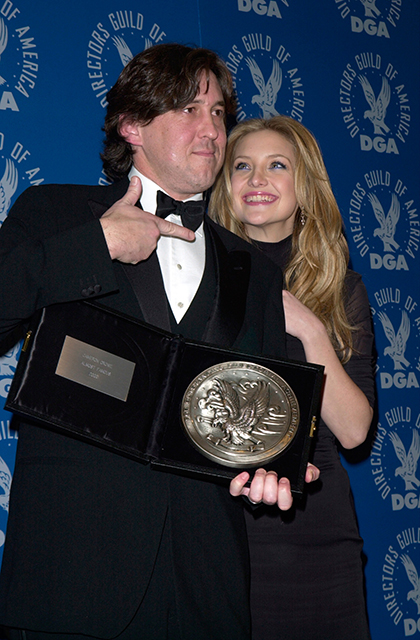
Cameron Crowe, rock journalist, film screenwriter and
movie director, tells his Bowie story in his recent deeply entertaining
memoire, The Uncool (Simon and Schuster, 2025). His Bowie interactions
lasted 18 months, were deeply personal and resulted in a revealing 1976 cover
story in Rolling Stone. (If you doubt the rock and roll lifestyle was
unhealthy--diets of cocaine, milk and red peppers--read this article.) Crowe was 18
years old and already a major player in music journalism. By then, he had
published an interview with The Eagles in The San Diego Door in 1972 (he
was 16), and in Rolling Stone, a profile interview of Jackson Browne in
1974, and separately in 1975, profiles of Led Zeppelin, Neil Young and, again,
The Eagles. For the latter piece, Crowe lived in an apartment with Glenn Frey
and Don Henley while they worked out their new music for the One of These
Nights album (number one on Billboard 200 chart in 1975; certified 4x
platinum.) All before he was 20 years old.
The early Crowe story has been told through the movie Almost
Famous, a fictionalized version of his life based on Crowe's original
screenplay for which he won an Oscar in 2000 (beating out, among others, Gladiator
and Erin Brockovich). Reading his memoire, one realizes how
little-fictionalized the screenplay is. Perhaps the "real" Penny Lane was not
as enchanting as Kate Hudson's portrayal, but there really were "Band Aids" who
refused to consider themselves groupies and were there for the music--or so they
believed.
Reading The Uncool is to return to an early day of
the music industry when much of the idealism of the '60s music scene retained
vitality. Sure, even then it was a business but not remotely like today's
automaton monetization machines of Apple Music and Spotify. It was a time when
countless young devotees waited impatiently for the next issue of Rolling
Stone to find out what, for example, Joni Mitchell was thinking about her
musical journey. When she appeared on the cover in 1969, the Woodstock
generation ran to the magazine rack.
Crowe's much-sung hero and mentor is Lester Bangs, the
Ur-rock-journalist of Creem Magazine fame, for whom integrity and
radical honesty was everything. (Creem was published out of Detroit and
gave space to cartoonist Robert Crumb's "keep on truckin'" imagery--found in
head shops coast to coast.) Bangs had been fired from Rolling Stone for
his supposedly disrespectful review of the band Canned Heat--a firing he wore
proudly. Crowe implies strongly that had there been no Lester Bangs, there
would have been no Cameron Crowe. If so, then Crowe's mother may have had her
way and Crowe would have gone to law school along with the rest of us.
The title, The Uncool, might seem to refer to
Crowe's early personal life in the business. As noted, he was young and running
in an older crowd, bookish--carrying around his
cassette recorder, not particularly successful with the ladies and, he would
have us believe, had a mother psychologically hovering over him even when he
was on the road with The Allman Brothers. The Band Aids might have some
affection for him as, say, a kid brother but we're not talking cool
like, say, Jackson Browne. But the title, The Uncool, can only be
understood by reference to Crowe's militant respect for Bangs. In Almost
Famous, Crowe puts these words in the mouth of late, great Philip Seymour
Hoffman who played the role of Lester Bangs: "The only true currency in this
bankrupt world is what you share with someone else when you're uncool."
Crowe is telling us uncool is authentic; uncool is honest;
most important, uncool is an inoculation from cooption. Uncool is, well, the
coolest thing ever. Crowe appears to have lived his life honoring that idea.
His paean to Bangs notwithstanding, this memoire, like his
Almost Famous screenplay and his Almost Famous: The Musical, is a
proclamation of the power of a loving, encouraging mother. Crowe's mother,
Alice, is the true north star of his life. Clearly an oddball San Diego
educator (depicted brilliantly by Frances McDormand in the movie), Alice
rabidly supports her son's dreams, insisting that he pursue them while
contemporaneously seeking to overprotect him from what lays ahead. "Don't take
drugs" she screams at him, dropping him off at the rock concert. Before he is
old enough to drive, she reluctantly consents to his boarding the band buses
for cross-county tours because, she knows, he has an irrepressible passion.
Meanwhile, she fretted at home about her decision.
Did her gamble pay off? You be the judge. Crowe's
contributions to early rock and roll journalism are unequalled, all the more remarkable given his age when he wrote them.
Scratchy black and white photos in the book bear witness--yes, this teenager
really did hang out with a haggard-looking Gregg Allman and was on the bus with
Neil Young and his band. He went on to other remarkable feats including his
writing the screenplay for Fast Times at Ridgemont High. His story of
the casting of Sean Penn (his then-second movie) as laid-back surfer-dude Jeff
Spicoli is not to be missed. Crowe's later screenwriting masterpieces include Jerry
Maguire and Vanilla Sky.
Celebrity is a noxious drug. It is the first cousin to
cool. People will do terrible things to have it and be around it. Crowe tells
us to be cautious with cool. Maybe Lester Bangs and Crowe got it right. Let us
celebrate the uncool.
Submit your own column for publication to Diana Bosetti
For reprint rights or to order a copy of your photo:
Email
Jeremy_Ellis@dailyjournal.com
for prices.
Direct dial: 213-229-5424
Send a letter to the editor:
Email: letters@dailyjournal.com