


Constitutional Law,
Administrative/Regulatory
Mar. 17, 2026
A house built of cards will crumble
Why SBA guidance encouraging bypassing permits doesn't relieve fire victims or builders from California's legal obligations.



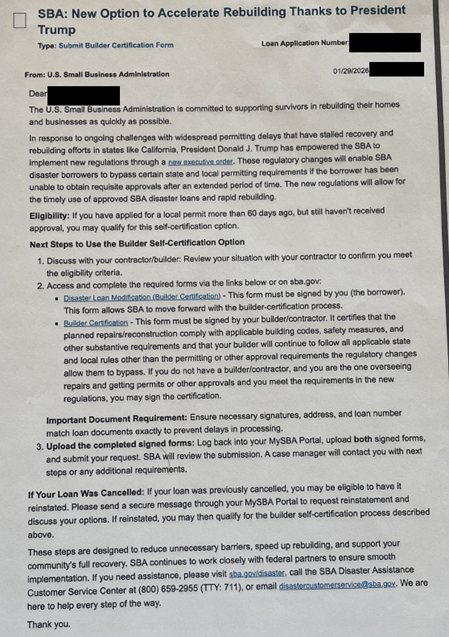
On Jan. 29, 2026, fire victims in the Palisades and
Altadena who had applied for federal Small Business Administration (SBA)
rebuilding loans received an email from the SBA titled, "New Option to
Accelerate Rebuilding Thanks to President Trump."
President Trump's Jan. 27 "California Wildfires" executive
order
The SBA Jan. 29, email came on the heels of President
Trump's Jan. 27 Wildfires Executive Order 14377, "Addressing
State and Local Failures to Rebuild Los Angeles After Wildfire Disasters."
The executive order called on particular federal agencies, specifically the Secretary
of Homeland Security (DHS), through Federal Emergency Management Agency (FEMA),
and the SBA, to consider promulgating regulations that "preempt state
or local permitting processes and other similar pre-approval requirements,"
and replace them with a federal self-certification process. The order
recommended that new, proposed rules issued by Feb. 26 and that final
regulations be promulgated by April 27. The federal regulations would be a
mechanism "to advance the policies" of the president's wildfires executive
order.
In the order, the president singled out, by name, California
state and Los Angeles local officials for failing (i)"to contain wildfires," (ii) "to engage in responsible
forest management," (iii)"to maintain water distribution and reservoir systems,"
(iv)"to quickly communicate evacuation warnings" and failing to (v) not
"act decisively or cohesively" to contain the spreading fires. Los Angeles
Mayor Karen Bass was chastised by the president for "traveling abroad" during
the fires. The Biden Administration was also blamed too for making "big
promises" (after the Jan. 7, 2025 fires) concerning debris
removal. The order asserted that debris removal did not begin in earnest until
after President Trump took office on Jan. 20, 2025 (13 days later).
Additionally, the executive order alleged that the federal
government had "approved numerous" fire victim relief claims (from both
homeowners and businesses), but that the victims were unable to access federal
funds as a result of burdensome local and state building
requirements.
The SBA's Jan. 29 email to Palisades & Altadena fire victims
The Jan. 27 executive order was discussed in the SBA's
Jan. 29 email to fire victims who had applied for SBA (federal) rebuilding
funds. In addition to lauding the president for his commitment to "accelerating
rebuilding" in California, the SBA described its own, new powers vis-à-vis
California's state and local authorities as follows:
"President Donald J. Trump has empowered the SBA to
implement new regulations through a new executive order," which allow "SBA disaster
borrowers to bypass certain state and local permitting requirements if the
borrower has been unable to obtain requisite approvals after an extended period
of time."
The SBA email also stated that if the fire victim had
applied for a rebuilding permit and the permit had not been acted upon withing 60
days of submission, then the victim (and the victim's builder-contractor) could
self-certify that "applicable building codes, safety measures and other
substantive requirements" have been followed, and build.
The SBA's self-certification forms are not a result of any
administratively promulgated regulations
No administrative regulations have been promulgated or are
in the works, which would arguably be the first step in any SBA attempt to
supersede local and state building and zoning regulations. In fact, on Jan. 29
(the same day as the SBA email), the SBA issued something called "regulatory
guidance" related to Pres. Trump's EO 14377 (incorrectly referred to
in the guidance statement as a non-existent EO 14277) (emphasis added). The regulatory
guidance statement is entitled, "Options to Bypass Permitting Delays." The
guidance statement directs the reader to fill-in-the blank federal self-certification
forms.
However, a regulatory guidance statement is not a
promulgation of an administrative rule. Pursuant to the Administrative
Procedures Act (APA), 5 U.S.C, Sec. 553, administrative rule-making
requires formal notice published in the Federal Register with (among other
things) reference to (i) the legal authority relied
in support of the proposed rule, as well as (ii) a statement regarding the
time, place and nature of the public rule making proceedings. Thereafter, as
part of the administrative rule making process, the federal agency gives (iii) notice
to "interested persons" to participate in the rule making process (iv) through "submission
of written data, views, or arguments with or without opportunity for oral
presentation."
The actions of the federal government in entreating
California fire victims and their contractors to use federal self-certification
forms is very "cart-before-the horse." It has not been established that the
identified federal agencies have the legal authority to create such forms or, in
any way, that they have complied with the APA's requirements.
What do you as a lawyer tell your client, the fire victim
and/or builder contractor?
Imagine that you represent a fire victim and/or a
builder-contractor who received the SBA's "go self-certify" email. Suppose your
client asks you whether they should self-certify and start rebuilding without
following the established permitting processes of the locality, county, and the
state.
What should you say? Quick answer: Don't do it. Or if you
do it--don't rely on it. Self-certifying that you have complied with all laws
does not mean that you are exempted from liability for not following the laws
of the city, county and the state in which the building is to be constructed.
Tell your client that the federal government's avenue for "self-certification"
implicates several constitutional issues. Translation? Neither the president or
his agents have the constitutional authority to direct that a state's
inhabitants skip or ignore state and local zoning requirements. There is no
federal legislation or constitutional provision that vests in the president or
the executive branch the ability to nullify California's zoning requirements.
That "Trump
officials vow to speed up permits for fire rebuilding" does not make
it so and does not make it legal.
Bottom line: fire victims beware
Federally encouraged rebuilding "self-certifications" are
not a magic bullet. Homeowners and contractors must still obey and follow state
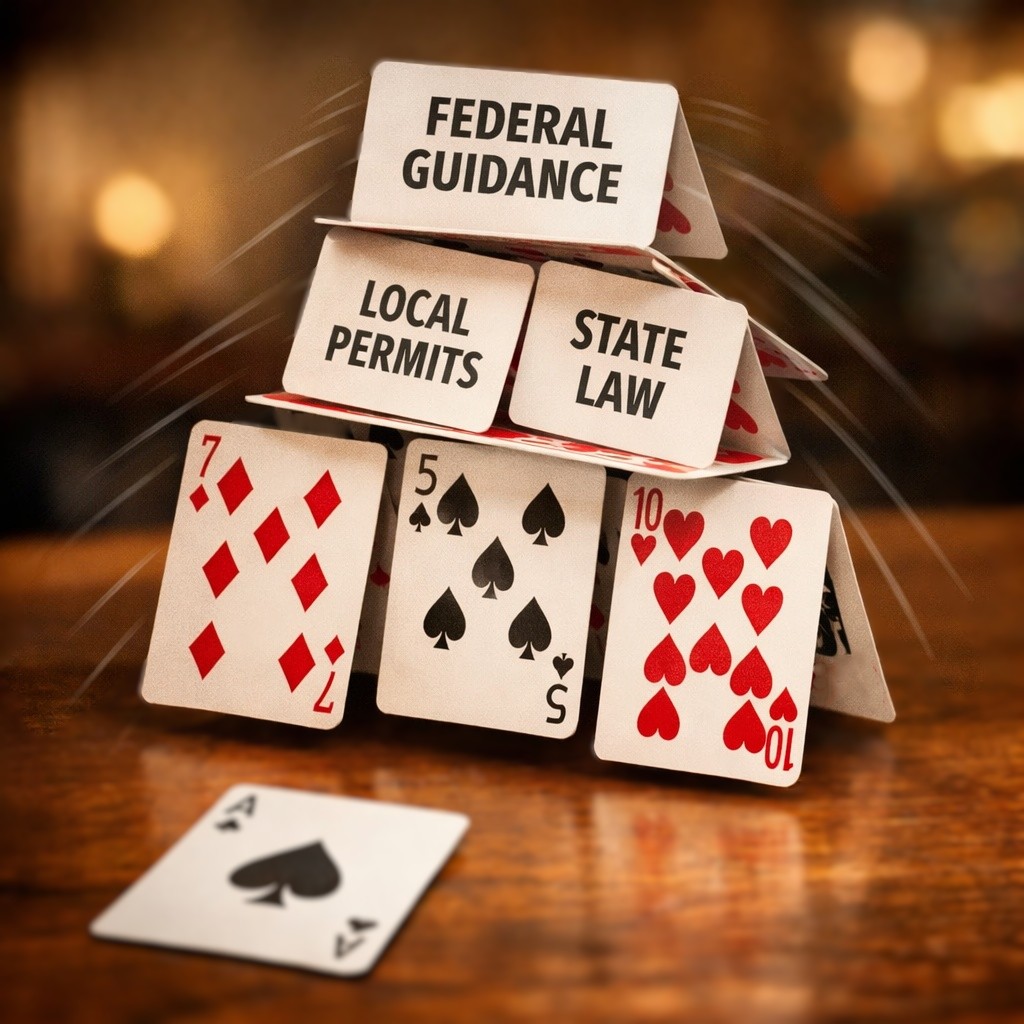
and local laws and abide by those practices. A federally self-certified
structure is just a house of cards. Should the house fall in on someone, no
federal self-certification will inoculate the homeowner or the contractor from
liability.
An old adage (modified slightly) is apropos
here. "Be wary of federal officials bearing gifts."
Submit your own column for publication to Diana Bosetti
For reprint rights or to order a copy of your photo:
Email
Jeremy_Ellis@dailyjournal.com
for prices.
Direct dial: 213-229-5424
Send a letter to the editor:
Email: letters@dailyjournal.com