


Ethics/Professional Responsibility
Mar. 13, 2026
California civility rule meets its match in First Amendment
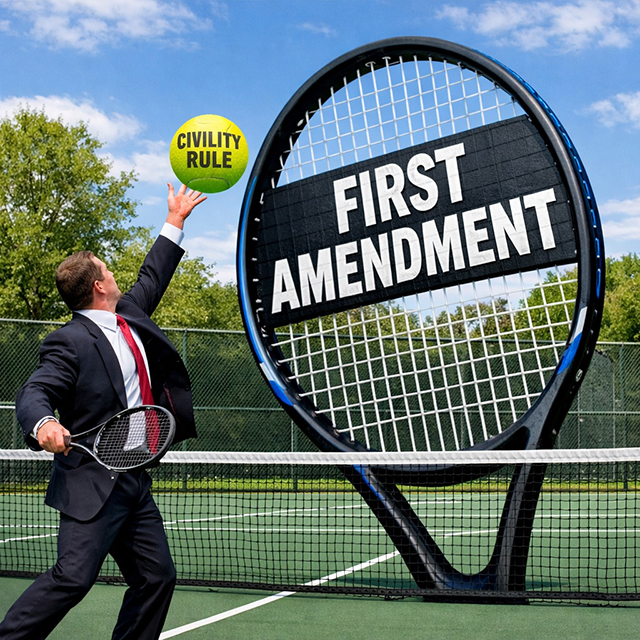
California Rule of Professional Conduct 8.4.1 was designed to prevent attorney discrimination and harassment, but First Amendment protections and inconsistent enforcement by the State Bar have limited its effectiveness in promoting civility among lawyers.


Despite much ink being spilled about civility,
it appears as though one of the enforcement mechanisms may not have
teeth. All standards of civility would seem to require attorneys
at the very least not engage in bigotry when practicing
law, even if it is directed at opposing counsel. At first glance,
the current Rule of Professional Conduct 8.4.1 appears to insist that
lawyers refrain from engaging in such discriminatory practices based on
protected characteristics "in representing a client" and "in
relation to a law firm's operations."
However, one of the comments for Rule 8.4.1 restricts
the rule's application based on First Amendment
grounds. This complicates the application of the rule in situations
where an attorney makes a bigoted remark about another attorney's cultural
background, even when done during a recorded deposition.
In other words, if an attorney is caught making a bigoted
comment while practicing law, how is Rule 8.4.1 harmonized with First Amendment
protections?
Former Rule of Professional Conduct 2-400
The State Bar's previous anti-discrimination
rule, former Rule of Professional Conduct 2-400, required a judicial
finding of discrimination before the State Bar could
obtain jurisdiction over a matter. In pertinent
part, former Rule 2-400(B) provided that "a member shall not unlawfully
discriminate or knowingly permit unlawful discrimination on the basis of race,
national origin, sex, sexual orientation, religion, age or disability in [the
operation or management of a law practice]." Rule 2-400(C) provided that "[n]o disciplinary investigation or
proceeding may be initiated by the State Bar against a member under this rule
unless and until a tribunal of competent jurisdiction, other than a disciplinary
tribunal, shall have first adjudicated a complaint of alleged discrimination
and found that unlawful conduct occurred."
The State Bar's discussion of the
rule stated that "[i]n order for discriminatory conduct to be
actionable under this rule, it must first be found to be unlawful by an
appropriate civil administrative or judicial tribunal under applicable
state or federal law. Until there is a finding of civil unlawfulness,
there is no basis for disciplinary action under this rule." (Emphasis
added.)
Current Rule of Professional Conduct 8.4.1
The requirement for a prior judicial determination of
discrimination was eliminated by current Rule 8.4.1, making it unlawful to
discriminate, harass, or retaliate against anyone based on a
protected characteristic.
Interestingly, Comment [4] to
Rule 8.4.1 states that "[t]his rule does not apply to conduct protected by the
First Amendment to the United States Constitution or by Article I, Section
2 of the California Constitution." In other words, protected speech
outranks protected class. It is unclear whether the State Bar
included this comment in order to avoid
problems with the First Amendment; however, it is certainly a reasonable
conclusion.
Generally, the First Amendment precludes lawyer
discipline for offensive speech or expressive conduct of the type you allege
absent facts demonstrating at least a substantial likelihood of
material prejudice to an adjudicative proceeding. The State Bar did not
explain what this "material prejudice to an adjudicative proceeding" standard
means. It is reasonable to believe that an adjudicative
proceeding is materially prejudiced simply by an attorney
shamelessly making a bigoted statement. Regardless, no such "material
prejudice" restriction appears in Rule 8.4.1.
In contrast, the Rule indicates that a
lawyer would be subject to discipline if that lawyer were to engage in
discrimination against an employee in the workplace, suggesting that
the standard for employers was intended to apply to
attorneys. Clearly, the First Amendment does not protect
all speech. Hate speech and racial slurs have long been
held to create liability for an employer.
Illustrative examples
A clear example of unprotected speech is present in
the matter involving San Diego attorney Benjamin Pavone. In
the Matter of Pavone, No. SBC-20-O-30496 (Cal. State bar Ct.
Rev. Dep't Feb. 21, 2023). Pavone was sanctioned for misconduct
after describing a female judge's ruling as "succubustic" in a court filing.
The State Bar concluded that the term constituted gender-based bias
and harassment. Pavone argued that this was in violation of his First
Amendment Rights, but the Review Department upheld the recommended
discipline. The Pavone matter occurred prior to the implementation of Rule
8.4.1. If similar conduct were to be evaluated under the rule, this
kind of behavior would likely fall within the framework of harassment
based on gender.
More recently, the State Bar investigated an elderly
attorney for the use of insensitive language
in internal communications towards replacement counsel who
happened to be transgender. As part of their investigation, the State Bar
requested respondent attorney to turn over files in connection with a
fee dispute, which she ultimately won, with the new attorney who
had demanded release of her entire attorney lien. As respondent's internal
communications contained insensitive language, she was
required to complete sensitivity training, as the language was
considered potentially discriminatory.
Lack of enforcement
Similarly, the State Bar should use the same standard in
deciding whether to discipline attorneys pursuant to Rule
8.4.1(b). Otherwise, attorneys with bigoted views will only
become emboldened, continue to engage in bigoted conduct
and render civility guidelines meaningless. Instances in
which an attorney's disgraceful conduct is met with no
consequence set a false and dangerous precedent. Indeed,
what would stop other attorneys from brazenly discriminating against
opposing counsel based on protected characteristics or membership in a
protected class?
If civility standards are to be taken seriously, we
must ensure that licensed attorneys will be held to the
same baseline standard as employers.
It is important to note that the State Bar has yet to
enforce discipline on attorneys in violation of Rule 8.4.1. It may
well be that Rule 8.4.1 is either a rule that the State
Bar just won't enforce; will only enforce it when the
attorney accused of bigotry is a white cisgender male or will decline to
enforce if the complainant is from a particular culture.
Although Rule 8.4.1 initially engendered hope
that attorneys would refrain from making bigoted comments to
one another while engaged in legal discourse, it seems as though that
hope is largely shattered.
Far from enforcing basic civility standards, it appears as
though the State Bar has decided to shield attorneys
who flaunt their bigotry from any negative
consequences of their actions. Rule 8.4.1 appears to be a sham, declawed by the protection
of the First Amendment even though the First Amendment does not exonerate employers in similar situations. More generally, it appears as
though all attempts to enforce promotion of civility standards may be doomed.
Submit your own column for publication to Diana Bosetti
For reprint rights or to order a copy of your photo:
Email
Jeremy_Ellis@dailyjournal.com
for prices.
Direct dial: 213-229-5424
Send a letter to the editor:
Email: letters@dailyjournal.com