


Family,
Ethics/Professional Responsibility
Mar. 6, 2026
Why civility still wins in the courtroom
See more on Why civility still wins in the courtroomCivility isn't just good manners -- it's a strategic advantage that can enhance your credibility, persuade judges, and ultimately deliver better outcomes for your clients.



Nancy Wieben Stock
Mediator, Arbitrator and Private Judge
JAMS
500 N State College Blvd
Orange , CA 92868
Phone: (714) 939-1300
Fax: (714) 939-8710
University of California Davis School of Law

Scott M. Gordon
Private Judge, Mediator and Arbitrator
Signature Resolution LLC
Email: judgegordon@signatureresolution.com
Southwestern University School of Law
Judge Gordon (Ret.) is a member of the International Network of Hague Judges.
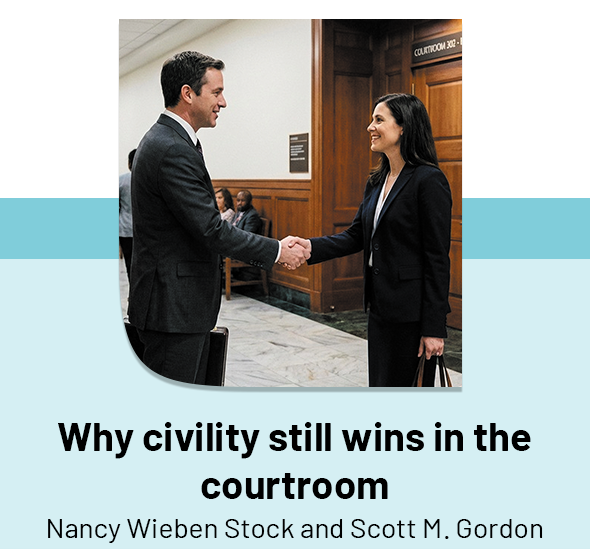
As civility in public discourse continues to decline, we
revisit how attorneys can rise above the fray and maintain a high level of
civility and professionalism in the practice of law.
Is incivility practice specific?
Is attorney incivility and unprofessional conduct
atmospheric? Should it depend on an attorney's specialty? There's a saying: "In
criminal court, bad people come to court never looking better; and in family
court, good people come to court never looking worse." The notion that bad
conduct in family law adversely influences attorney behavior is enshrined in
the State Bar of California's Attorney Guidelines of Civility and
Professionalism. Family law
practitioners are the only attorneys called out for special treatment. As if no
other practitioner could possibly engage in this conduct, family law attorneys
are admonished that they should "discourage and should not abet vindictive conduct, and treat all participants with courtesy and
respect in order to minimize the emotional intensity" of the representation.
What family law teaches about accountability and empathy
But family law attorneys may not require special
instruction. Much like their counterparts in criminal prosecution and defense,
family law lawyers practice within a community, and there is real
accountability when the same lawyers appear against each other in front of the
same judges. We believe that family law practitioners benefit from the
collegiality of a small and specialized practice and because they alternately
represent both sides--one day a husband, the next day a wife. This cultivates
empathy regarding the opposing position, unlike almost every other area of law
practice. Civility should not be reserved for family practitioners. All lawyers
enjoy the numerous benefits of a reputation for civility. Civility in
litigation can lead to better outcomes, enhanced credibility, a strategic
advantage in the courtroom and enhancement of one's professional reputation.
As stated in the recently revised Orange County Bar
Association's Civility Guidelines: "Civility allows for zealous representation,
reduces clients' costs, better advances clients' interests, reduces stress,
increases professional satisfaction, and promotes effective conflict
resolution."
Why civility is not a sign of weakness
While the benefits of civility are both personal and
professional, a lawyer may dismiss these benefits for fear that in taking the
high road, they may be perceived by their clients and opposing counsel as an
ineffective advocate. Because of the impact of media depictions of lawyers in
court and the changes in public discourse, many feel that they are advocating
effectively only when engaging in verbal combat armed with personal invectives,
attacks and hyperbole. Overly aggressive litigation tactics do not lead to
long-lasting, positive outcomes for both litigants and the justice system.
Passion and civility can coexist
"Yet civility does not reduce the practice of law to an
antiseptic exercise. Some of the most passionate and effective advocates for
their clients also hold their adversaries, the Court, and its judicial officers
in the highest regard. After all, passion can easily coexist with respect,
dignity, and civility." People v. Whitus (2012) 209 Cal.App.4th Supp. 1,
14.
Civility in action: Confidence in the courtroom
Be the lawyer who leaps to the rescue when opposing
counsel's technology breaks down mid-trial. Offering your equipment or the services of your technician sends a clear message that the
opposing case need not be interrupted, because you are confident in your case
and the expected outcome. Lawyers who practice civility and professionalism are
perceived as more competent by judges. It takes a certain amount of confidence
to overcome the temptation to match overly aggressive litigation tactics
employed by the opposing side. Judges were once lawyers too. We understand how
difficult it is to tame client expectations when it appears that the opposing
party's tactics are working. Unfortunately, those tactics can result in
increased fees to your client that may not be recompensed through sanctions.
Civility persuades courts
But, where it counts, attorney civility and
professionalism should pave the way for a favorable result in the courtroom.
This does not mean that a losing case can be converted into a winning one. It
means that arguments made by a well-prepared lawyer are more likely to persuade
a judge motivated to make a correct ruling. Almost any judge will tell you how
difficult it is to stay abreast of all of the paper
that comes into a busy public courtroom. When one set of papers is loaded with ad
hominem attacks and another focuses on key issues and proposes specific
solutions, the judge will inevitably turn to the latter for guidance. In this
way, the civil lawyer has seized the moment and the
uncivil lawyer has inadvertently silenced their client's voice.
Reducing burnout and supporting our courts
Civil lawyers reduce judicial burnout and foster an
atmosphere that enhances a judge's ability to give attention to every aspect of
the case. This is especially important in high-turnover assignments such as
family courts. As stated by the court in People v Whitus (2012) 209
Cal.App.4th Supp. 1, 13, "[C]ounsel are considered
officers of the court. The handshake at the end of the trial is not the only
time when professionalism and civility are expected. It is demanded
of lawyers at all times and at all stages of the case, no
matter what the stakes involved. Especially in this day and
age of distrust and cynicism, counsel's respect for the institution and
administration of justice is critical." (emphasis in original).
Judges see lawyers who are civil as more competent. Much
of the material that comes before a judge, especially in an all-purposes
assignment, derives from interactions between counsel recorded in emails, text
messages and sometimes video depositions.
Passing the torch of professionalism
In every sense, lawyers are always "on the record" when
dealing with opposing counsel and clients. Lawyers are responsible for their
own words and tone, as well as those of their trainees and subordinates.
Associates mentored by intemperate partners may unwittingly take on some
unfortunate attributes, potentially diminishing their effectiveness as trial
lawyers later in their careers. As Justice Ruth Bader Ginsburg once said, "You
can disagree without being disagreeable."
As lawyers, we have the ability to
rise above the current level of rude and disrespectful discourse across
society. When we do this, we reap the rewards of a solid reputation for stellar
advocacy.
Disclaimer: The content is intended for general
informational purposes only and should not be construed as legal advice. If you
require legal or professional advice, please contact an attorney.
For reprint rights or to order a copy of your photo:
Email
Jeremy_Ellis@dailyjournal.com
for prices.
Direct dial: 213-229-5424
Send a letter to the editor:
Email: letters@dailyjournal.com