


Judges and Judiciary
Mar. 5, 2026
Inside the federal courthouse infrastructure crisis and the case for Real Property Authority
The crumbling infrastructure of federal courthouses is not merely a crisis of bricks and mortar but a profound human tragedy that undermines the constitutional promise of a fair and accessible legal system and underscores the urgent need for reform.


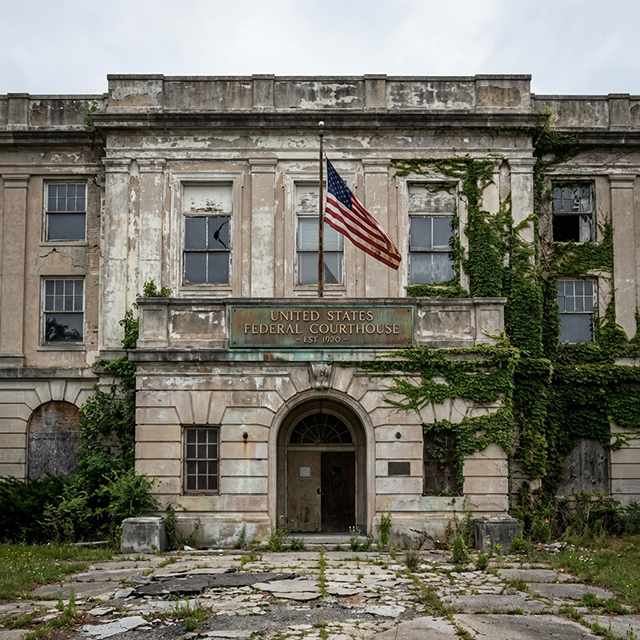
Judges, attorneys,
jurors and the public are exposed daily to environments that threaten their
safety, health and dignity. As ceilings collapse and mold spreads, the very
spaces meant to uphold justice become hazards, undermining the constitutional
promise of a fair and accessible legal system. In response, the Judicial Conference has asked Congress to
grant the judiciary independent real property authority to manage, maintain and
fund buildings critical to court operations, a position first adopted in 1989
and reaffirmed in 2006. This essay explores the
urgent need for reform, driven by a commitment to protect those who serve and
seek justice within these walls.
Scope and nature of the deterioration
Basic courthouse systems--including
elevators, HVAC, roofs, lighting, doors and windows--are broken or beyond their
useful life, causing operational disruptions, costly emergency interventions,
and risks to health and safety. The delinquent maintenance and infrastructure
backlog has reached approximately $8.3 billion and continues to grow, with many
projects languishing indefinitely despite safety and functionality concerns.
Documented incidents include prolonged elevator entrapments, a courtroom
ceiling collapse during trial, legionella identified in water systems without
remediation plans, water intrusion in workspaces, and mold causing illness
among court personnel and judges. In Chicago's Everett McKinley Dirksen
Courthouse, a 2024 water valve failure damaged six floors, one courtroom
remains closed nearly 18 months later, and lighting failures took years to
remedy despite trial disruptions. (See, Judiciary Says Courthouses Are in
Crisis, Seeks Real Property Authority)
Systemic management failures and resource constraints
Recent GSA reorganization and
staffing reductions have stalled critical work: Funded projects have halted for
lack of project managers, including 18 security upgrades now at risk of
non-execution. As of early 2026, nearly 75% of courthouses with five or more
judges lack onsite building managers, impeding rapid response to life-safety
and operational emergencies. Contractor oversight is deficient, with reports of
abandoned projects without accountability. (See, the Judiciary
background paper (PDF))
Cost pressures that undermine court operations
The judiciary pays approximately
$1.3 billion annually in rent and services to GSA. GSA has announced pricing
policy changes that could add up to $60 million per year in rent beginning in
FY 2027, with increases expected to escalate annually. GSA also imposes 3-7%
overhead on real property transactions; in 2025, the judiciary paid $280
million in overhead and $10 million for lease administration of a relatively
small portfolio. These cost escalations present budget shocks that jeopardize
continuity of court operations during fiscal constraints. (Id.)
Constitutional and public health implications
Continued deterioration impairs
the judiciary's ability to fulfill its constitutional mandate to administer
justice by disrupting trials, limiting courtroom access and degrading security.
Unsafe building conditions--such as water intrusion, mold and unremediated legionella--pose direct risks to the health of
judges, staff, jurors, attorneys and the public. In aging and historic
courthouses, environmental conditions have produced headaches, nosebleeds, sore
throats in winter and mold-related respiratory issues in summer, demonstrating
ongoing health impacts tied to facility failures. (Id.)
The judiciary's request to Congress: Real Property
Authority and dedicated funding
On Feb. 24, 2026, the Judicial
Conference transmitted to congressional leadership a legislative proposal to
grant the judiciary independent Real Property Authority, enabling it to
acquire, lease, operate, maintain, alter and construct facilities necessary for
court operations. (See, Judiciary
to ask Congress (PDF).)
The draft bill would establish a judiciary
Buildings Service within the Administrative Office, authorize transfers of
jurisdiction, custody and control over court accommodations from GSA, and
create a Judicial Space and Facilities Management Fund for dedicated, until expended
use on courthouse needs. Congressional oversight would be preserved through
prospectus approvals for major projects and leases above specified thresholds,
annual inflation adjustments and required milestone notifications.
Implementation would be phased, beginning no earlier than 180 days after
enactment, with initial transfers limited to no more than 10 judicial districts
and focused on properties critical to the judiciary's constitutional mission.
The judiciary would remain authorized to request GSA support in multitenant
contexts and to reimburse GSA at actual cost for services provided.
Anticipated benefits and early proof points
Granting Real Property Authority
would allow the judiciary to allocate infrastructure funding to urgent safety,
security and operational priorities without competing against executive branch
portfolios, while remaining subject to congressional oversight. Limited
delegated pilots show the judiciary can complete building projects at
materially lower cost than GSA estimates--e.g., 11 paint and carpet projects at
64% less (saving $1 million), and 24 tenant alterations at 63% less (saving
$2.5 million). Transferring special-purpose court properties would also enable
GSA to concentrate on executive branch needs and shed an $8.3 billion
maintenance burden it lacks resources to address. (See, the Judiciary
background paper (PDF))
Consequences of inaction
Absent immediate and structural
change, the downward spiral of critical-system failures, repair underfunding,
security exposures and rising costs will intensify. Persistent outages and
environmental hazards will continue to endanger health, impede courtroom
operations and erode public confidence in the administration of justice.
Judiciary leaders have concluded that the current GSA-dependent model no longer
reliably delivers necessary maintenance, investment or responsiveness,
rendering the status quo unsustainable. Federal courts have formally advised
Congress of the need for legislation and initiated a dialogue with GSA to
ensure a gradual, orderly transition if authority is granted. (See, Judiciary Says Courthouses Are in
Crisis, Seeks Real Property Authority)
Conclusion
The record demonstrates systemic facility degradation, a
multi-billion-dollar maintenance backlog, acute safety and health risks, and
operational disruptions that jeopardize the judicial branch's constitutional
function. The judiciary's request for Real Property Authority and a dedicated
fund--implemented in phased coordination with Congress and GSA--offers a
targeted, accountable remedy to stabilize and restore federal courthouses. As officers
of the court, who collectively spend a substantial amount of time in these
facilities in the service of our clients and justice, we members of the federal
bar are in a unique position to support the judiciary in urging Congress to
take the timely congressional action needed to arrest further deterioration,
protect the health of all courthouse users and safeguard the uninterrupted
administration of justice nationwide.
Submit your own column for publication to Diana Bosetti
For reprint rights or to order a copy of your photo:
Email
Jeremy_Ellis@dailyjournal.com
for prices.
Direct dial: 213-229-5424
Send a letter to the editor:
Email: letters@dailyjournal.com