


Military Law,
Civil Rights
Feb. 3, 2026
The largest murder trial in the history of the United States
The 1917 Houston incident exposed how entrenched racism, mob violence, and profound due process failures led the U.S. Army to wrongfully court-martial and execute 19 Black Buffalo Soldiers of the 24th Infantry--an injustice formally acknowledged and corrected only more than a century later through posthumous clemency.


4th Appellate District, Division 3
Eileen C. Moore
Associate Justice
California Courts of Appeal
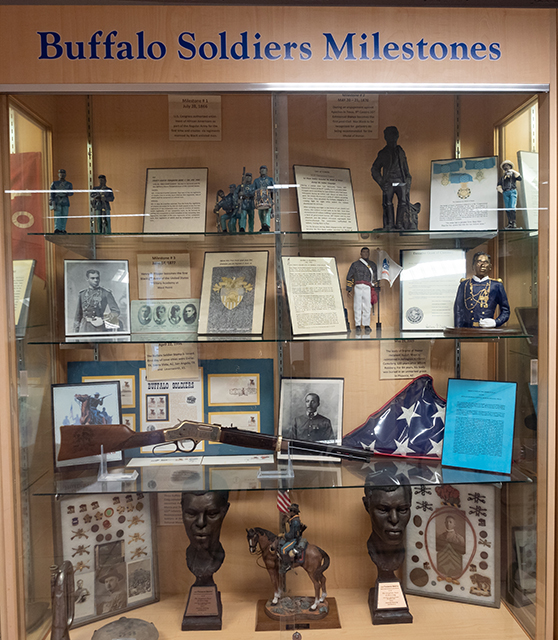
"White People did not like the idea of well-armed African-American Soldiers in their midst."
-- Fred L. Borch III, Army Regimental Historian
In 1917 and 1918, 19 Black service members, part of the
famed group known as the Buffalo Soldiers, were hung by the United States Army.
Immediately following announcement of the first round of executions, some
commentators accused the Army of carrying out a military lynching.
History of the 24th Infantry of Buffalo Soldiers
Part of the original Buffalo Soldiers, the 24th Infantry, was formed in Texas in 1869 following the Civil War. The all-Black unit served with distinction, several of its members earning the Medal of Honor. During the 1880s and 1890s, the unit served honorably in Texas, New Mexico, the Indian Territories, Utah and Wyoming. The 24th Infantry deployed to Cuba in 1898, fighting in the Battle of San Juan Hill. Between 1899 and 1915, they assisted in the defeat of the Philippine Insurrection and the ensuing pacification of the islands. In 1916, the 24th Infantry participated in an expedition led by General John Pershing against the Mexican guerrilla forces of Pancho Villa after Villa's attack on Columbus, New Mexico.
Military's attitude toward its Black service members
On April 1, 1917, there were 10,000 Black soldiers in the military in segregated units when the War Department in Washington sent telegrams to recruiting stations throughout the nation:
"NEGRO RECRUITING HALTED
NO MORE NEGROES WILL BE ACCEPTED FOR
ENLISTMENT IN THE UNITED STATES ARMY
ALL COLORED UNITS FILLED."
The U.S. entered World War I five days later, on April 6,1917. The War Department soon changed its tune. Manpower was needed for the young nation to engage in a world war. In the end, nearly 400,000 Black soldiers served in World War I.
Racial situation in Texas
Black soldiers of the US Army were particularly resented by White Texans. Between 1900 and 1917, there were many major incidents of racially motivated violence against Black soldiers in the Texas cities of El Paso, Del Rio, San Antonio, Brownsville and Waco.
During the same time period, savagery and lynchings were a regular phenomenon in the Lone Star State in what could accurately be described as racial terrorism. Spectacle lynchings with crowds of thousands of ordinary White citizens gathered to watch public torture, mutilation and unrestrained sadism as Black men were murdered. One mob in Howard, Texas took a public vote for how they should put a Black man to death, and then watched the victim die in agony as they burned him alive.
Assignment to Camp Logan
Nonetheless, the War Department posted battalions of the 24th Infantry to Texas in 1917 without first ensuring that Black military personnel would be fairly treated by the local communities. On July 27, the 24th Infantry was assigned to a seven-week mission to protect the construction of Camp Logan, just outside Houston, Texas. Camp Logan was intended to be used as a training center for World War I's mobilization.
Lieutenant Colonel William Newman, the unit's commander tried to get the orders for the 24th changed, stating: "I had already had an unfortunate experience when I was in command of two companies of the 24th Infantry at Del Rio, Texas, April 1916, when a colored soldier was killed by a Texas Ranger for no other reason than that he was a colored man; that it angered Texans to see colored men in the uniform of a soldier."
Indeed, after all the enemies the 24th had valiantly faced, it was Houston that proved to be its most potent foe.
The incident
Houston police regularly beat the Black soldiers. Early on August 23, 1917, several were brutally beaten and jailed. Corporal Charles Baltimore, who was acting in his official capacity as a duly appointed and conspicuously identified provost, was shot at, beaten and arrested by Houston police. He returned to Camp Logan bloodied but alive.
A White mob was said to be coming toward Camp Logan. Conflicting reports about whether or not the police had killed Baltimore abounded. According to the website of the Equal Justice Initiative, the men from the 24th planned to stage a peaceful march to the police station as a demonstration against their mistreatment by police. Others said that about 150 Black soldiers armed themselves and left the camp to confront the mob and the police. Whatever was real or whatever was rumor, overwhelming evidence was that the men who left the camp that night were ordered to fall in and were marched out of camp by their First Sergeant in a military formation, clearly not an indication the group was overriding military authority, an issue that would become important later.
Just outside the city, the soldiers encountered the mob of armed White men. In the ensuing three hours of violence, four soldiers, four policemen, and 12 civilians were killed.
Court-Martial
In the aftermath, the military investigated and court-martialed 157 Black soldiers, trying them in three separate proceedings. United States v. Nesbit began on Nov. 1, 1917, with 63 soldiers on trial. The remainder were tried in second and third trials.
The trials were held in a building that had been a chapel on the ground of Fort Sam Houston, Texas. The huge white cross that had topped the steeple was temporarily removed and replaced with the Stars and Stripes. It was the largest murder trial in American history. All of the Black defendants were part of the regular forces, not draftees.
Lack of due process
The prisoners on trial were the only Blacks in the courtroom. A nonlawyer with almost no support represented all of the Black soldiers throughout the three back-to-back trials. The prosecution, by contrast, was a team of experienced trial lawyers with full administrative support.
The military prosecution team threatened the noose while conducting pretrial questioning of the confined Black soldiers. Coerced statements made under threats and deceptive tactics were used against the soldiers at trial.
Also at trial, the prosecutors contended there was a mutiny. Mutiny is not just a betrayal of the nation's trust in its soldiers, it is a betrayal of one's comrades and leaders. It requires the specific intent to override military authority. Of course, the mere fact the soldiers marched out of Camp Logan in military formation under command of their First Sergeant belies mutiny.
Mutiny is considered a crime of conspiracy, so the charge was used to impose joint liability. It was that joint liability aspect of mutiny that allowed the prosecution to achieve so many murder convictions, despite the fact that no witness was able to identify any soldier as personally committing an act of murder or assault. Plus, the prosecution relied on faulty roll calls at the camp taken after the incident, in the midst of the chaos, to argue who took part in the carnage.
Compounding the other problems, the nonlawyer representing the accused soldiers did not raise the issue of race in their defense.
Result of the first trial
Fifty-four of the 63 soldiers were convicted of all charges. At sentencing, 13 were sentenced to death and 43 received sentences of life imprisonment. The 13 condemned soldiers were denied any right to appeal or any time to seek clemency, or even time to say goodbye to their families. They were hanged 12 hours after sentencing, on Dec. 11, 1917, at the site that is today's 15th tee on the post golf course. Those hung included every non-commissioned officer among the original 63 defendants. Corporal Baltimore was one of those executed.
Major General John W. Ruckman ordered that the verdicts and sentences not be made public. It remains the largest mass execution of American soldiers ever carried out by the Army. Only after the hangings were concluded did Ruckman publicly announce the death sentences and executions.
Because Congress had declared war on Germany, Ruckman was not required to forward the record of proceedings to the President for confirmation of the death sentences. However, his rush to execution was not mandated because the country was at war.
General Order No. 7
Despite the virulent racism of the time, the nation recognized the injustice and taint of the first trial. The secrecy and unreviewed executions resulted in a national outcry. To prevent other hasty executions, the War Department issued General Order No. 7.
On Jan. 17, 1918, the Army created an appellate process for military court-martial that prohibited the execution of a soldier without review by the Army Judge Advocate General's office. It also required that all death sentences be reviewed by the President.
The second and third trials
The second and third trials, United States v. Washington and United States v. Tillman, resulted in death sentences for an additional 16 soldiers. However, those men were given the opportunity to appeal. President Woodrow Wilson ultimately commuted the death sentences for 10 of the remaining soldiers facing death, but six were hanged in September 1918. In total, the Houston incident resulted in the executions of 19 Black soldiers.
Posthumous clemency
In 2020, authors Dru Brenner-Beck and John Haymond joined with the Houston branch of the National Association for the Advancement of Colored People, NAACP, and the South Texas College of Law Houston to petition the Secretary of the Army for posthumous clemency for all the soldiers convicted in the three trials based on the egregious due process failures. The petition specifically requested the characterizations of the soldiers' discharges be upgraded to honorable. The City of Houston passed a resolution supporting the petition.
In November 2023, The Secretary of the Army set aside the court-martial convictions of the Buffalo soldiers of the 24th Infantry. The Secretary stated: "After a thorough review, the Board has found that these Soldiers were wrongly treated because of their race and were not given fair trials... By setting aside their convictions and granting honorable discharges, the Army is acknowledging past mistakes and setting the record straight."
Conclusion
No Whites, civilian or military, were ever brought to trial for involvement in the violence. This was despite explicit recommendations by the two Inspector Generals who investigated the events that charges be brought against two specific White officers.
Brenner-Beck and Haymond later wrote that the events in Houston delayed the integration of the U.S. military by a generation.
This is Black History Month. We cannot forget our history.
Information for this article was found in: "Farewell to the Mockingbirds" by James McEachin; 2011-FEB ARMLAW 1; 61 S. Tex. L. Rev. 535; https://racism.org/articles/law-and-justice/375-legal-system-and-racism/1056; https://www.nimj.org/uploads/1/3/5/5/135587129/returning_the_24th_infantry_soldiers_to_the_colors__bookmarked_11-20-2020.pdf; https://studythepast.com/civilrightsundergraduate/materials/houstonriot1917_houstonreview.pdf; https://www.nimj.org/uploads/1/3/5/5/135587129/returning_the_24th_infantry_soldiers_to_the_colors__bookmarked_11-20-2020.pdf
Submit your own column for publication to Diana Bosetti
For reprint rights or to order a copy of your photo:
Email
Jeremy_Ellis@dailyjournal.com
for prices.
Direct dial: 213-229-5424
Send a letter to the editor:
Email: letters@dailyjournal.com