


LA Fires
Dec. 26, 2025
Eaton and Palisades Fire litigation strained courts in 2025
Eaton and Palisades wildfire lawsuits involve tens of thousands of plaintiffs, novel immunity defenses, utility liability disputes, and unprecedented strain on California courts and coordinated litigation systems.


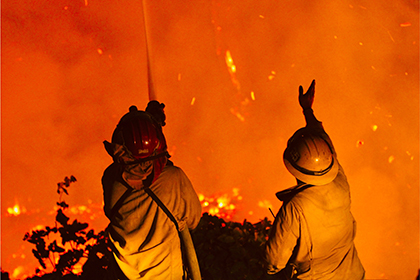
Wildfire litigation was a central feature of Southern California's legal landscape in 2025, as a series of destructive Los Angeles County blazes generated overlapping waves of claims throughout the year and tested the ability of the courts, attorneys and defendants to manage the expanding docket.
According to some attorneys, the Palisades and Eaton Fires, while distinct in their causes and defendants, emerged as focal points in a year that highlighted how wildfire litigation continues to evolve.
"Compared to past wildfire cases, the Eaton and Palisades Fire cases are on steroids," Robertson & Associates LLP founder Alexander Robertson IV said.
"The cases are bigger, more complex and involve tens of thousands of plaintiffs. The scope and scale of these cases is testing the limits of the court's electronic data management system and requiring much more case management by plaintiffs' leadership and the court."
Robertson is co-lead in the coordinated Palisades Fire litigation before Superior Court Judge Samantha P. Jessner. The master complaint accuses the City of Los Angeles and California Department of Parks and Recreation of negligence and related failures tied to the containment and response to the Jan. 1 Lachman Fire. Plaintiffs say embers were allowed to remain active from that fire and erupt into a neighborhood-destroying conflagration a week later.
Robertson said that while the Superior Court's "experienced" panel judges are well equipped to manage such large wildfire cases, the volume of the filings and parties has required heightened coordination and oversight. The Palisades Fire litigation, in particular, stands out because it departs from the more familiar model of wildfire cases centered on investor-owned utilities, he said.
"Unlike prior wildfire cases ... the target defendants in the Palisades case ... are claiming governmental immunities as a defense to the plaintiffs' tort claims. This immunity defense is unique to the Palisades Fire case," Robertson said.
The Palisades Fire case also involves dozens of public agency defendants and multiple theories of liability, adding layers of complexity that have shaped how the litigation has unfolded and contributed to the rising frustration among fire victims.
"The anger and frustration by the victims of the Palisades Fire is palpable," Robertson said. "It is beyond anything I've ever seen before, and their anger is growing. Our clients feel betrayed by the public agencies they expected would keep them safe. This was a failure at every level of government."
The state parks and its counsel said they do not comment on pending litigation. Attorneys defending the city at Munger Tolles & Olson LLP were unable to comment.
In court filings, the city and state deny the plaintiffs' theory that state parks officials instructed firefighters to refrain from full suppression of the Lachman Fire, which they say caused embers to smolder and later reignite into the Palisades blaze. Demurrers are scheduled to be heard in February while limited depositions of select firefighters and state parks staff began earlier this month. Grigsby et al. v. City of Los Angeles acting by and through Los Angeles Department of Water and Power et al., 25STCV00832 (L.A. Super. Ct., filed Jan. 13, 2025).
While the Palisades litigation centers largely on alleged government failures, the Eaton Fire lawsuits place blame on Southern California Edison under more traditional utility wildfire liability theories.
Wisner Baum LLP partner Ari S. Friedman, who represents Eaton Fire victims, said the case illustrates both continuity and contradiction in how utilities approach wildfire claims.
Friedman said Edison's out-of-court wildfire compensation program highlights what he views as a disconnect between the utility's public messaging and its litigation position. In October, Edison finalized the program to cover more than 18,000 eligible properties and said it was a voluntary alternative to litigation. The utility asserts the program does not constitute a legal admission of liability.
"I think what we saw in Eaton, to a degree that I haven't experienced on this scale, is a dichotomy between Edison simultaneously going to the public and saying, 'Sorry for starting the fire. We're going to create this compensation program and we want to start offering affected people the ability to get paid for what they lost and ... went through," Friedman said.
"But when they walk into court and they have to deal with the litigation, they say the exact opposite," Friedman continued. "This is kind of unique for me in the sense that they're saying, 'Yes, we did it. Yes, we understand a lot of people were harmed and killed, but inside the four walls of the courtroom, we're not going to take that same type of responsibility.'"
Friedman said it was frustrating from a litigation perspective, "because all of my clients are looking down and saying, 'Isn't the CEO of Edison admitting they started the fire?'"
Singleton Schreiber LLP partner Gerald B. Singleton, another attorney representing Eaton Fire victims, said the case has been frustrating for him because he believes Edison has taken litigation positions that conflict with public statements by company leadership, for example, while at the same time seeking to delay trial proceedings and resisting discovery.
He said those alleged tactics have prolonged uncertainty for victims despite what he views as clear evidence of how the fire started.
In comparison to past wildfire litigation against Edison, Singleton said, "I think the biggest difference here has been how Edison has responded. This is the first fire where there's absolutely no question where the fire started because it's on video. ... There's no mystery what happened here," Singleton said.
Through a company spokeswoman, Southern California Edison general counsel Gabriela Ornelas said in a statement: "This has been a difficult year for everyone affected by the wildfires in Southern California. We are committed to helping our communities recover and will continue working through the legal process in a careful and timely manner to reach a fair resolution."
Outside counsel representing the utility at Hueston Hennigan LLP were unable to comment.
Friedman said that while the out-of-court wildfire settlement option isn't new for Edison, he argued the utility is using the program more aggressively in this instance to manage future litigation exposure because of the coordinated litigation's magnitude - which also includes thousands of claims and cases.
"It seems to be something they're putting a lot more stock into ... to try and buy off claims cheap ... and reduce their ultimate liability when and if they start settling litigation claims," Friedman said.
While denying liability in court, Edison's counsel has said the cause-and-origin investigation of the Eaton Fire remains ongoing and that avenues such as mediation would be premature at this stage. The plaintiffs allege circumstantial evidence suggests Edison's high-voltage transmission equipment near the Eaton Fire's area of origin - which the fire victims say the utility failed to de-energize despite red flag weather warnings - is the likely cause.
Superior Court Judge Laura A. Seigle oversees the coordinated Eaton Fire litigation and set a trial for January 2027. Gursey v. Southern California Edison et al., 25STCV00731 (L.A. Super. Ct., filed Jan. 13, 2025).
"In the litigation sense, that's on the faster side," Friedman said, noting that wildfire trial timelines often depend on the circumstances of each fire and that a roughly two-year path from filing to trial is relatively expedited.
"Once that trial date starts to solidify, I anticipate Edison will do what it's done in every other wildfire, and that is to start reaching out to create a settlement program."
Singleton said that while the two-year trial timeline is quicker than in some wildfire cases, it should be viewed in context, noting that litigation stemming from the 2017 Thomas and 2018 Woolsey fires, for example, was slowed by the COVID-19 pandemic and more complex disputes over fire origin.
"And what I think is very frustrating is that they have waged a disingenuous, and frankly, unethical campaign to ... delay the trial as long as they can by making affirmative representations to the court in terms of how long it would take ... and things like that," Singleton said about Edison.
Singleton said the utility sought to delay the Eaton Fire trial date by telling the judge additional preparation time was needed, only to later acknowledge it could proceed on a faster timeline after the January 2027 continuance was granted.
"Frankly, I think a trial date in June, which is what we were asking for, would have been more than reasonable," Singleton said, claiming that "there's no dispute" about where or how the Eaton Fire started that would otherwise reasonably delay the proceedings.
"The only delay we have here is that Edison continually refuses to comply with its discovery obligations and turn things over," Singleton added.
Another issue in the Eaton case is Edison International's effort to distance itself from its Southern California subsidiary. The parent company, which has successfully sought dismissal in prior wildfire litigation, including the 2020 Bobcat Fire, says the same grounds apply here.
Friedman described this dispute as a fact-sensitive inquiry into whether the parent company can legitimately avoid liability based on corporate separateness, an argument he said is common in complex corporate litigation.
Singleton, who is among the attorneys preparing the opposition to Edison International's summary judgment motion, said the Eaton Fire litigation differs materially from prior cases in which the parent company exited the proceedings.
He noted that while he was not involved in the 2020 Bobcat Fire litigation when the issue arose, most claims in that case had already settled, whereas the Eaton Fire claims remain at an early stage with liability still actively contested.
Singleton said "there's absolutely no basis" for Edison International to avoid liability here, pointing, in part, to public statements made by its CEO, Pedro Pizarro.
"If you just look at one of the many statements that Pedro Pizarro has made about how Edison is going to be compensating the victims, how Edison is involved in oversight ... you really don't have to look any farther than his statements to show that Edison's argument that they don't have any role in governing Southern California Edison ... doesn't pass the laugh test," Singleton said.
On Oct. 29, after Southern California Edison finalized its out-of-court compensation program, Pizarro said in a company news release: "We listened to more than a thousand voices and learned what matters most to those impacted by the Eaton Fire: clarity, fairness and speed."
The Eaton Fire burned more than 14,000 acres in Altadena, Pasadena and the Angeles National Forest, damaging or destroying over 9,400 structures over the course of three weeks.
The Palisades Fire destroyed large areas of Pacific Palisades, Topanga and Malibu before it was fully extinguished on Jan. 31. It burned more than 23,000 acres, killed 12 people and destroyed over 6,800 structures.
Devon Belcher
devon_belcher@dailyjournal.com
For reprint rights or to order a copy of your photo:
Email
Jeremy_Ellis@dailyjournal.com
for prices.
Direct dial: 213-229-5424
Send a letter to the editor:
Email: letters@dailyjournal.com