


Government,
Constitutional Law
Jun. 24, 2025
Behind the mask: Why federal agents won't bow to California's SB 627
In the face of escalating violence and political resistance, federal ICE and CBP agents, attacked by rioters and left without timely local support in Los Angeles, now confront a controversial California SB 627 that's seeking to unmask them.


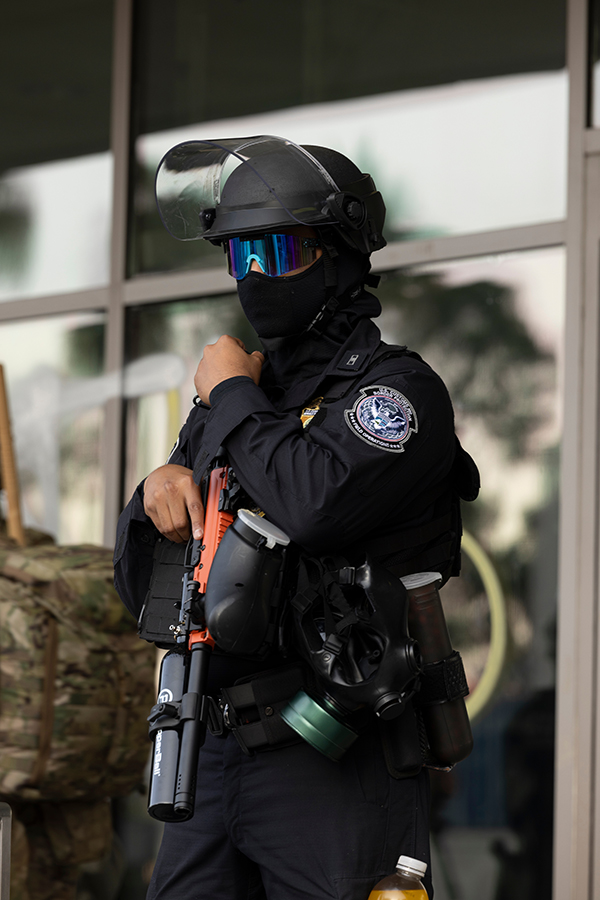
In recent months, federal law enforcement officers from the U.S. Immigration and Customs Enforcement (ICE) and the U.S. Customs and Border Protection (CBP), both federal entities within the Department of Homeland Security, faced unprecedented violence and resistance while performing their official duties.
For instance, on June 6, federal agents were outnumbered by thousands of violent rioters and surrounded by numerous vicious attackers outside of a federal building in downtown Los Angeles. The Los Angeles Police Department (LAPD) and Los Angeles County Sheriff's Department (LASD) were called multiple times, but it took over two hours to respond to the federal agents.
Some blamed the sanctuary city policies by Mayor Karen Bass and the county's Board of Supervisors who directed Sheriff Robert Luna to hold back its Sheriff's Response Team, which consisted of hundreds of deputies armed with less-lethal weapons to combat rioters - both LAPD and LASD response personnel were staging with all of their gear and equipment less than a mile away. All responding deputies and officers were awaiting approval to assist the federal agents, but were told to "stand by" by the executives of both LAPD and LASD; meanwhile, the federal agents were under siege by the violent rioters.
In the political arena, the massive deportation efforts by the federal law enforcement officers from CBP and ICE received more criticism than support from the politicians in California.
On June 16, in what some see as an attempt to thwart federal agents from effectively performing their job, State Senators Scott Wiener (D-San Francisco) and Jesse Arreguin (D-Berkeley) introduced SB 627, the No Secret Police Act. The bill would prohibit law enforcement officers -- federal, state, or local -- from concealing their faces during public interactions, with narrow exceptions for medical or wildfire-related reasons. Violations would be punishable as misdemeanors. To the extent that SB 627 is passed and codified under Penal Code section 185.5, local, county, and state law enforcement must follow this statute.
Without a doubt, the hidden purpose of SB 627 is an attempt to force federal agents to show their faces while investigating, apprehending and arresting illegal aliens. The primary reason for the concealment of the names and faces of the federal agents is due to their safety and the safety of their family members. In response to the critics of federal agents covering their faces, ICE Director Todd Lyons stated on June 3: "People are out there taking photos, of their names, their faces, and posting them online with death threats to their family and themselves."
According to SB 627, any law enforcement officer who violates this proposed law is guilty of a misdemeanor crime.
Do federal agents have to follow SB 627?
The short answer is, No.
Under the Supremacy Clause of the United States Constitution, which establishes the supremacy of federal law over state law, California may not prosecute a federal agent for a violation of California law while acting within the scope of federal duties.
Interestingly enough, this issue was first decided by the United States Supreme Court in In re Neagle, 135 U.S. 1 (1890). In Neagle, Deputy United States Marshal David Neagle was charged under California law for murder when he killed the former California Supreme Court Chief Justice David Terry while acting in his official duties as a federal law enforcement officer protecting the U.S. Supreme Court Associate Justice Stephen Johnson Field.
Terry had previously made violent threats against Field, and Neagle was assigned to protect Field. On the day in question, Terry slapped Field to provoke a fight and allegedly reached into his breast pocket. When Terry made the furtive movement into the breast pocket, this made Neagle believe that Terry was going to pull out a weapon, and acting in defense of Field, Neagle fatally shot Terry. After the shooting, it turned out that Terry was unarmed, and the local sheriff arrested Neagle on murder charges.
On writ of habeas corpus, the U.S. Supreme Court released Neagle and established a two-prong test for this type of immunity from California's criminal prosecution: (1) Was the officer performing an act that federal law authorized him to perform? (2) Were his actions necessary and proper to fulfill his federal duties? If the federal officer satisfies this test, he or she is immune from prosecution for violation of California law.
The official text of SB 627 includes:
A law enforcement officer shall not wear any mask or personal disguise while interacting with the public in the performance of their duties, except for medical grade masks that are surgical or N95 respirators designed to prevent the transmission of airborne diseases and masks designed to protect against exposure to smoke during a state of emergency related to wildfires.
(b) A violation of this section shall be punishable as a misdemeanor.
(c) (1) It is the intent of the Legislature to enact legislation to ensure that Special Weapons and Tactics (SWAT) team officers can utilize gear necessary to protect their faces from physical harm while they perform their SWAT responsibilities.
(2) It is the intent of the Legislature to enact legislation to require law enforcement officers to include their name or badge number on their uniforms.
(d) For the purposes of this section, "law enforcement officer"
means any officer of a local, state, or federal law enforcement agency, or any
person acting on behalf of a local, state, or federal law enforcement agency.
(e) The provisions of this section are severable. If any provision of this section or its application is held invalid, that invalidity shall not affect other provisions or applications that can be given effect without the invalid provision or application.
If SB 627 is passed and the law is codified under Penal Code section 185.5, all federal law enforcement officers will be able to show that when they wear their masks to conceal their identities, they are acting in their official capacities to enforce federal law to identify, investigate, apprehend and arrest illegal aliens under Title 8, section 1226 and other federal statutes to deport individuals from the United States.
More importantly, the wearing of masks and concealing their faces without a name tag are certainly proper and necessary for federal law enforcement officers to protect themselves and their families amid rising violence and threats.
Currently, the federal law enforcement officers are duty-bound to identify themselves. "At the time of the arrest, the designated immigration officer shall, as soon as it is practical and safe to do so." (8 C.F.R. § 287.8, available at https://www.ecfr.gov/current/title-8/chapter-I/subchapter-B/part-287/section-287.8#p-287.8(c).)
However, as repeatedly demonstrated, ICE and CBP officers are often met with violence and threats the moment they begin investigating or detaining suspects, making it neither practical nor safe for them to identify themselves to individuals amid such hostile conditions.
For reprint rights or to order a copy of your photo:
Email
Jeremy_Ellis@dailyjournal.com
for prices.
Direct dial: 213-229-5424
Send a letter to the editor:
Email: letters@dailyjournal.com